4,068 posters, 219 videos, 101 topics, 69 sessions, 14,365 authors, 6,128 institutions
ePostersLive by SciGen Technologies S.A. All rights reserved.
Alzheimer's Association International Conference 2026
July 12-15, 2026 | London, United Kingdom, and Online

2906
Long-term Interaction Between Depressive Symptoms And Cognitivefunction In Multi-regional Middle-aged Individuals
Poster Presenter
Authors
Yaping Zhang, Renwei Chen, Lihua Wang, Haoran Zhang, Chunyan Li, Lihong Shao, Zheng Lin, Xin Xu
Affiliations
School of Public Health, the Second Affiliated Hospital of School of Medicine, Zhejiang University, Hangzhou, Zhejiang, China, Department of Nursing, the Second Affiliated Hospital of School of Medicine, Zhejiang University, Hangzhou, Zhejiang, China, Department of Psychiatry, the Second Affiliated Hospital of School of Medicine, Zhejiang University, Hangzhou, Zhejiang, China, School of Public Health, the Second Affiliated Hospital of School of Medicine, Zhejiang University, Hangzhou, Zhejiang, China;Nanhu Brain-computer Interface Institute, Hangzhou, Zhejiang, China;Key Laboratory of Intelligent Preventive Medicine of Zhejiang Province, Hangzhou, Zhejiang, China
Part of Topic
Long-term Interaction Between Depressive Symptoms And Cognitivefunction In Multi-regional Middle-aged Individuals
Abstract:
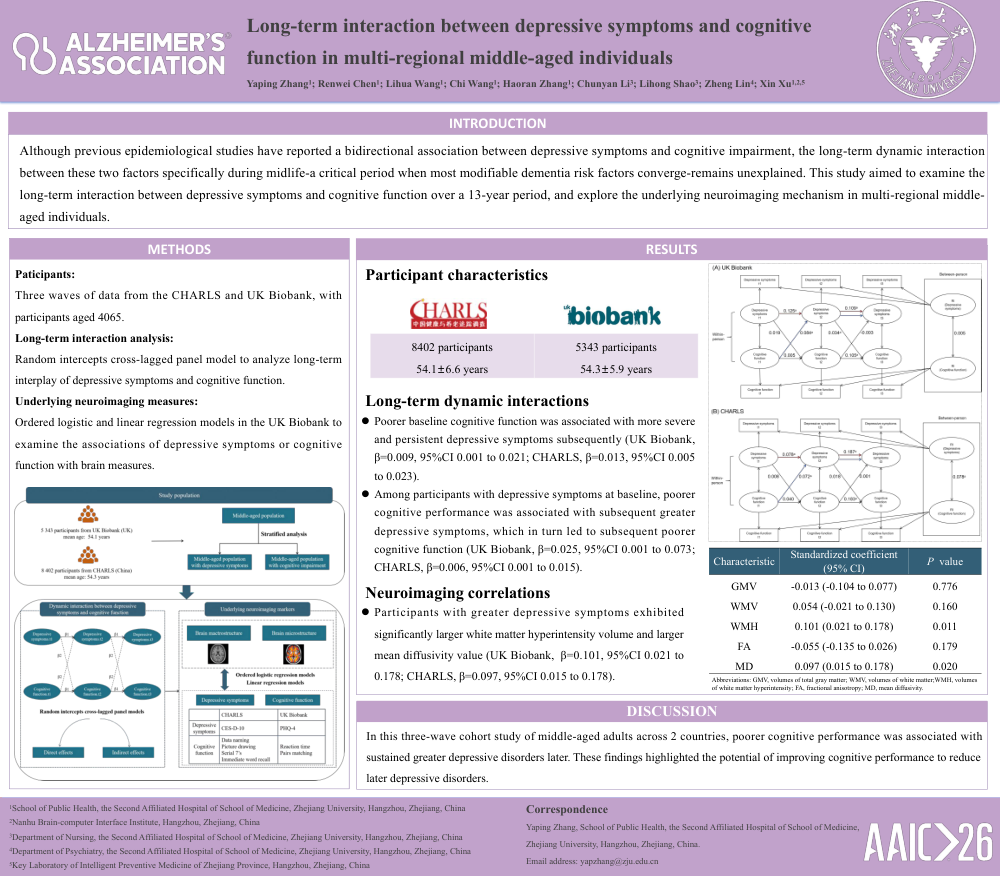
Background: Although previous epidemiological studies have reported a bidirectional association between depressive symptoms and cognitive impairment, the long-term dynamic interaction between these two factors specifically during midlife-a critical period when most modifiable dementia risk factors converge-remains unexplained. This study aimed to examine the long-term interaction between depressive symptoms and cognitive function over a 13-year period, and explore the underlying neuroimaging mechanism in multi-regional middle-aged individuals.
Methods: This study used data across 3 waves from 2 nationally representative cohorts, including the China Health and Retirement Longitudinal Study (CHARLS), the UK Biobank. Participants aged 40-65 years were included in the analysis. The long-term interactions between depressive symptoms and cognitive function were examined using a random intercepts cross-lagged panel model. Using the UK Biobank, ordered logistic regression models and linear regression models were used to assess the associations between depressive symptoms or cognitive function and brain measures.
Results: This study included 8402 participants from CHARLS cohort and 5343 participants from the UK Biobank (mean [SD] age, 54.1[6.6] and 54.3[5.9]years, respectively). After adjusting for stable between-person differences and covariates, within-person poorer baseline cognitive function was associated with more severe and persistent depressive symptoms subsequently (In UK Biobank, β=0.009, [95%CI, 0.001 to 0.021]; In CHARLS, β=0.013, [95%CI, 0.005 to 0.023]). Among participants with depressive symptoms at baseline, poorer cognitive performance was associated with subsequent greater depressive symptoms, which in turn led to subsequent poorer cognitive function (In UK Biobank, β=0.025, [95%CI, 0.001 to 0.073]; In CHARLS, β=0.006, [95%CI, 0.001 to 0.015]). This association was not observed among participants with cognitive impairment at baseline. On brain MRI, participants with greater depressive symptoms exhibited significantly larger white matter hyperintensity volume and larger mean diffusivity value (β=0.101, [95%CI, 0.021 to 0.178] and β=0.097, [95%CI, 0.015 to 0.178], respectively).
Conclusion: In this 3-wave cohort study of middle-aged adults across 2 countries, poorer cognitive performance was associated with sustained greater depressive disorders later. These findings highlighted the potential of improving cognitive performance to reduce later depressive disorders.
Comments
Email is required but is not shown publicly.
Loading comments...