4,068 posters, 219 videos, 101 topics, 69 sessions, 14,365 authors, 6,128 institutions
ePostersLive by SciGen Technologies S.A. All rights reserved.
Alzheimer's Association International Conference 2026
July 12-15, 2026 | London, United Kingdom, and Online

368
Cerebrospinal Fluid Glucose-6-phosphate Isomerase As A Tau-related Biomarker In Alzheimer's Disease
Poster Presenter
Authors
Affiliations
Part of Topic
Title: Cerebrospinal Fluid Glucose-6-Phosphate Isomerase as a Tau-Related Biomarker in Alzheimer's Disease
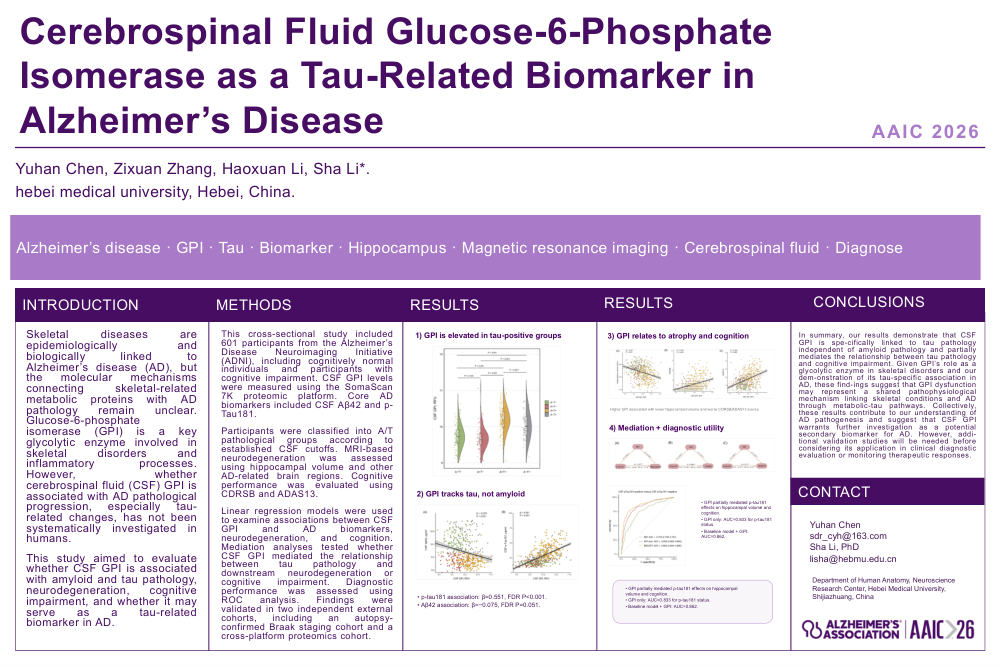
Background: Skeletal diseases are closely linked to Alzheimer's disease (AD) in terms of epidemiology and pathogenesis. Glucose-6-phosphate isomerase (GPI), a critical enzyme in the glycolytic pathway that participates in various skeletal disorders, has unclear effects on AD pathological progression in humans. This study aimed to evaluate whether cerebrospinal fluid (CSF) GPI is associated with amyloid and tau pathology, neurodegeneration, cognitive impairment, and whether it may serve as a tau-related biomarker in AD.
Methods: This cross-sectional study included 601 participants from the Alzheimer's Disease Neuroimaging Initiative (ADNI), including 260 women (43.3%) and 288 APOE ε4 carriers (47.9%). The cohort comprised 151 cognitively normal (CN) participants and 450 cognitively impaired (CI) participants. CSF GPI levels, AD biomarkers including CSF β-amyloid 42 (Aβ42) and phosphorylated tau 181 (p-Tau181), magnetic resonance imaging-based neurodegenerative changes, and cognitive performance were assessed. Associations between CSF GPI and AD pathology, neurodegeneration, and cognition were evaluated using linear regression models. Mediation analyses were performed to investigate whether CSF GPI mediated the relationship between tau pathology and downstream neurodegeneration or cognitive impairment. Findings were validated in two independent external cohorts, including an autopsy-confirmed Braak staging cohort and a cross-platform proteomics cohort.
Results: Among the total cohort, CSF GPI levels were significantly elevated in participants with tau pathology, regardless of amyloid status. CSF GPI was positively associated with CSF p-Tau181 but not significantly associated with CSF Aβ42. Higher CSF GPI levels were also associated with downstream tau-related changes, including reduced hippocampal volume and worse cognitive performance. Mediation analyses showed that CSF GPI partially mediated the effects of tau pathology on hippocampal volume reduction and cognitive impairment. CSF GPI demonstrated good diagnostic performance in distinguishing tau-positive from tau-negative participants, with an area under the curve (AUC) of 0.833, which increased to 0.862 when combined with demographic indicators. In the external autopsy cohort, Braak staging was positively associated with CSF GPI levels, and cross-platform validation showed strong concordance of GPI measurements between different analytical methods.
Conclusions: CSF GPI is associated with tau pathology independent of amyloid status and may partially mediate the relationship between tau pathological changes and neurodegeneration. These findings indicate that CSF GPI may serve as a potential biomarker reflecting tau-related pathological processes in AD. Further validation studies are warranted to establish its utility for clinical diagnostic evaluation or therapeutic monitoring.
Comments
Email is required but is not shown publicly.
Loading comments...