4,068 posters, 219 videos, 101 topics, 69 sessions, 14,365 authors, 6,128 institutions
ePostersLive by SciGen Technologies S.A. All rights reserved.
Alzheimer's Association International Conference 2026
July 12-15, 2026 | London, United Kingdom, and Online

10329
Racially And Ethnically Diverse Sexual And Gender Minority Dementia Caregivers Support Networks: Findings From The Qcare Study
Poster Presenter
Authors
Affiliations
Part of Topic
Title:
Racially And Ethnically Diverse Sexual And Gender Minority Dementia Caregivers Support Networks: Findings From The Qcare Study
Authors:
Finn Shelp-Peck, MA & Krystal Kittle, PhD
School of Public Health and Health Sciences, University of Massachusetts - Amherst
Background:
- Racially and ethnically diverse and gender and sexual minority (SGM) caregivers of people with Alzheimer’s and other related dementias (ADRD) face unique social, financial, emotional, and physical barriers and challenges related to caregiving and daily life.
- These groups are understudied and underrepresented in ADRD caregiver research, despite being more likely to be informal caregivers than their white, cisgender, and/or heterosexual peers.
- Using a modified Health Equity Promotion model, racially and ethnically diverse and SGM caregivers are prone to stigma and discrimination due to multiple minority stress, leading to increased prevalence of physical and mental health disparities.
Participants: 15 racially and ethnically diverse SGM ADRD caregivers; English or Spanish speakers.
Verification: AD8 questionnaire.
Analysis: Transcripts reviewed and coded using Nvivo and the Health Equity Promotion Model.
Results:
Core themes
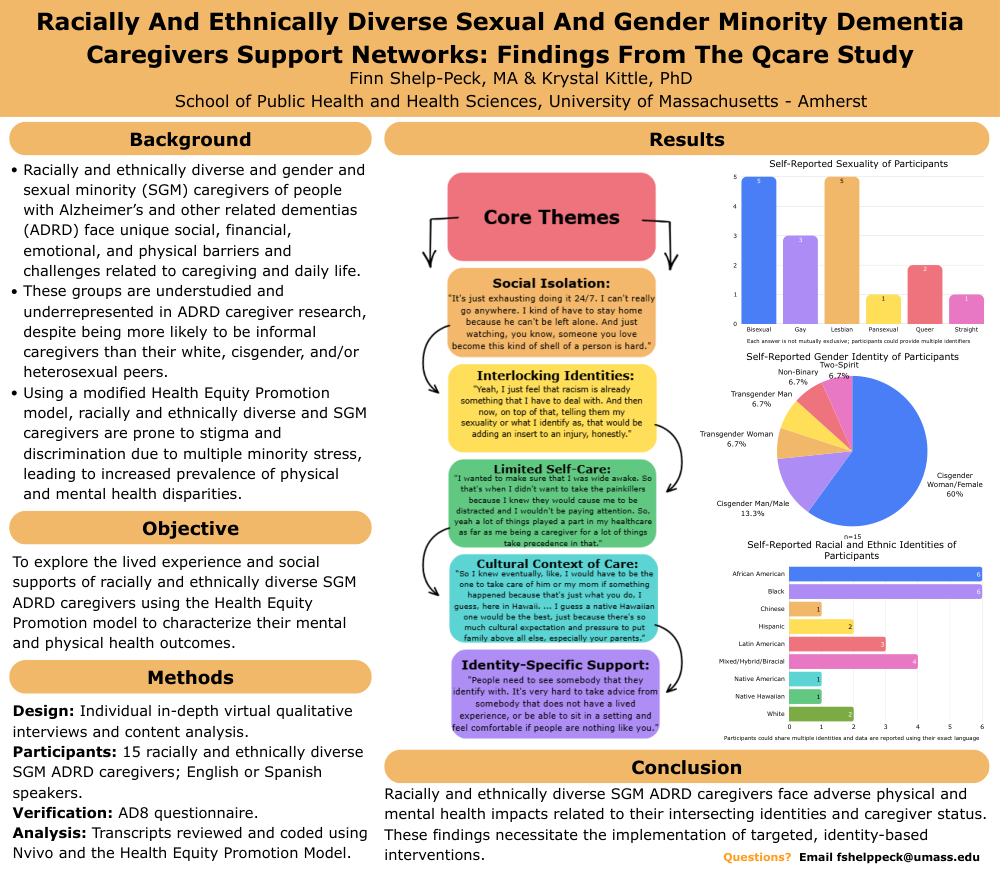
- Social Isolation: "It's just exhausting doing it 24/7. I can't really go anywhere. I kind of have to stay home because he can't be left alone. And just watching, you know, someone you love become this kind of shell of a person is hard."
- Interlocking Identities: "Yeah, I just feel that racism is already something that I have to deal with. And then now, on top of that, telling them my sexuality or what I identify as, that would be adding an insert to an injury, honestly."
- Limited Self-Care: "I wanted to make sure that I was wide awake. So that's when I didn't want to take the painkillers because I knew they would cause me to be distracted and I wouldn't be paying attention. So, yeah a lot of things played a part in my healthcare as far as me being a caregiver for a lot of things take precedence in that."
- Cultural Context of Care: “So I knew eventually, like, I would have to be the one to take care of him or my mom if something happened because that's just what you do, I guess, here in Hawaii. ... I guess a native Hawaiian one would be the best, just because there's so much cultural expectation and pressure to put family above all else, especially your parents.”
- Identity-Specific Support: "People need to see somebody that they identify with. It's very hard to take advice from somebody that does not have a lived experience, or be able to sit in a setting and feel comfortable if people are nothing like you."
- Self-Reported Sexuality of Participants: Bisexual (5), Gay (3), Lesbian (5), Pansexual (1), Queer (2), and Straight (1) [Each answer is not mutually exclusive; participants could provide multiple identifiers]
- Self-Reported Gender Identity of Participants: Cisgender Woman/Female (60%), Cisgender Man/Male (13.3%), Trangender Woman (6.7%), Transgender Man (6.7%), Non-Binary (6.7%), Two-Spirit (6.7%) [n=15]
- Self-Reported Racial and Ethnic Identities of Participants: African American (6), Black (6), Chinese (1), Hispanic (2), Latin American (3), Mixed/Hybrid/Biracial (4), Native American (1), Native Hawaiian (1), White (2) [Participants could share multiple identities and data are reported using their exact language]
Conclusion:
Racially and ethnically diverse SGM ADRD caregivers face adverse physical and mental health impacts related to their intersecting identities and caregiver status. These findings necessitate the implementation of targeted, identity-based interventions.
Questions? Email fshelppeck@umass.edu
Comments
Email is required but is not shown publicly.
Loading comments...