4,068 posters, 219 videos, 101 topics, 69 sessions, 14,365 authors, 6,128 institutions
ePostersLive by SciGen Technologies S.A. All rights reserved.
Alzheimer's Association International Conference 2026
July 12-15, 2026 | London, United Kingdom, and Online

3083
Implementation of Blood-Based Biomarkers for Alzheimer’s Disease: Insights from a Scenario Workshop with Experts and Interviews with German General Practitioners, Affected People, and Caregivers
Poster Presenter
Part of Topic
Video
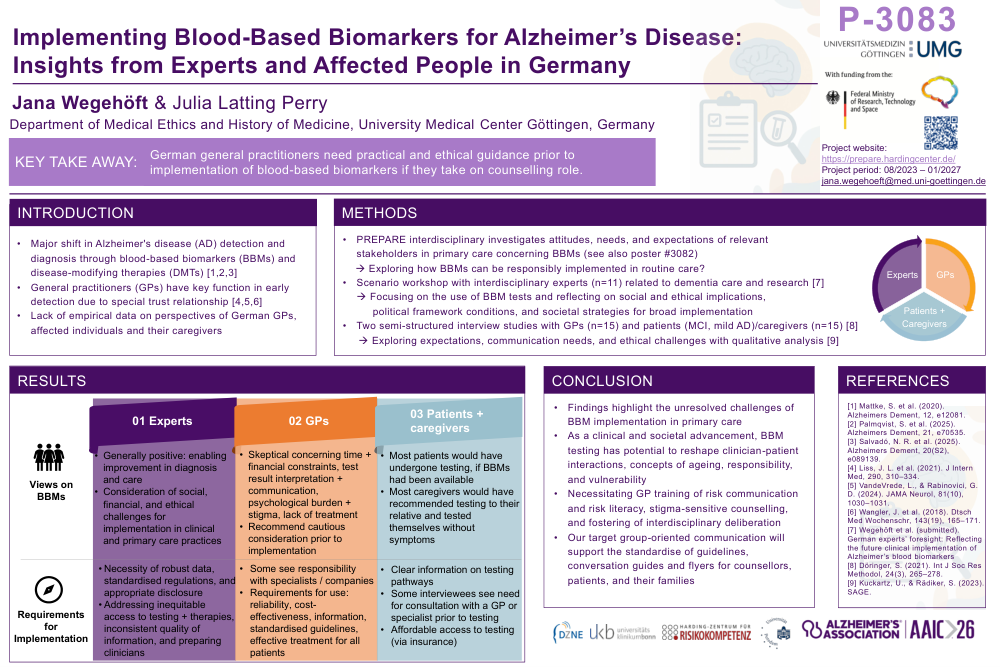
Title: Implementing Blood-Based Biomarkers for Alzheimer’s Disease: Insights from Experts and Affected People in Germany
Background: The development of blood-based biomarkers (BBMs) to aid the diagnosis of Alzheimer’s disease (AD) and the availability of disease-modifying therapies are contributing to a major shift in early detection and diagnosis of AD. The special trust relationship between potential AD patients and their general practitioners (GPs) implies that primary care will play a gatekeeping role for implementing BBMs in routine care. However, there is currently a lack of empirical data including GPs and affected individuals on perceived acceptance and ethical challenges of BBM testing, particularly with regard to anticipating communication and counselling needs.
Methods: Within the interdisciplinary PREPARE project (2023-2026), funded by the German Federal Ministry of Research, Technology and Space (BMFTR), we first conducted a scenario workshop with eleven German experts from various fields. They developed scenarios for the use of BBM tests and reflected on social and ethical implications, political framework conditions, and societal strategies for the implementation of BBMs. In a second step, to explore the perspectives of GPs, affected individuals, and their caregivers on BBM implementation approaches, we are currently conducting two semi-structured interview studies (each n=15, see Blawert/Thyrian in this symposium). All interviews explore expectations, communication needs, and potential ethical challenges. The data will be analysed using qualitative content analysis.
Results: Findings from the scenario workshop highlight that BBM testing is not merely a clinical innovation but implies a societal development that could reshape concepts of ageing, responsibility, and vulnerability. Anticipatory and ethically grounded governance will be crucial to ensure that the benefits of these technologies are realised without reinforcing existing inequalities or creating new forms of burden. Initial results of our qualitative interview analysis point to openness towards BBM testing, however, also highlight concrete information and communication needs prior to testing, and comprehensive support structures in the health care system.
Conclusion: Based on our empirical findings, we will reflect on how BBMs can be implemented in routine care in an ethically and socially responsible manner. We will consider effective communication approaches focusing on minimising negative psychosocial outcomes, determining clear distinctions between disease and at risk‐states of individuals, and promoting equitable access.
Comments
Email is required but is not shown publicly.
Loading comments...