4,068 posters, 219 videos, 101 topics, 69 sessions, 14,365 authors, 6,128 institutions
ePostersLive by SciGen Technologies S.A. All rights reserved.
Alzheimer's Association International Conference 2026
July 12-15, 2026 | London, United Kingdom, and Online

5959
Survival Random Forest Based Prediction Of Dementia Using Complete Blood Count With Differential Measures In The Framingham Heart Study
Poster Presenter
Authors
Part of Topic
Background
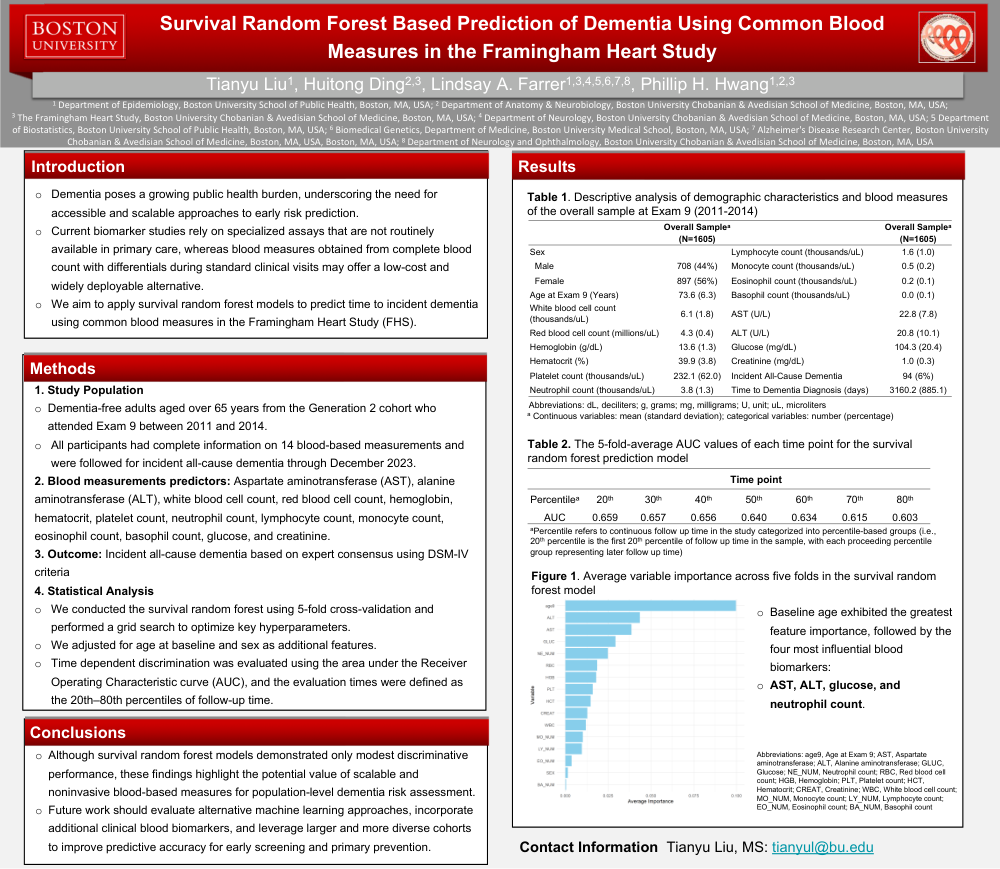
Dementia poses a growing public health burden, underscoring the need for accessible and scalable approaches to early risk prediction. Current biomarker studies rely on specialized assays that are not routinely available in primary care, whereas blood measures obtained from complete blood count with differentials during standard clinical visits may offer a low-cost and widely deployable alternative. To address this gap, we aim to apply survival random forest models to predict time to incident dementia using blood biomarkers in the Framingham Heart Study (FHS).
Methods
The study included dementia-free adults aged over 65 years from the Generation 2 cohort between 2011 and 2014. All participants had complete information on 14 blood-based measurements and were followed for incident all-cause dementia through December 2023. The blood measurements included aspartate aminotransferase (AST), alanine aminotransferase (ALT), white blood cell count, red blood cell count, hemoglobin, hematocrit, platelet count, neutrophil count, lymphocyte count, monocyte count, eosinophil count, basophil count, glucose, and creatinine. We conducted the survival random forest using 5-fold cross-validation and performed a grid search to optimize key hyperparameters. We also included age at baseline and sex as additional features in the model. Time dependent discrimination was evaluated using the area under the Receiver Operating Characteristic (ROC) curve (AUC), and the evaluation times were defined as the 20th–80th percentiles of follow-up time.
Results
The study sample was 56% female, with a mean baseline age of 74 years. Among 1,605 participants, 94 developed all-cause dementia over a mean follow-up of 8.7 years. The AUC was 0.659 at the 20th percentile of follow-up time and decreased to 0.603 at the 80th percentile. Baseline age exhibited the greatest feature importance, followed by the four most influential blood biomarkers: AST, ALT, glucose, and neutrophil count.
Conclusion
Although survival random forest models demonstrated only modest discriminative performance, these findings highlight the potential value of scalable and noninvasive blood-based measures for population-level dementia risk assessment. Future work should evaluate alternative machine learning approaches, incorporate additional clinical blood biomarkers, and leverage larger and more diverse cohorts to improve predictive accuracy and assess the feasibility for early screening and primary prevention.
Comments
Email is required but is not shown publicly.
Loading comments...