4,068 posters, 219 videos, 101 topics, 69 sessions, 14,365 authors, 6,128 institutions
ePostersLive by SciGen Technologies S.A. All rights reserved.
Alzheimer's Association International Conference 2026
July 12-15, 2026 | London, United Kingdom, and Online

6812
Social Vulnerability And Adrd Risk In South Carolina: A Spatial Epidemiology Study
Poster Presenter
Authors
Affiliations
Part of Topic
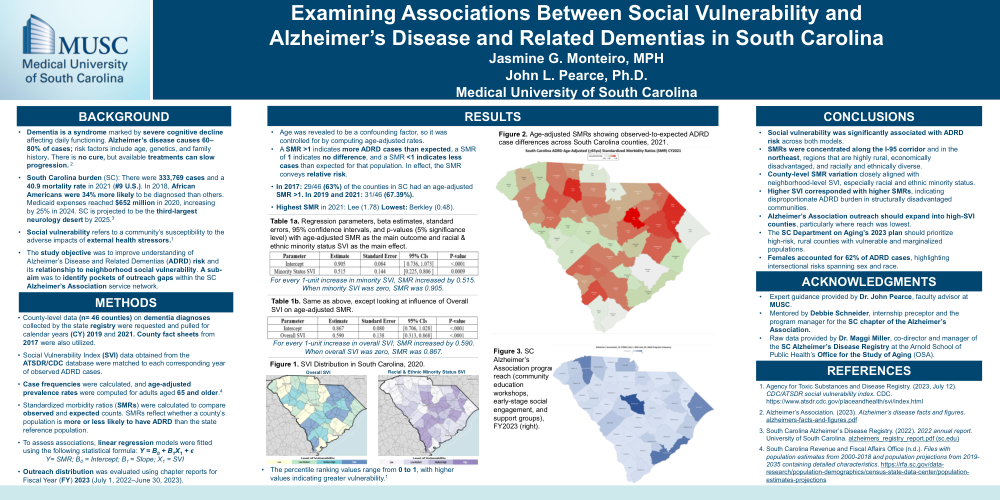
Examining Associations Between Social Vulnerability and Alzheimer’s Disease and Related Dementias in South Carolina
Jasmine G. Monteiro, MPH
John L. Pearce, Ph.D.
Medical University of South Carolina
Background:
•Dementia is a syndrome marked by severe cognitive decline affecting daily functioning. Alzheimer’s disease causes 60–80% of cases; risk factors include age, genetics, and family history. There is no cure, but available treatments can slow progression. 2
•South Carolina burden (SC): There were 333,769 cases and a 40.9 mortality rate in 2021 (#9 U.S.). In 2018, African Americans were 34% more likely to be diagnosed than others. Medicaid expenses reached $652 million in 2020, increasing by 25% in 2024. SC is projected to be the third-largest neurology desert by 2025.3
•Social vulnerability refers to a community’s susceptibility to the adverse impacts of external health stressors.1
•The study objective was to improve understanding of Alzheimer’s Disease and Related Dementias (ADRD) risk and its relationship to neighborhood social vulnerability. A sub-aim was to identify pockets of outreach gaps within the SC Alzheimer’s Association service network.
Methods:
•County‑level data (n= 46 counties) on dementia diagnoses collected by the state registry were requested and pulled for calendar years (CY) 2019 and 2021. County fact sheets from 2017 were also utilized.
•Social Vulnerability Index (SVI) data obtained from the ATSDR/CDC database were matched to each corresponding year of observed ADRD cases.
•Case frequencies were calculated, and age‑adjusted prevalence rates were computed for adults aged 65 and older.4
•Standardized morbidity ratios (SMRs) were calculated to compare observed and expected counts. SMRs reflect whether a county’s population is more or less likely to have ADRD than the state reference population.
•To assess associations, linear regression models were fitted using the following statistical formula: Y = B0 + B1X1 + ϵ
Y= SMR; B0 = Intercept; B1 = Slope; X1 = SVI
•Outreach distribution was evaluated using chapter reports for Fiscal Year (FY) 2023 (July 1, 2022–June 30, 2023).
Results:
•Age was revealed to be a confounding factor, so it was controlled for by computing age-adjusted rates.
•A SMR >1 indicates more ADRD cases than expected, a SMR of 1 indicates no difference, and a SMR <1 indicates less cases than expected for that population. In effect, the SMR conveys relative risk.
•In 2017: 29/46 (63%) of the counties in SC had an age-adjusted SMR >1. In 2019 and 2021: 31/46 (67.39%).
•Highest SMR in 2021: Lee (1.78) Lowest: Berkley (0.48).
• For every 1-unit increase in minority SVI, SMR increased by 0.515., When minority SVI was zero, SMR was 0.905.
• For every 1-unit increase in overall SVI, SMR increased by 0.590., When overall SVI was zero, SMR was 0.867.
•The percentile ranking values range from 0 to 1, with higher values indicating greater vulnerability.1
Conclusions:
•Social vulnerability was significantly associated with ADRD risk across both models.
•SMRs were concentrated along the I‑95 corridor and in the northeast, regions that are highly rural, economically disadvantaged, and racially and ethnically diverse.
•County‑level SMR variation closely aligned with neighborhood‑level SVI, especially racial and ethnic minority status (p= 0.0009).
•Higher SVI corresponded with higher SMRs, indicating disproportionate ADRD burden in structurally disadvantaged communities.
•Alzheimer’s Association outreach should expand into high‑SVI counties, particularly where reach was lowest.
•The SC Department on Aging’s 2023 plan should prioritize high‑risk, rural counties with vulnerable and marginalized populations.
•Females accounted for 62% of ADRD cases, highlighting intersectional risks spanning sex and race.
Acknowledgements:
•Expert guidance provided by Dr. John Pearce, faculty advisor at MUSC.
•Mentored by Debbie Schneider, internship preceptor and the program manager for the SC chapter of the Alzheimer’s Association.
•Raw data provided by Dr. Maggi Miller, co‑director and manager of the SC Alzheimer’s Disease Registry at the Arnold School of Public Health’s Office for the Study of Aging (OSA).
References:
1.Agency for Toxic Substances and Disease Registry. (2023, July 12). CDC/ATSDR social vulnerability index. CDC. https://www.atsdr.cdc.gov/placeandhealth/svi/index.html
2.Alzheimer’s Association. (2023). Alzheimer’s disease facts and figures. alzheimers-facts-and-figures.pdf
3.South Carolina Alzheimer’s Disease Registry. (2022). 2022 annual report. University of South Carolina. alzheimers_registry_report.pdf (sc.edu)
4.South Carolina Revenue and Fiscal Affairs Office (n.d.). Files with population estimates from 2000-2018 and population projections from 2019-2035 containing detailed characteristics. https://rfa.sc.gov/data-research/population-demographics/census-state-data-center/population-estimates-projections
Comments
Email is required but is not shown publicly.
Loading comments...