4,068 posters, 219 videos, 101 topics, 69 sessions, 14,365 authors, 6,128 institutions
ePostersLive by SciGen Technologies S.A. All rights reserved.
Alzheimer's Association International Conference 2026
July 12-15, 2026 | London, United Kingdom, and Online

744
Gait Speed and Variability as Digital Biomarkers Using a Low Cost Wearable System (PaceB)
Poster Presenter
Authors
Dr V Selva Ganapathy, Mayank Sharma, Dr Ravi GS, Dr Deepak Menon, Dr Seena Vengalil, Dr Saraswathi Nashi, Naveen Venkatesh, Dr Atchayaram Nalini
Affiliations
Physiotherapy Centre,National Institute of Mental Health & Neurosciences (NIMHANS), Dept of Biostatistics,National Institute of Mental Health & Neurosciences (NIMHANS), Dept of Neurology,National Institute of Mental Health & Neurosciences (NIMHANS)
Part of Topic
PaceB, an indigenous wearable footwear system, demonstrates 100% operational feasibility for gait assessment across healthy, Parkinson's disease and stroke populations in routine LMIC clinical settings. Temporal gait parameters (stance time and step time) demonstrate excellent agreement (ICC 0.80 to 0.95) with the laboratory based GAITRite® system, supporting their application for objective assessment of gait alterations associated with cognitive and motor impairment. Parameter-dependent agreement reflects measurement context differences, positioning PaceB as a complementary tool for continuous, ecologically valid gait assessment in underserved populations where dementia risk is highest but assessment capacity is lowest.
INTRODUCTION
Disruption of gait is a hallmark sign in neurological conditions such as Stroke, Parkinson’s Disease ,Multiple Sclerosis, etc. Gait speed and gait variability are well-established early markers of cognitive decline and predictors of dementia progression. Yet, in low and middle-income countries (LMICs), access to quantitative gait assessment remains severely limited due to the high cost, infrastructure needs, and restricted portability of laboratory systems such as GAITRite®. This lack of accessible mobility assessment contributes to missed opportunities for early identification of functional decline, falls risk and mobility patterns associated with neurological conditions.PaceB, an indigenous footwear-embedded gait analysis system integrating plantar pressure sensors and accelerometery, was developed in India to address this gap by offering an ultra-low-cost, portable and scalable alternative suitable for community-based screening in resource constrained environments.This study evaluated the operational feasibility of PaceB for capturing spatiotemporal gait patterns in healthy adults, stroke survivors and individuals with Parkinson's disease, while also assessing its concurrent validity with GAITRite®
METHODS
Participants: 119 participants comprising 52 healthy adults, 33 chronic stroke survivors and 34 individuals with idiopathic Parkinson's disease (PD).Protocol: Participants completed a 120 second continuous overground walk at a self selected pace along a 30 metre corridor while wearing PaceB footwear, followed by standardized GAITRite® assessment. Gait parameters: Step time, stance time, walking velocity and coefficients of variation were extracted as objective gait measures.Statistical analysis: Agreement between PaceB and GAITRite® was evaluated using intraclass correlation coefficients (ICC), Bland Altman analysis and limits of agreement (LoA).
RESULTS
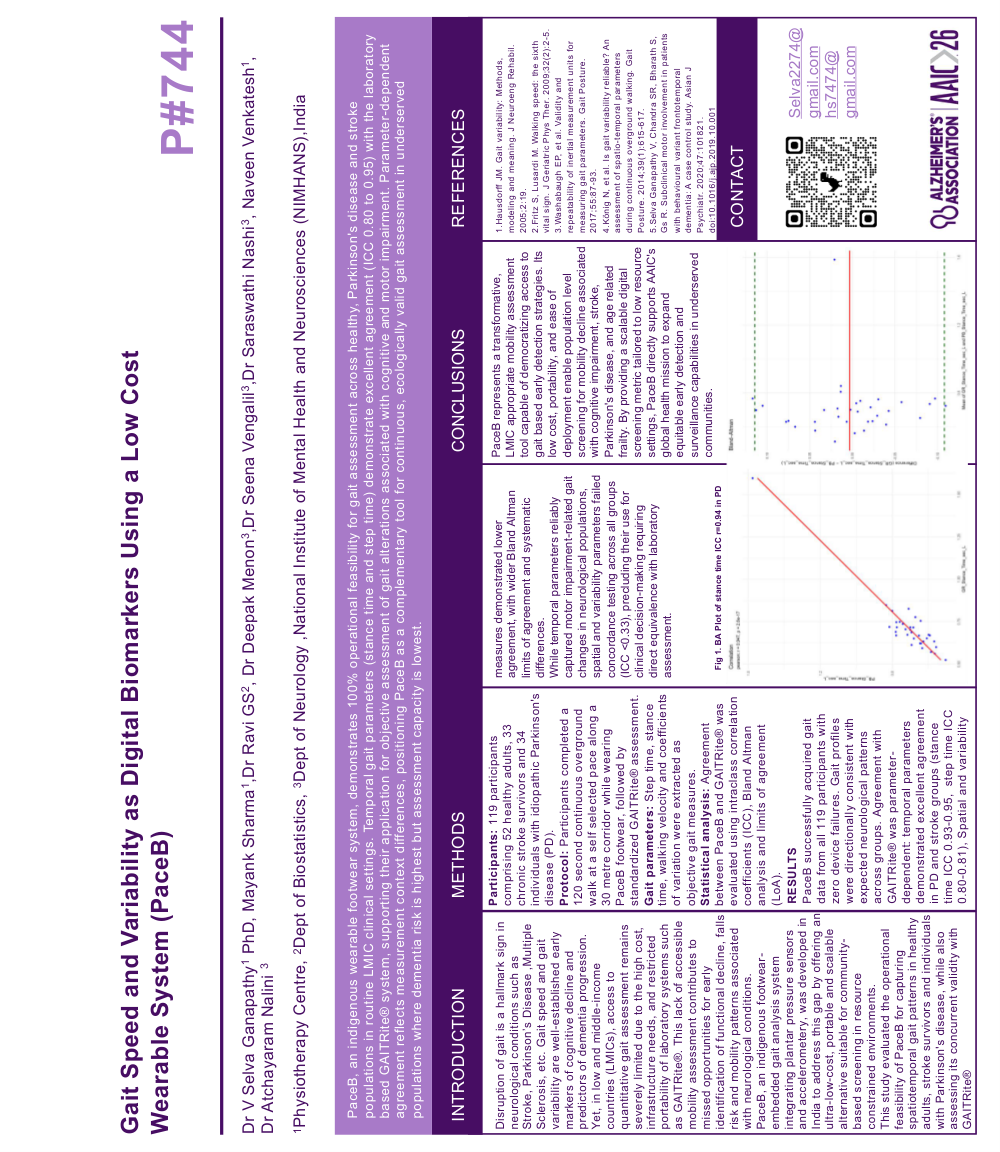
PaceB successfully acquired gait data from all 119 participants with zero device failures. Gait profiles were directionally consistent with expected neurological patterns across groups. Agreement with GAITRite® was parameter-dependent: temporal parameters demonstrated excellent agreement in PD and stroke groups (stance time ICC 0.93-0.95, step time ICC 0.80-0.81), Spatial and variability measures demonstrated lower agreement, with wider Bland Altman limits of agreement and systematic differences.While temporal parameters reliably captured motor impairment-related gait changes in neurological populations, spatial and variability parameters failed concordance testing across all groups (ICC <0.33), precluding their use for clinical decision-making requiring direct equivalence with laboratory assessment.
CONCLUSION
PaceB represents a transformative, LMIC appropriate mobility assessment tool capable of democratizing access to gait based early detection strategies. Its low cost, portability, and ease of deployment enable population level screening for mobility decline associated with cognitive impairment, stroke, Parkinson's disease, and age related frailty. By providing a scalable digital screening metric tailored to low resource settings, PaceB directly supports AAIC's global health mission to expand equitable early detection and surveillance capabilities in underserved communities.
Comments
Email is required but is not shown publicly.
Loading comments...