4,068 posters, 219 videos, 101 topics, 69 sessions, 14,365 authors, 6,128 institutions
ePostersLive by SciGen Technologies S.A. All rights reserved.
Alzheimer's Association International Conference 2026
July 12-15, 2026 | London, United Kingdom, and Online

4484
Plasma Metabolomic Signatures Of Nut Consumption And Their Associations With Cognitive Function
Poster Presenter
Authors
Mengjia Zhao, Siya Shan, Tongtong Li, Gulisiya Hailili, Yuhui Li, Hangrui Zhang, Yimin Zhu, Minyu Wu, Changzheng Yuan
Affiliations
School of Public Health, the Second Affiliated Hospital, Zhejiang University School of Medicine, Hangzhou, Zhejiang, China, School of Public Health, the Second Affiliated Hospital, Zhejiang University School of Medicine, Hangzhou, Zhejiang, China.
Part of Topic
Plasma metabolomic signatures of nut consumption and their associations with cognitive function
KEY TAKEAWAYS:
Our study identified replicable plasma metabolomic signatures of nut consumption and showed that these signatures partially mediated the positive association between nut intake and cognitive function.
BACKGROUND:
Evidence is limited on the associations between nut consumption, their plasma metabolomic signatures and cognitive function.
METHODS:
Design and participants: We used data from two prospective cohorts of adults aged ≥45 years: UK Biobank (UKB, N = 10,306) and Whitehall II (WHII, N = 5,877).
Metabolite identification: Plasma metabolites associated with nut consumption (consumer vs. non-consumer) were independently identified in each cohort.
Score construction: Cohort-specific metabolite scores for nut intake were constructed using elastic-net regression.
Mediation analysis: The potential mediating role of these metabolite scores in the nut consumption–cognition association was evaluated using causal mediation analysis.
RESULTS:
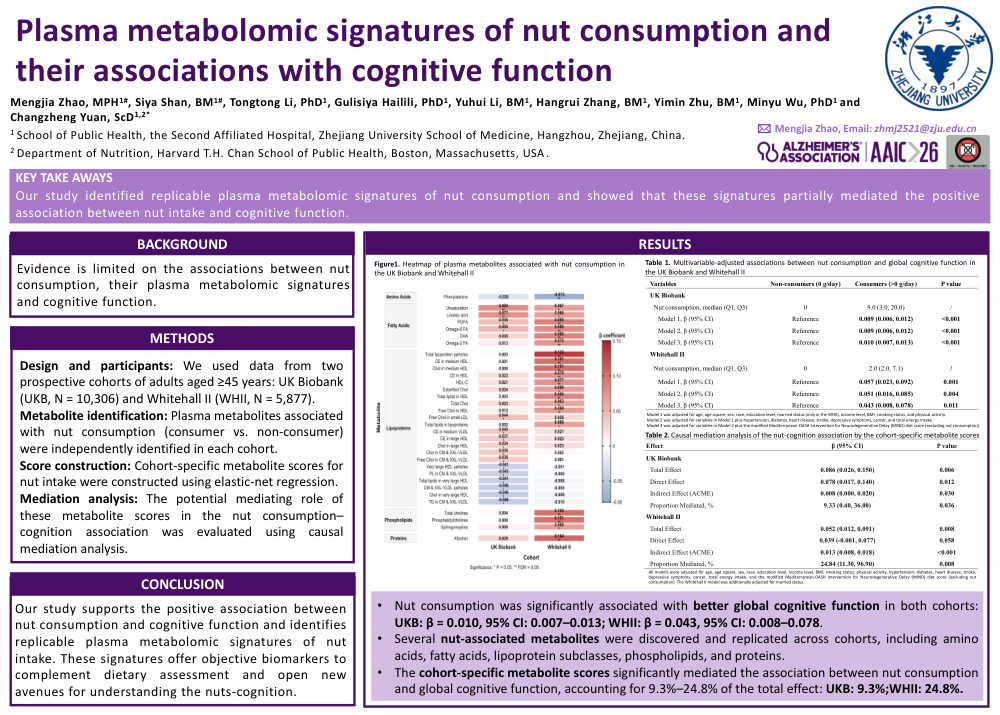
Nut consumption was significantly associated with better global cognitive function in both cohorts: UKB: β = 0.010, 95% CI: 0.007–0.013; WHII: β = 0.043, 95% CI: 0.008–0.078.
Several nut-associated metabolites were discovered and replicated across cohorts, including amino acids, fatty acids, lipoprotein subclasses, phospholipids, and proteins.
The cohort-specific metabolite scores significantly mediated the association between nut consumption and global cognitive function, accounting for 9.3%–24.8% of the total effect: UKB: 9.3%;WHII: 24.8%.
CONCLUSION
Our study supports the positive association between nut consumption and cognitive function and identifies replicable plasma metabolomic signatures of nut intake. These signatures offer objective biomarkers to complement dietary assessment and open new avenues for understanding the nuts-cognition.
Comments
Email is required but is not shown publicly.
Loading comments...