4,068 posters, 219 videos, 101 topics, 69 sessions, 14,365 authors, 6,128 institutions
ePostersLive by SciGen Technologies S.A. All rights reserved.
Alzheimer's Association International Conference 2026
July 12-15, 2026 | London, United Kingdom, and Online

9386
Racial/ethnic Disparities In MCI And Dementia And Social Determinants In A Multi-ethnic Us Cohort: A Machine Learning Approach
Poster Presenter
Authors
Affiliations
Rory Meyers College of Nursing, New York University, New York, NY 10010, USA, NYU Shanghai, Shanghai 200124, China, Department of Neurology, Rutgers-Robert Wood Johnson Medical School and Center for Healthy Aging Research, USA; Rutgers Institute for Health, Health Care Policy, and Aging Research, Rutgers Health, New Brunswick, USA
Part of Topic
Title:
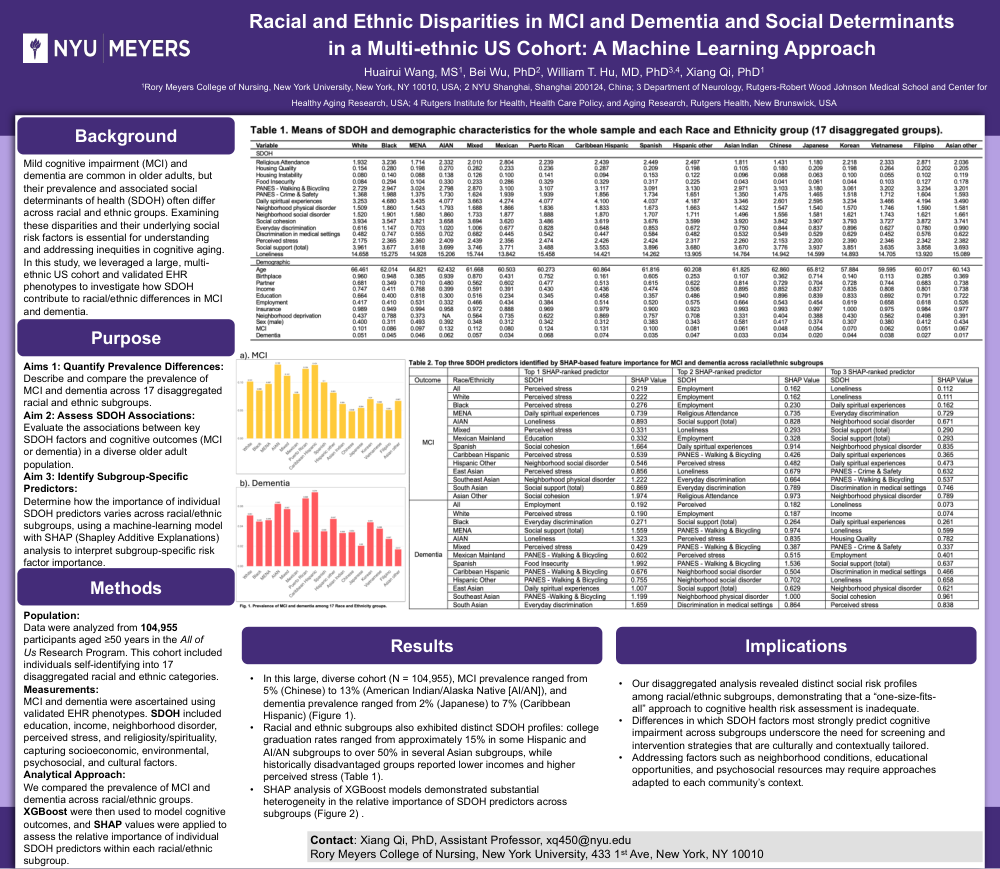
Racial and Ethnic Disparities in MCI and Dementia and Social Determinants in a Multi-ethnic US Cohort: A Machine Learning Approach
Authors:
Huairui Wang, MS1, Bei Wu, PhD2, William T. Hu, MD, PhD3,4, Xiang Qi, PhD1
1Rory Meyers College of Nursing, New York University, New York, NY 10010, USA; 2 NYU Shanghai, Shanghai 200124, China; 3 Department of Neurology, Rutgers-Robert Wood Johnson Medical School and Center for Healthy Aging Research, USA; 4 Rutgers Institute for Health, Health Care Policy, and Aging Research, Rutgers Health, New Brunswick, USA
Background:
Mild cognitive impairment (MCI) and dementia are common in older adults, but their prevalence and associated social determinants of health (SDOH) often differ across racial and ethnic groups. Examining these disparities and their underlying social risk factors is essential for understanding and addressing inequities in cognitive aging.
In this study, we leveraged a large, multi-ethnic US cohort and validated EHR phenotypes to investigate how SDOH contribute to racial/ethnic differences in MCI and dementia.
Purpose:
Aims 1: Quantify Prevalence Differences:
Describe and compare the prevalence of MCI and dementia across 17 disaggregated racial and ethnic subgroups.
Aim 2: Assess SDOH Associations:
Evaluate the associations between key SDOH factors and cognitive outcomes (MCI or dementia) in a diverse older adult population.
Aim 3: Identify Subgroup-Specific Predictors:
Determine how the importance of individual SDOH predictors varies across racial/ethnic subgroups, using a machine-learning model with SHAP (Shapley Additive Explanations) analysis to interpret subgroup-specific risk factor importance.
Methods:
Population:
Data were analyzed from 104,955 participants aged ≥50 years in the All of Us Research Program. This cohort included individuals self-identifying into 17 disaggregated racial and ethnic categories.
Measurements:
MCI and dementia were ascertained using validated EHR phenotypes. SDOH included education, income, neighborhood disorder, perceived stress, and religiosity/spirituality, capturing socioeconomic, environmental, psychosocial, and cultural factors.
Analytical Approach:
We compared the prevalence of MCI and dementia across racial/ethnic groups. XGBoost were then used to model cognitive outcomes, and SHAP values were applied to assess the relative importance of individual SDOH predictors within each racial/ethnic subgroup.
Results:
Implications:
Our disaggregated analysis revealed distinct social risk profiles among racial/ethnic subgroups, demonstrating that a “one-size-fits-all” approach to cognitive health risk assessment is inadequate.
Differences in which SDOH factors most strongly predict cognitive impairment across subgroups underscore the need for screening and intervention strategies that are culturally and contextually tailored.
Addressing factors such as neighborhood conditions, educational opportunities, and psychosocial resources may require approaches adapted to each community’s context.
Comments
Email is required but is not shown publicly.
Loading comments...