4,068 posters, 219 videos, 101 topics, 69 sessions, 14,365 authors, 6,128 institutions
ePostersLive by SciGen Technologies S.A. All rights reserved.
Alzheimer's Association International Conference 2026
July 12-15, 2026 | London, United Kingdom, and Online

5093
Associations Of Dietary Flavonoids Intake With Cognitive Function: A Population-based Prospective Study In Chinese Older Adults
Poster Presenter
Authors
Yuhui Li, Zhouxin Xing, Gulisiya Hailili, Hangrui Zhang, Mengjia Zhao, Jie Shen, Shuyi Li, Xiaofeng Wang, Yan Zheng, Changzheng Yuan
Affiliations
School of Public Health, the Second Affiliated Hospital, Zhejiang University School of Medicine, Hangzhou, Zhejiang, China., State Key Laboratory of Genetic Engineering, School of Life Sciences and Human Phenome Institute, Fudan University, 200433, Shanghai, China., 1. School of Public Health, the Second Affiliated Hospital, Zhejiang University School of Medicine, Hangzhou, Zhejiang, China. 2. Department of Nutrition, Harvard T.H. Chan School of Public Health, Boston, MA 02115, USA.
Part of Topic
Title: Associations of dietary flavonoids intake with cognitive function: A population-based prospective study in Chinese older adults
Authors: Yuhui Li, Zhouxin Xing, Gulisiya Hailili, Hangrui Zhang, Mengjia Zhao, Jie Shen, Shuyi Li, Xiaofeng Wang, Yan Zheng, Changzheng Yuan
Background: Dietary flavonoids have been associated with cognitive function, yet population-based evidence in Chinese older adults remains limited.
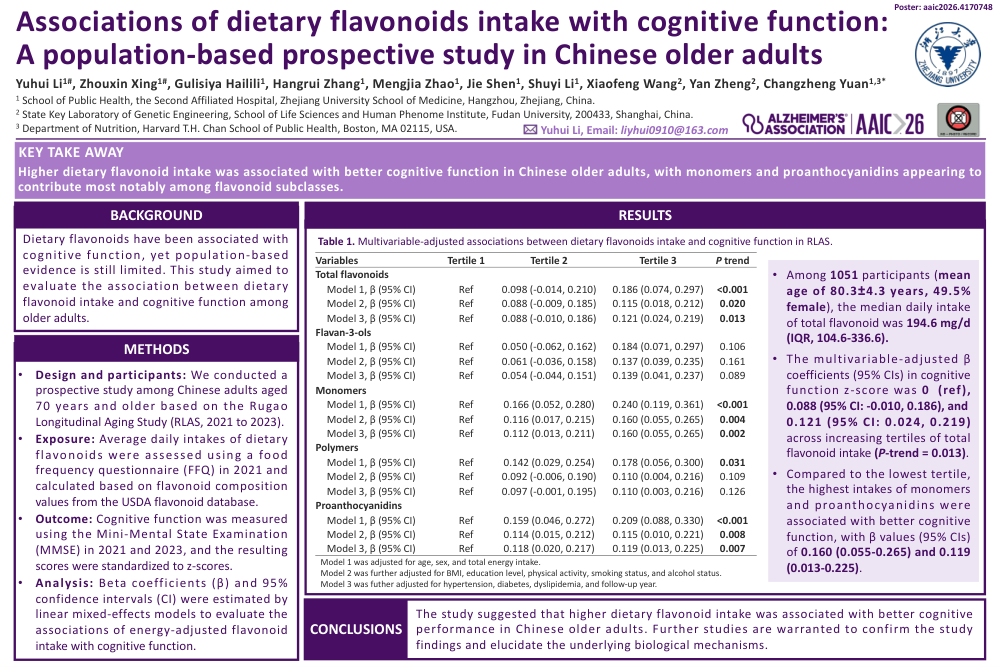
Methods: Prospective analysis of 1,051 adults aged ≥70 years from the Rugao Longitudinal Aging Study (RLAS, 2021–2023). Dietary flavonoid intakes were assessed by FFQ in 2021 and calculated using the USDA flavonoid database. MMSE was administered in 2021 and 2023; scores were standardized to z-scores. Linear mixed-effects models were used to estimate multivariable-adjusted associations across tertiles of flavonoid intake.
Results: Higher total flavonoid intake was associated with better cognitive z-scores (Model 3: T3 vs T1 β=0.121, 95% CI: 0.024, 0.219; P for trend=0.013). Monomers and proanthocyanidins showed significant associations in Model 3 (P for trend=0.002 and 0.007, respectively).
Conclusions: Higher dietary flavonoid intake was associated with better cognitive function in Chinese older adults. These findings warrant confirmation in independent cohorts.
Keywords: flavonoids; cognitive function; older adults; prospective study
Comments
Email is required but is not shown publicly.
Loading comments...