4,068 posters, 219 videos, 101 topics, 69 sessions, 14,365 authors, 6,128 institutions
ePostersLive by SciGen Technologies S.A. All rights reserved.
Alzheimer's Association International Conference 2026
July 12-15, 2026 | London, United Kingdom, and Online

9340
Cognitive Impairment And Health-related Quality Of Life In Adults Aged 50 Years Or Older In Tumbes, Peru
Poster Presenter
Authors
Affiliations
Part of Topic
Cognitive Impairment and Health-Related Quality of Life in Adults Aged 50 Years or Older in Tumbes, Peru
Authors and affiliations:
María Pia Lecca 1 https://orcid.org/0000-0001-9898-8827
Antonio Bernabe-Ortiz 1 https://orcid.org/0000-0002-6834-1376
Maria Kathia Cardenas1 https://orcid.org/0000-0002-3173-9284
1 CRONICAS Center of Excellence in Chronic Diseases, Universidad Peruana
Cayetano Heredia, Lima, Peru
Background
Cognitive impairment can decrease daily functioning and may worsen neuropsychiatric symptoms, reducing health-related quality of life (HRQoL). Our aim was to describe HRQoL in adults aged ≥50 years and its association with cognitive impairment and sociodemographic factors.
Methods
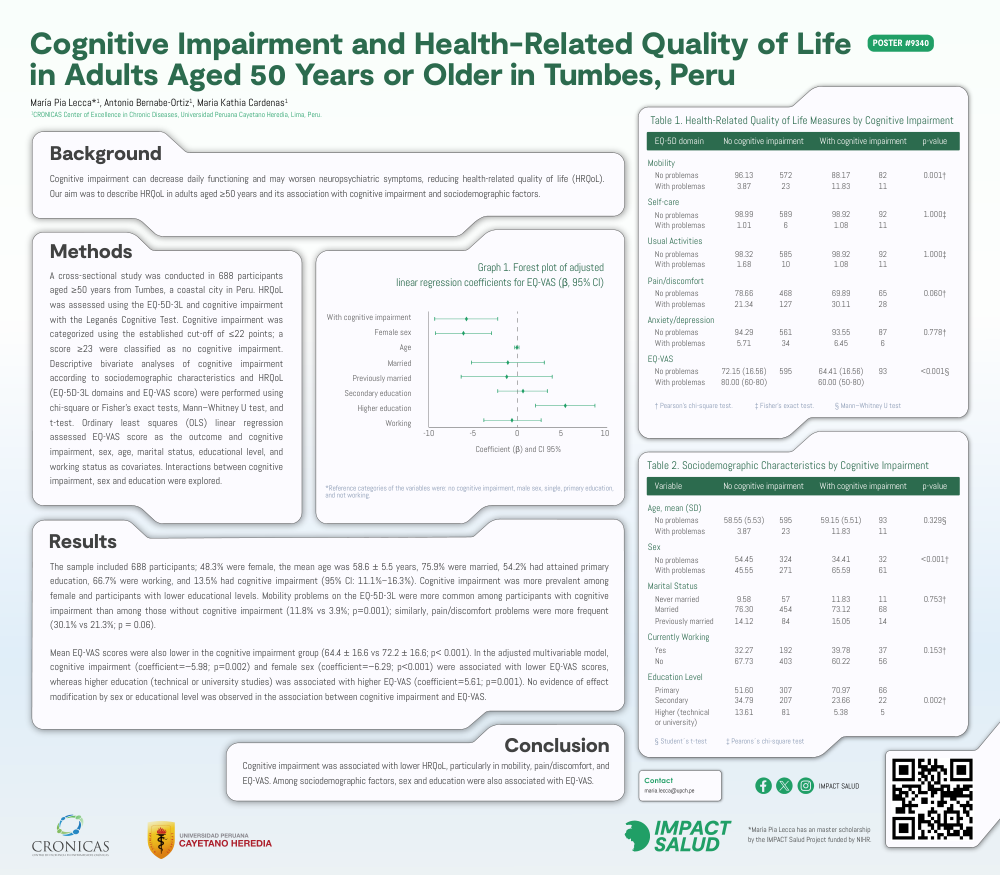
A cross-sectional study was conducted in 688 participants aged ≥50 years from Tumbes, a coastal city in Peru. HRQoL was assessed using the EQ-5D-3L and cognitive impairment with the Leganés Cognitive Test. Cognitive impairment was categorized using the established cut-off of ≤22 points; a score ≥23 were classified as no cognitive impairment. Descriptive bivariate analyses of cognitive impairment according to sociodemographic characteristics and HRQoL (EQ-5D-3L domains and EQ-VAS score) were performed using chi-square or Fisher's exact tests, Mann–Whitney U test, and t-test. Ordinary least squares (OLS) linear regression assessed EQ-VAS score as the outcome and cognitive impairment, sex, age, marital status, educational level, and working status as covariates. Interactions between cognitive impairment, sex and education were explored.
Results
The sample included 688 participants; 48.3% were female, the mean age was 58.6 ± 5.5 years, 75.9% were married, 54.2% had attained primary education, 66.7% were working, and 13.5% had cognitive impairment (95% CI: 11.1%–16.3%). Cognitive impairment was more prevalent among female and participants with lower educational levels. Mobility problems on the EQ-5D-3L were more common among participants with cognitive impairment than among those without cognitive impairment (11.8% vs 3.9%; p=0.001); similarly, pain/discomfort problems were more frequent (30.1% vs 21.3%; p = 0.06). Mean EQ-VAS scores were also lower in the cognitive impairment group (64.4 ± 16.6 vs 72.2 ± 16.6; p< 0.001). In the adjusted multivariable model, cognitive impairment (coefficient=−5.98; p=0.002) and female sex (coefficient=−6.29; p<0.001) were associated with lower EQ-VAS scores, whereas higher education (technical or university studies) was associated with higher EQ-VAS (coefficient=5.61; p=0.001). No evidence of effect modification by sex or educational level was observed in the association between cognitive impairment and EQ-VAS.
Conclusion
Cognitive impairment was associated with lower HRQoL, particularly in mobility, pain/discomfort, and EQ-VAS. Among sociodemographic factors, sex and education were also associated with EQ-VAS.
Comments
Email is required but is not shown publicly.
Loading comments...