4,068 posters, 219 videos, 101 topics, 69 sessions, 14,365 authors, 6,128 institutions
ePostersLive by SciGen Technologies S.A. All rights reserved.
Alzheimer's Association International Conference 2026
July 12-15, 2026 | London, United Kingdom, and Online

10720
Tau But Not Neurodegeneration Mediates The Association Between Physical Frailty And Cognitive Decline In Preclinical AD
Poster Presenter
Authors
Kailee Palmgren, Nicholas Vogt, Paola Matos, Akpevweoghene Ikoba, Talia Robinson, Stephanie Schultz, Zahra Shirzadi, Dylan Kirn, Michael Properzi, Aaron Schultz, Rachel Buckley, Rebecca Amariglio, Dorene Rentz, Keith Johnson, Reisa Sperling, Jasmeer Chhatwal, Wai-Ying Wendy Yau
Affiliations
Massachusetts General Brigham, Massachusetts General Brigham, Marcus Institute for Aging Research, Medical College of Wisconsin, Massachusetts General Brigham, Harvard Medical School
Part of Topic
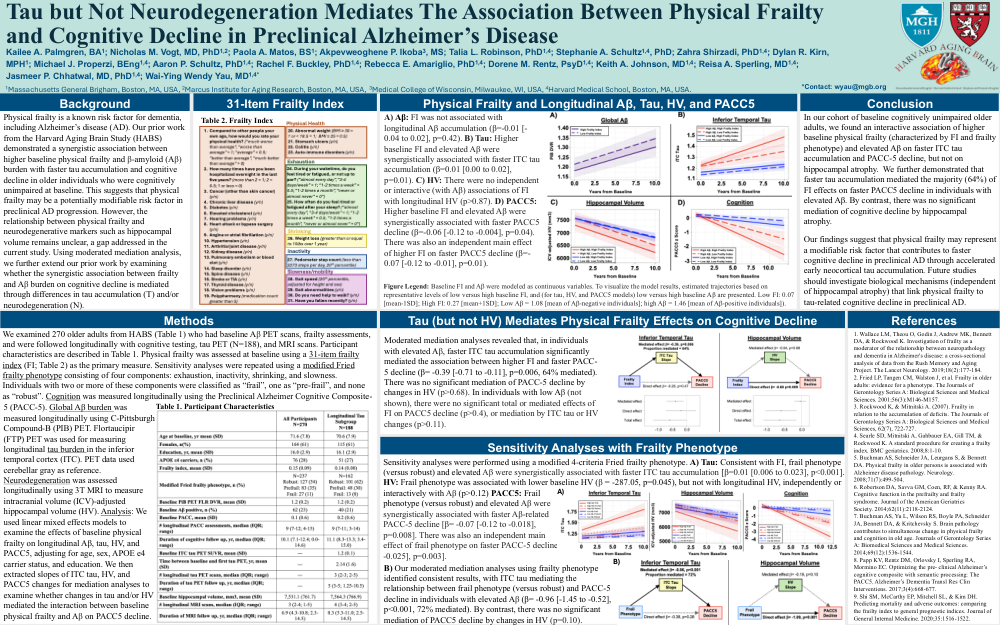
Physical frailty is a known risk factor for dementia, including Alzheimer’s disease (AD). Our prior work from the Harvard Aging Brain Study (HABS) demonstrated a synergistic association between higher baseline physical frailty and β-amyloid (Aβ) burden with faster tau accumulation and cognitive decline in older individuals who were cognitively unimpaired at baseline. This suggests that physical frailty may be a potentially modifiable risk factor in preclinical AD progression. However, the relationship between physical frailty and neurodegenerative markers such as hippocampal volume remains unclear, a gap addressed in the current study. Using moderated mediation analysis, we further extend our prior work by examining whether the synergistic association between frailty and Aβ burden on cognitive decline is mediated through differences in tau accumulation (T) and/or neurodegeneration (N).
We examined 270 older adults from HABS (Table 1) who had baseline Aβ PET scans, frailty assessments, and were followed longitudinally with cognitive testing, tau PET (N=188), and MRI scans. Participant characteristics are described in Table 1. Physical frailty was assessed at baseline using a 31-item frailty index (FI; Table 2) as the primary measure. Sensitivity analyses were repeated using a modified Fried frailty phenotype consisting of four components: exhaustion, inactivity, shrinking, and slowness. Individuals with two or more of these components were classified as “frail”, one as “pre-frail”, and none as “robust”. Cognitionwas measured longitudinally using the Preclinical Alzheimer Cognitive Composite-5 (PACC-5). Global Aβ burden was measured longitudinally using C-Pittsburgh Compound-B (PIB) PET. Flortaucipir (FTP) PET was used for measuring longitudinal tau burden in the inferior temporal cortex (ITC). PET data used cerebellar gray as reference. Neurodegeneration was assessed longitudinally using 3T MRI to measure intracranial volume (ICV)-adjusted hippocampal volume (HV). Analysis: We used linear mixed effects models to examine the effects of baseline physical frailty on longitudinal Aβ, tau, HV, and PACC5, adjusting for age, sex, APOE e4 carrier status, and education. We then extracted slopes of ITC tau, HV, and PACC5 changes for mediation analyses to examine whether changes in tau and/or HV mediated the interaction between baseline physical frailty and Aβ on PACC5 decline.
A) Aβ: FI was not associated with longitudinal Aβ accumulation (β=-0.01 [-0.04 to 0.02], p=0.42). B) Tau: Higher baseline FI and elevated Aβ were synergistically associated with faster ITC tau accumulation (β=0.01 [0.00 to 0.02], p=0.01). C) HV: There were no independent or interactive (with Aβ) associations of FI with longitudinal HV (p>0.87). D) PACC5: Higher baseline FI and elevated Aβ were synergistically associated with faster PACC5 decline (β=-0.06 [-0.12 to -0.004], p=0.04). There was also an independent main effect of higher FI on faster PACC5 decline (β=-0.07 [-0.12 to -0.01], p=0.01).
Moderated mediation analyses revealed that, in individuals with elevated Aβ, faster ITC tau accumulation significantly mediated the association between higher FI and faster PACC-5 decline (β= -0.39 [-0.71 to -0.11], p=0.006, 64% mediated). There was no significant mediation of PACC-5 decline by changes in HV (p>0.68). In individuals with low Aβ (not shown), there were no significant total or mediated effects of FI on PACC5 decline (p>0.4), or mediation by ITC tau or HV changes (p>0.11).
Sensitivity analyses were performed using a modified 4-criteria Fried frailty phenotype. A) Tau: Consistent with FI, frail phenotype (versus robust) and elevated Aβ were synergistically associated with faster ITC tau accumulation [β=0.01 [0.006 to 0.023], p<0.001]. HV: Frail phenotype was associated with lower baseline HV (β = -287.05, p=0.045), but not with longitudinal HV, independently or interactively with Aβ (p>0.12) PACC5: Frail phenotype (versus robust) and elevated Aβ were synergistically associated with faster Aβ-related PACC-5 decline [β= -0.07 [-0.12 to -0.018], p=0.008]. There was also an independent main effect of frail phenotype on faster PACC-5 decline [β= -0.07 [-0.123 to -0.025], p=0.003]. B) Our moderated mediation analyses using frailty phenotype identified consistent results, with ITC tau mediating the relationship between frail phenotype (versus robust) and PACC-5 decline in individuals with elevated Aβ (β= -0.96 [-1.45 to -0.52], p<0.001, 72% mediated). By contrast, there was no significant mediation of PACC5 decline by changes in HV (p=0.10).
In our cohort of baseline cognitively unimpaired older adults, we found an interactive association of higher baseline physical frailty (characterized by FI and frailty phenotype) and elevated Aβ on faster ITC tau accumulation and PACC-5 decline, but not on hippocampal atrophy. We further demonstrated that faster tau accumulation mediated the majority (64%) of FI effects on faster PACC5 decline in individuals with elevated Aβ. By contrast, there was no significant mediation of cognitive decline by hippocampal atrophy. Our findings suggest that physical frailty may represent a modifiable risk factor that contributes to faster cognitive decline in preclinical AD through accelerated early neocortical tau accumulation. Future studies should investigate biological mechanisms (independent of hippocampal atrophy) that link physical frailty to tau-related cognitive decline in preclinical AD.
Comments
Email is required but is not shown publicly.
Loading comments...