4,068 posters, 219 videos, 101 topics, 69 sessions, 14,365 authors, 6,128 institutions
ePostersLive by SciGen Technologies S.A. All rights reserved.
Alzheimer's Association International Conference 2026
July 12-15, 2026 | London, United Kingdom, and Online

1719
Treatment Of β-amyloid-induced Increased Tonic Conductance And Cognitive Deficits By An α5 Gaba Inverse Agonist
Poster Presenter
Authors
Aoife O’Connell, Oran McNamara, Ciara Ní Dhochartaigh, Éabha Mc Inernery, Leo Quinlan, Andrea Kwakowsky
Affiliations
Pharmacology and Therapeutics, School of Pharmacy and Medical Sciences, Institute for Health Discovery and Innovation, Institute, Physiology, School of Pharmacy and Medical Sciences, Institute for Health Discovery and Innovation, Institute for Clinical Trials, Galway Neuroscience Centre, University of Galway, Galway, Ireland
Part of Topic
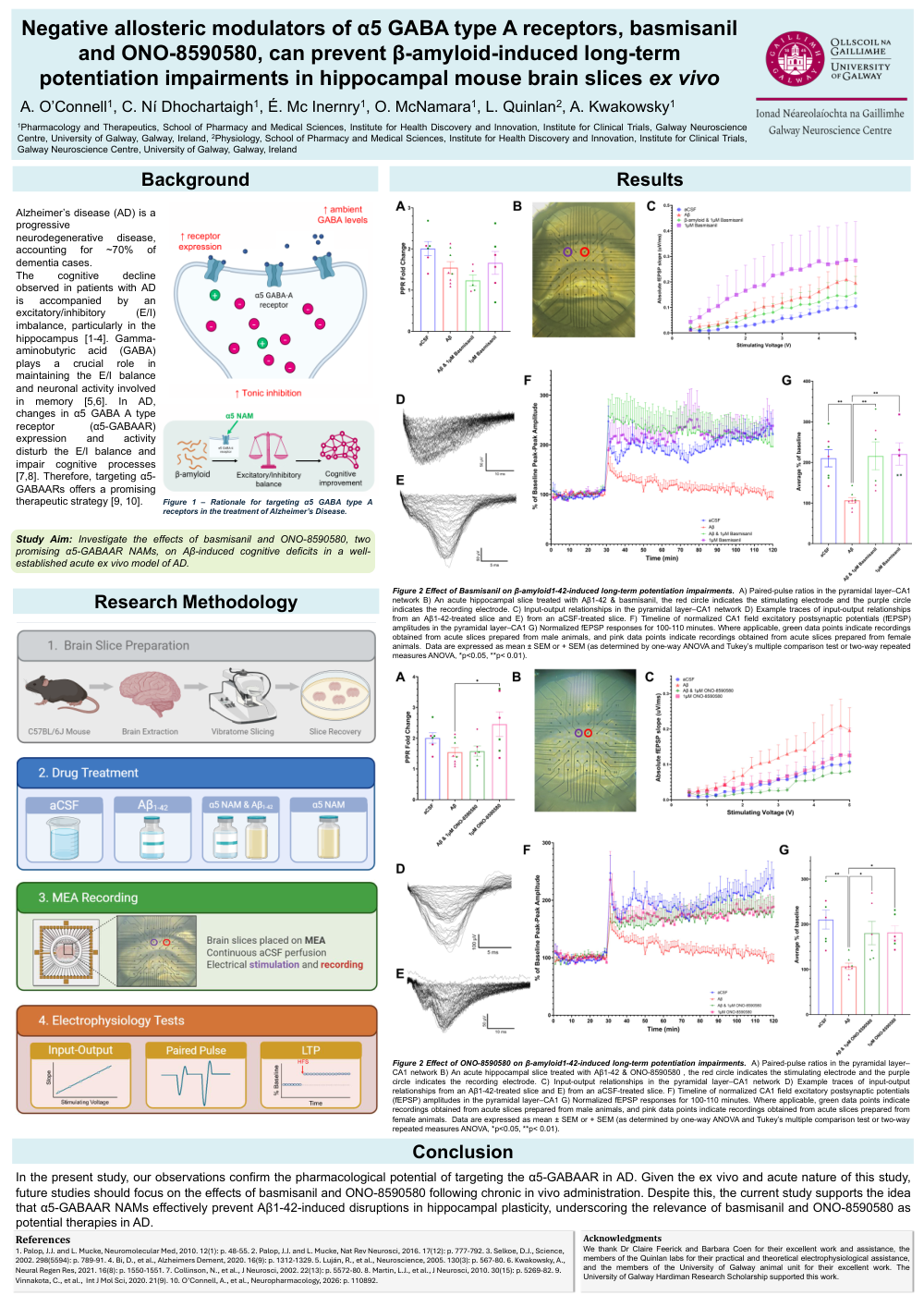
Negative allosteric modulators of α5 GABA type A receptors, basmisanil and ONO-8590580, can prevent β-amyloid-induced long-term potentiation impairments in hippocampal mouse brain slices ex vivo
Background:
Alzheimer’s disease (AD) is a progressive neurodegenerative disease, accounting for ~70% of dementia cases. The cognitive decline observed in patients with AD is accompanied by an excitatory/inhibitory (E/I) imbalance, particularly in the hippocampus [1-4]. Gamma-aminobutyric acid (GABA) plays a crucial role in maintaining the E/I balance and neuronal activity involved in memory [5,6]. In AD, changes in α5 GABA A type receptor (α5-GABAAR) expression and activity disturb the E/I balance and impair cognitive processes [7,8]. Therefore, targeting α5-GABAARs offers a promising therapeutic strategy [9, 10].
Aims:
Investigate the effects of basmisanil and ONO-8590580, two promising α5-GABAAR NAMs, on Aβ-induced cognitive deficits in a well-established acute ex vivo model of AD.
Methods:
MEA with ex vivo hippocampal slices.
Results:
Effect of Basmisanil on β-amyloid1-42-induced long-term potentiation impairments. A) Paired-pulse ratios in the pyramidal layer–CA1 network B) An acute hippocampal slice treated with Aβ1-42 & basmisanil, the red circle indicates the stimulating electrode and the purple circle indicates the recording electrode. C) Input-output relationships in the pyramidal layer–CA1 network D) Example traces of input-output relationships from an Aβ1-42-treated slice and E) from an aCSF-treated slice. F) Timeline of normalized CA1 field excitatory postsynaptic potentials (fEPSP) amplitudes in the pyramidal layer–CA1 G) Normalized fEPSP responses for 100-110 minutes. Where applicable, green data points indicate recordings obtained from acute slices prepared from male animals, and pink data points indicate recordings obtained from acute slices prepared from female animals. Data are expressed as mean ± SEM or + SEM (as determined by one-way ANOVA and Tukey’s multiple comparison test or two-way repeated measures ANOVA, *p<0.05, **p< 0.01).
Effect of ONO-8590580 on β-amyloid1-42-induced long-term potentiation impairments. A) Paired-pulse ratios in the pyramidal layer–CA1 network B) An acute hippocampal slice treated with Aβ1-42 & ONO-8590580 , the red circle indicates the stimulating electrode and the purple circle indicates the recording electrode. C) Input-output relationships in the pyramidal layer–CA1 network D) Example traces of input-output relationships from an Aβ1-42-treated slice and E) from an aCSF-treated slice. F) Timeline of normalized CA1 field excitatory postsynaptic potentials (fEPSP) amplitudes in the pyramidal layer–CA1 G) Normalized fEPSP responses for 100-110 minutes. Where applicable, green data points indicate recordings obtained from acute slices prepared from male animals, and pink data points indicate recordings obtained from acute slices prepared from female animals. Data are expressed as mean ± SEM or + SEM (as determined by one-way ANOVA and Tukey’s multiple comparison test or two-way repeated measures ANOVA, *p<0.05, **p< 0.01).
Conclusion:
In the present study, our observations confirm the pharmacological potential of targeting the α5-GABAAR in AD. Given the ex vivo and acute nature of this study, future studies should focus on the effects of basmisanil and ONO-8590580 following chronic in vivo administration. Despite this, the current study supports the idea that α5-GABAAR NAMs effectively prevent Aβ1-42-induced disruptions in hippocampal plasticity, underscoring the relevance of basmisanil and ONO-8590580 as potential therapies in AD.
Comments
Email is required but is not shown publicly.
Loading comments...