4,068 posters, 219 videos, 101 topics, 69 sessions, 14,365 authors, 6,128 institutions
ePostersLive by SciGen Technologies S.A. All rights reserved.
Alzheimer's Association International Conference 2026
July 12-15, 2026 | London, United Kingdom, and Online

4712
Network Pharmacology And Molecular Docking Analysis Of Moringa Oleifera In Alzheimer's Disease
Poster Presenter
Authors
Part of Topic
Video
Network Pharmacology and Molecular Docking Analysis of Moringa oleifera in Alzheimer’s Disease
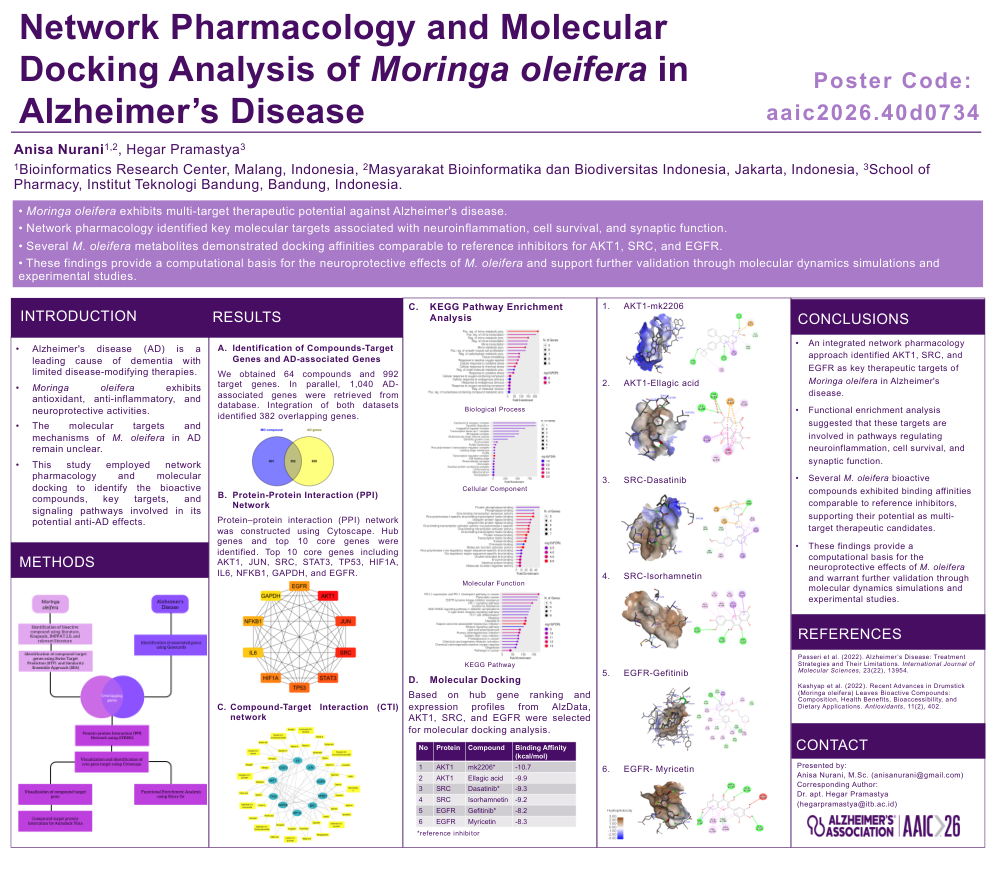
Background: Moringa oleifera Lamarck has been traditionally used to treat wounds, ulcers, liver and cardiovascular diseases, and cancer, and has also been reported to exert neuroprotective effects in the central nervous system. These properties prompted us to investigate the potential role of M. oleifera in Alzheimer’s disease (AD) using a network pharmacology and molecular docking approach.
Methods: Bioactive compounds of M. oleifera were identified from KNApSAcK, IMPPAT 2.0, and relevant literature. Potential targets were predicted using the SEA Search Server and SwissTargetPrediction, while AD-associated genes were retrieved from the GeneCards database. Overlapping genes were imported into STRING v12.0 and visualized using Cytoscape v3.10.4 to construct a protein–protein interaction (PPI) network. Hub genes were identified using CytoHubba, and the top 10 essential genes were selected. Functional enrichment analysis was performed using ShinyGO 8.5. Based on hub ranking and expression profiles from AlzData, AKT1, SRC, and EGFR were selected for molecular docking. Docking simulations were conducted using AutoDock Vina in PyRx v0.8, and interactions were visualized using Discovery Studio 2019.
Results: A total of 64 M. oleifera compounds corresponding to 992 predicted targets were identified, while 1,040 AD-associated genes were retrieved. Integration yielded 382 overlapping genes. The PPI network consisted of 379 nodes and 3,394 edges. The top hub genes were AKT1, SRC, JUN, STAT3, TP53, HIF1A, EGFR, NFKB1, IL6, and GAPDH. Functional enrichment analysis revealed significant involvement in gene expression regulation, miRNA-related processes, oxidative stress response, and neuroinflammatory pathways. Molecular docking showed strong binding affinities of key compounds, including luteolin, isorhamnetin, and myricetin, toward AKT1, SRC, and EGFR compared with reference inhibitors.
Conclusion: This integrative network pharmacology and docking study suggests that M. oleifera may exert neuroprotective effects in AD through multi-target regulation of oxidative stress, inflammation, and gene expression pathways. Further molecular dynamics simulations are warranted to validate the stability and interaction dynamics of the identified complexes.
Comments
Email is required but is not shown publicly.
Loading comments...