4,068 posters, 219 videos, 101 topics, 69 sessions, 14,365 authors, 6,128 institutions
ePostersLive by SciGen Technologies S.A. All rights reserved.
Alzheimer's Association International Conference 2026
July 12-15, 2026 | London, United Kingdom, and Online

6928
Alzheimer's Clinical Trials Across The Globe: A Cross-sectional Analysis Of Site Distribution And Disease Burden
Part of Topic
Alzheimer's Clinical Trials Across the United States of America: A Cross-Sectional Analysis of Site Distribution and Disease Burden
Lina Petrossian, BS1, Carla Margossian2, Sayler Towsley3, Zella Margossian3, Sarmen Sarkissian, MD3
1School of Medicine, California University of Science and Medicine, Colton, CA, USA
2University at Buffalo, Buffalo, NY, USA
3Armenian American Medical Society, Glendale, CA, USA
INTRODUCTION
Alzheimer’s remains the most common form of dementia worldwide. Participation in clinical trials is critical for the advancement of new treatments. However, equitable access to therapies depends on the geographic distribution of trial sites. Disparities in trial availability can limit participation for patients living in countries with high Alzheimer’s incidence and mortality, but few research opportunities. China has the highest rate of Alzheimer’s incidence and mortality. These patterns raise questions about whether the availability of trials aligns with the global burden of disease.
METHODS
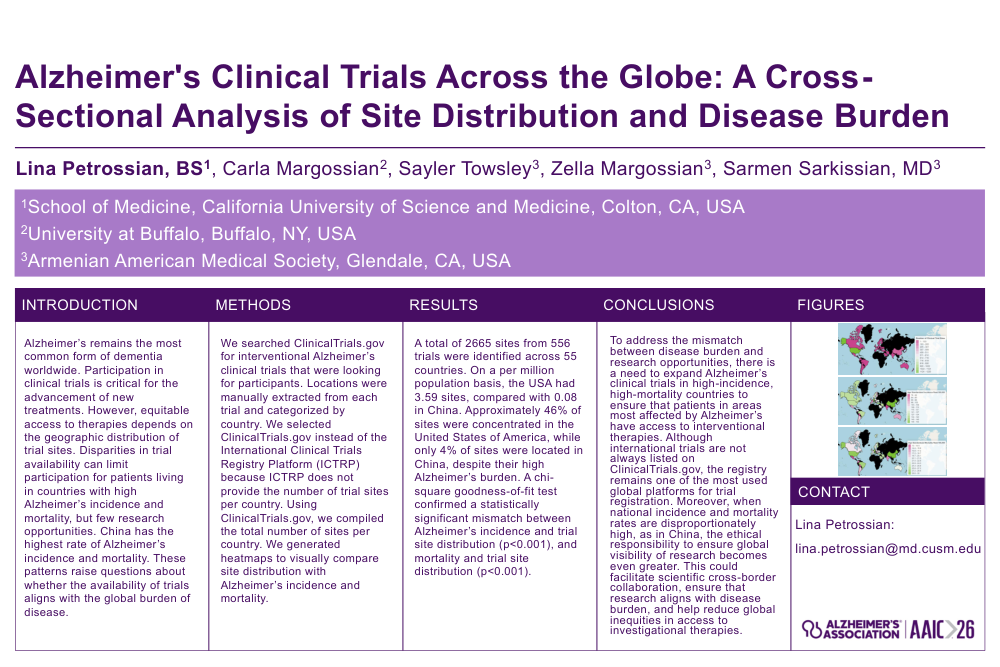
We searched ClinicalTrials.gov for interventional Alzheimer’s clinical trials that were looking for participants. Locations were manually extracted from each trial and categorized by country. We selected ClinicalTrials.gov instead of the International Clinical Trials Registry Platform (ICTRP) because ICTRP does not provide the number of trial sites per country. Using ClinicalTrials.gov, we compiled the total number of sites per country. We generated heatmaps to visually compare site distribution with Alzheimer’s incidence and mortality.
RESULTS
A total of 2665 sites from 556 trials were identified across 55 countries. On a per million population basis, the USA had 3.59 sites, compared with 0.08 in China. Approximately 46% of sites were concentrated in the United States of America, while only 4% of sites were located in China, despite their high Alzheimer’s burden. A chi-square goodness-of-fit test confirmed a statistically significant mismatch between Alzheimer’s incidence and trial site distribution (p<0.001), and mortality and trial site distribution (p<0.001).
CONCLUSIONS
To address the mismatch between disease burden and research opportunities, there is a need to expand Alzheimer’s clinical trials in high-incidence, high-mortality countries to ensure that patients in areas most affected by Alzheimer’s have access to interventional therapies. Although international trials are not always listed on ClinicalTrials.gov, the registry remains one of the most used global platforms for trial registration. Moreover, when national incidence and mortality rates are disproportionately high, as in China, the ethical responsibility to ensure global visibility of research becomes even greater. This could facilitate scientific cross-border collaboration, ensure that research aligns with disease burden, and help reduce global inequities in access to investigational therapies.
FIGURES
CONTACT
Lina Petrossian:
lina.petrossian@md.cusm.edu
Comments
Email is required but is not shown publicly.
Loading comments...