4,068 posters, 219 videos, 101 topics, 69 sessions, 14,365 authors, 6,128 institutions
ePostersLive by SciGen Technologies S.A. All rights reserved.
Alzheimer's Association International Conference 2026
July 12-15, 2026 | London, United Kingdom, and Online

3353
Monoclonal Antibodies As Tau-Targeted Immunotherapies: Current Progress And Challenges In Clinical Trials
Part of Topic
Title
Monoclonal Antibodies as Tau-Targeted Immunotherapies: Current Progress and Challenges in Clinical Trials
Yuveer Kelkar1, Chad Gentry1, Mayur S. Parmar, Ph.D. 1
1Dr. Kiran C. Patel College of Osteopathic Medicine, Nova Southeastern University, Tampa Bay Regional Campus, Clearwater, Florida, USA
Abstract
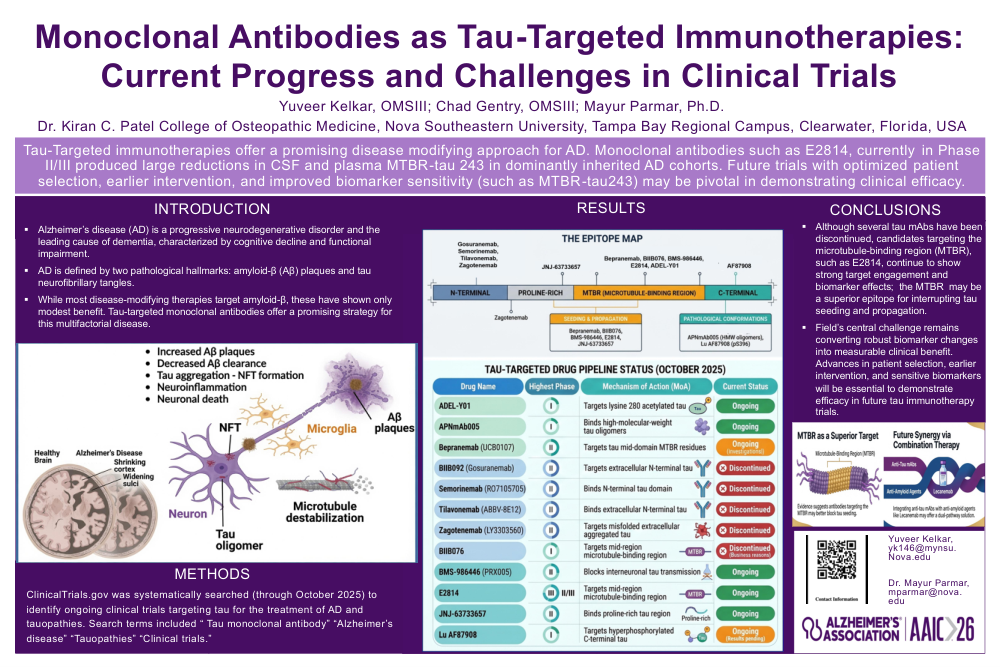
Background: Alzheimer’s disease (AD) is a progressive neurodegenerative disorder characterized by cognitive decline and impaired daily function. Pathologically, AD features amyloid-beta (Aβ) plaques and Tau neurofibrillary tangles. While past therapies have mostly targeted Aβ, recent research highlights Tau as a crucial therapeutic target due to its closer correlation with clinical progression. Monoclonal antibodies designed to bind pathological Tau have shown promise in preclinical and early trials.
Methods: ClinicalTrials.gov was systematically searched (through October 2025) to identify ongoing clinical trials targeting Tau for the treatment of AD and Tauopathies. Search terms included "Tau monoclonal antibody," "Alzheimer’s disease," and "Tauopathies."
Results: Numerous monoclonal antibodies targeting Tau have entered clinical studies. Most show favorable safety and target engagement (e.g., reductions in CSF Tau or PET Tau signals). However, as of October 2025, no candidate has demonstrated consistent, robust cognitive benefit in Phase II/III trials. Etalanetug (E2814), currently in Phase II/III, produces large reductions in CSF and plasma MTBR‑tau243 in dominantly inherited AD cohorts, with cognitive outcomes from the DIAN‑TU NexGen study expected around 2027–2028. Bepranemab (UCB0107) shows substantial slowing of tau PET accumulation and post‑hoc signals of slowed clinical progression in subgroups but has not yet met its primary endpoint and remains investigational. In contrast, BIIB076 (terminated after Phase I), gosuranemab (BIIB092), semorinemab, tilavonemab (ABBV-8E12), and zagotenemab (LY3303560) failed to reach primary cognitive endpoints in Phase II, despite strong biomarker effects. These results raise the possibility that antibodies targeting N‑terminal or central tau epitopes may be less effective than those directed toward the MTBR implicated in tau seeding, although this remains to be conclusively demonstrated. So far, converting biomarker activity into clinical improvement remains a persistent challenge.
Conclusion: Translating robust target engagement and biomarker changes into measurable clinical benefit remains an unmet challenge, underscored by multiple trial failures. Nevertheless, continued advances in Tau-directed monoclonal antibody development, specifically those targeting distinct Tau epitopes such as the MTBR and pathological conformations, represent a promising frontier in Alzheimer’s disease therapeutics. Future trials with optimized
Comments
Email is required but is not shown publicly.
Loading comments...