4,068 posters, 219 videos, 101 topics, 69 sessions, 14,365 authors, 6,128 institutions
ePostersLive by SciGen Technologies S.A. All rights reserved.
Alzheimer's Association International Conference 2026
July 12-15, 2026 | London, United Kingdom, and Online

4472
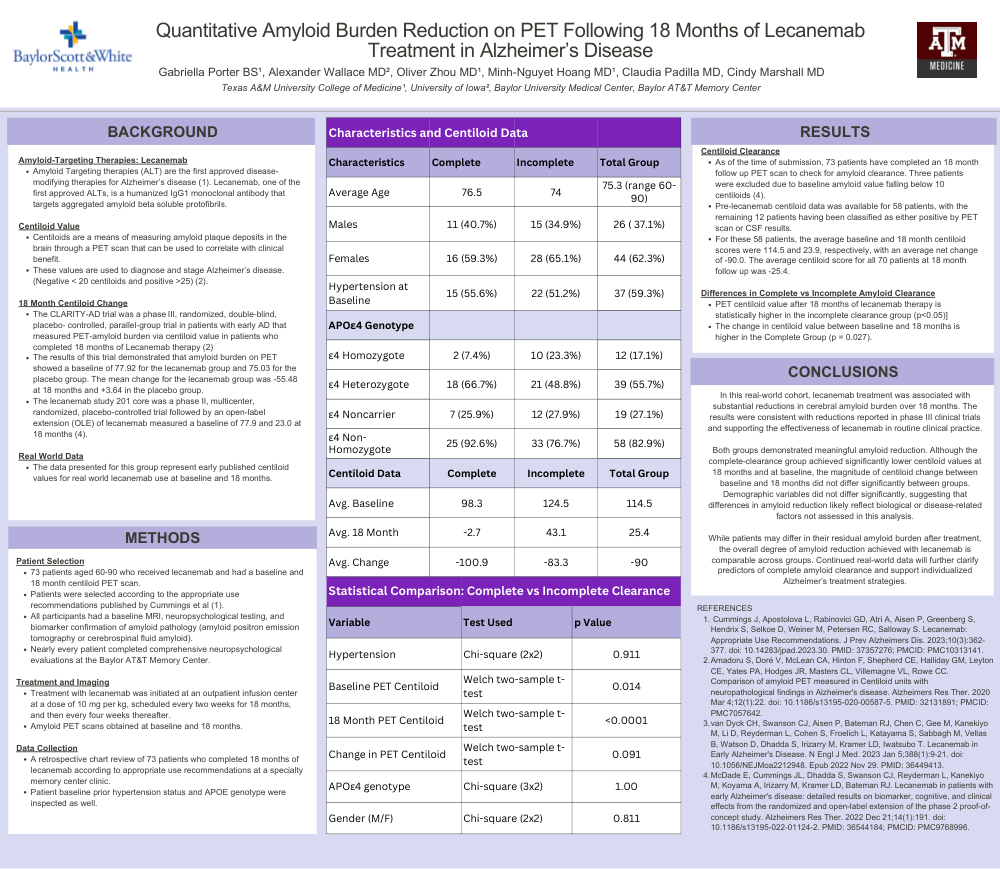
Quantitative Amyloid Burden Reduction On Pet Following 18 Months Of Lecanemab Treatment In Alzheimer’s Disease
Poster Presenter
Part of Topic
Background:
Amyloid-Targeting Therapies: Lecanemab
- Amyloid Targeting therapies (ALT) are the first approved disease-modifying therapies for Alzheimer’s disease (1). Lecanemab, one of the first approved ALTs, is a humanized IgG1 monoclonal antibody that targets aggregated amyloid beta soluble protofibrils.
Centiloid Value
- Centiloids are a means of measuring amyloid plaque deposits in the brain through a PET scan that can be used to correlate with clinical benefit.
- These values are used to diagnose and stage Alzheimer’s disease. (Negative < 20 centiloids and positive >25) (2).
18 Month Centiloid Change
- The CLARITY-AD trial was a phase III, randomized, double‑blind, placebo‑ controlled, parallel‑group trial in patients with early AD that measured PET-amyloid burden via centiloid value in patients who completed 18 months of Lecanemab therapy (2)
- The results of this trial demonstrated that amyloid burden on PET showed a baseline of 77.92 for the lecanemab group and 75.03 for the placebo group. The mean change for the lecanemab group was -55.48 at 18 months and +3.64 in the placebo group.
- The lecanemab study 201 core was a phase II, multicenter, randomized, placebo-controlled trial followed by an open-label extension (OLE) of lecanemab measured a baseline of 77.9 and 23.0 at 18 months (4).
Real World Data
- The data presented for this group represent early published centiloid values for real world lecanemab use at baseline and 18 months.
Patient Selection
- 73 patients aged 60-90 who received lecanemab and had a baseline and 18 month centiloid PET scan.
- Patients were selected according to the appropriate use recommendations published by Cummings et al (1).
- All participants had a baseline MRI, neuropsychological testing, and biomarker confirmation of amyloid pathology (amyloid positron emission tomography or cerebrospinal fluid amyloid).
- Nearly every patient completed comprehensive neuropsychological evaluations at the Baylor AT&T Memory Center.
Treatment and Imaging
- Treatment with lecanemab was initiated at an outpatient infusion center at a dose of 10 mg per kg, scheduled every two weeks for 18 months, and then every four weeks thereafter.
- Amyloid PET scans obtained at baseline and 18 months.
Data Collection
- A retrospective chart review of 73 patients who completed 18 months of lecanemab according to appropriate use recommendations at a specialty memory center clinic.
- Patient baseline prior hypertension status and APOE genotype were inspected as well.
Centiloid Clearance
- As of the time of submission, 73 patients have completed an 18 month follow up PET scan to check for amyloid clearance. Three patients were excluded due to baseline amyloid value falling below 10 centiloids (4).
- Pre-lecanemab centiloid data was available for 58 patients, with the remaining 12 patients having been classified as either positive by PET scan or CSF results.
- For these 58 patients, the average baseline and 18 month centiloid scores were 114.5 and 23.9, respectively, with an average net change of -90.0. The average centiloid score for all 70 patients at 18 month follow up was -25.4.
Differences in Complete vs Incomplete Amyloid Clearance
- PET centiloid value after 18 months of lecanemab therapy is statistically higher in the incomplete clearance group (p<0.05)]
- The change in centiloid value between baseline and 18 months is higher in the Complete Group (p = 0.027).
Conclusions:
In this real-world cohort, lecanemab treatment was associated with substantial reductions in cerebral amyloid burden over 18 months. The results were consistent with reductions reported in phase III clinical trials and supporting the effectiveness of lecanemab in routine clinical practice.
Both groups demonstrated meaningful amyloid reduction. Although the complete-clearance group achieved significantly lower centiloid values at 18 months and at baseline, the magnitude of centiloid change between baseline and 18 months did not differ significantly between groups. Demographic variables did not differ significantly, suggesting that differences in amyloid reduction likely reflect biological or disease-related factors not assessed in this analysis.
While patients may differ in their residual amyloid burden after treatment, the overall degree of amyloid reduction achieved with lecanemab is comparable across groups. Continued real-world data will further clarify predictors of complete amyloid clearance and support individualized Alzheimer’s treatment strategies.
REFERENCES
- Cummings J, Apostolova L, Rabinovici GD, Atri A, Aisen P, Greenberg S, Hendrix S, Selkoe D, Weiner M, Petersen RC, Salloway S. Lecanemab: Appropriate Use Recommendations. J Prev Alzheimers Dis. 2023;10(3):362-377. doi: 10.14283/jpad.2023.30. PMID: 37357276; PMCID: PMC10313141.
- Amadoru S, Doré V, McLean CA, Hinton F, Shepherd CE, Halliday GM, Leyton CE, Yates PA, Hodges JR, Masters CL, Villemagne VL, Rowe CC. Comparison of amyloid PET measured in Centiloid units with neuropathological findings in Alzheimer's disease. Alzheimers Res Ther. 2020 Mar 4;12(1):22. doi: 10.1186/s13195-020-00587-5. PMID: 32131891; PMCID: PMC7057642.
- van Dyck CH, Swanson CJ, Aisen P, Bateman RJ, Chen C, Gee M, Kanekiyo M, Li D, Reyderman L, Cohen S, Froelich L, Katayama S, Sabbagh M, Vellas B, Watson D, Dhadda S, Irizarry M, Kramer LD, Iwatsubo T. Lecanemab in Early Alzheimer's Disease. N Engl J Med. 2023 Jan 5;388(1):9-21. doi: 10.1056/NEJMoa2212948. Epub 2022 Nov 29. PMID: 36449413.
- McDade E, Cummings JL, Dhadda S, Swanson CJ, Reyderman L, Kanekiyo M, Koyama A, Irizarry M, Kramer LD, Bateman RJ. Lecanemab in patients with early Alzheimer's disease: detailed results on biomarker, cognitive, and clinical effects from the randomized and open-label extension of the phase 2 proof-of-concept study. Alzheimers Res Ther. 2022 Dec 21;14(1):191. doi: 10.1186/s13195-022-01124-2. PMID: 36544184; PMCID: PMC9768996.
Comments
Email is required but is not shown publicly.
Loading comments...