4,068 posters, 219 videos, 101 topics, 69 sessions, 14,365 authors, 6,128 institutions
ePostersLive by SciGen Technologies S.A. All rights reserved.
Alzheimer's Association International Conference 2026
July 12-15, 2026 | London, United Kingdom, and Online

2376
Loss Of A Loved One, Life Stress And Longitudinal Cognitive Decline In Adults With Down Syndrome
Poster Presenter
Authors
Alexandra Linker, Sigan Hartley, Shahid Zaman, Benjamin Handen, Luciana Mascarenhas Fonseca
Affiliations
Elson S. Floyd College of Medicine, Washington State University, Spokane, WA, United States, School of Human Ecology and Waisman Center, University of Wisconsin-Madison, Madison, WI, United States, Department of Psychiatry, School of Clinical Medicine, University of Cambridge, Cambridge, UK; Cambridgeshire & Peterborough NHS Foundation Trust, Cambridge, U, Department of Psychiatry, University of Pittsburgh, Pittsburgh, Pennsylvania, United States, The Krieger Klein Alzheimer’s Research Center, Brain Health Institute, Rutgers University, New Brunswick, NJ, United States
Part of Topic
Loss Of A Loved One, Life Stress And Longitudinal Cognitive Decline In Adults With Down Syndrome
Alexandra Linker1, Sigan Hartley2, Shahid Zaman3, Benjamin Handen4, Luciana Mascarenhas Fonseca5
1 Elson S. Floyd College of Medicine, Washington State University, Spokane, WA, United States, 2 School of Human Ecology and Waisman Center, University of Wisconsin-Madison, Madison, WI, United States, 3 Department of Psychiatry, School of Clinical Medicine, University of Cambridge, Cambridge, UK; Cambridgeshire & Peterborough NHS Foundation Trust, Cambridge, UK 4 Department of Psychiatry, University of Pittsburgh, Pittsburgh, Pennsylvania, United States. 5 The Krieger Klein Alzheimer’s Research Center, Brain Health Institute, Rutgers University, New Brunswick, NJ, United States
Introduction:
-
Individuals with DS are at high risk of developing Alzheimer’s Disease (AD)1
-
Exposure to stress has been suggested as a risk factor for cognitive decline in the general population 2,3
-
Death of a loved one suggested as a particularly potent stressor4
-
Role of life stressors in longitudinal cognitive decline minimally investigated in adults with DS.
Methods:
-
Alzheimer’s Biomarkers Consortium - Down Syndrome Data Set5
-
participants with no Dementia or Mild Cognitive Impairment at Baseline Visit (N = 93)
-
Data set includes
-
Baseline Informant “Life Stressor Index”: 11 stressors in the past year and their impact (serious illness, hospitalization, a loved one’s hospitalization, a loved one’s death, a move, a friend moving away, a new roommate, losing/quitting a job/retiring, a new job, money problems; none, handled well, bad impact, complex impact)
-
Baseline and follow-up cognitive tests 6,7,8
-
Separate regressions assessed whether:
-
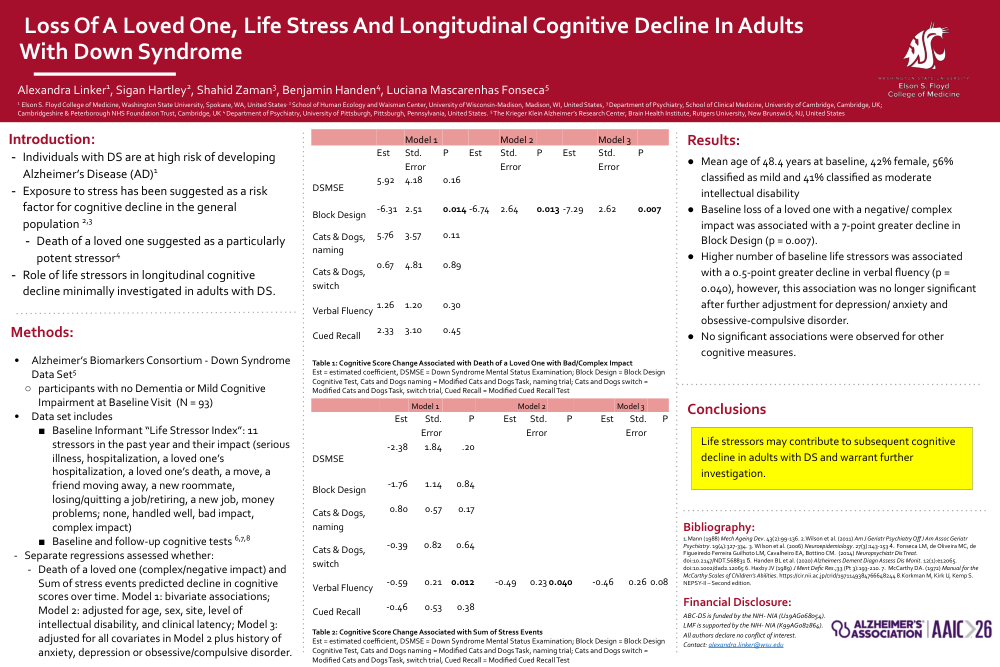
Death of a loved one (complex/negative impact) and Sum of stress events predicted decline in cognitive scores over time. Model 1: bivariate associations; Model 2: adjusted for age, sex, site, level of intellectual disability, and clinical latency; Model 3: adjusted for all covariates in Model 2 plus history of anxiety, depression or obsessive/compulsive disorder
Results:
-
Alzheimer’s Biomarkers Consortium - Down Syndrome Data Set5
-
participants with no Dementia or Mild Cognitive Impairment at Baseline Visit (N = 93)
-
Data set includes
-
Baseline Informant “Life Stressor Index”: 11 stressors in the past year and their impact (serious illness, hospitalization, a loved one’s hospitalization, a loved one’s death, a move, a friend moving away, a new roommate, losing/quitting a job/retiring, a new job, money problems; none, handled well, bad impact, complex impact)
-
Baseline and follow-up cognitive tests 6,7,8
-
Separate regressions assessed whether:
-
Death of a loved one (complex/negative impact) and Sum of stress events predicted decline in cognitive scores over time. Model 1: bivariate associations; Model 2: adjusted for age, sex, site, level of intellectual disability, and clinical latency; Model 3: adjusted for all covariates in Model 2 plus history of anxiety, depression or obsessive/compulsive disorder
Conclusions:
Life stressors may contribute to subsequent cognitive decline in adults with DS and warrant further investigation.
Bibiolgraphy and Funding
1.Mann (1988) Mech Ageing Dev. 43(2):99-136. 2.Wilson et al. (2011) Am J Geriatr Psychiatry Off J Am Assoc Geriatr Psychiatry. 19(4):327-334. 3. Wilson et al. (2006) Neuroepidemiology. 27(3):143-153 4. Fonseca LM, de Oliveira MC, de Figueiredo Ferreira Guilhoto LM, Cavalheiro EA, Bottino CM. (2014) Neuropsychiatr Dis Treat. doi:10.2147/NDT.S68831 5. Handen BL et al. (2020) Alzheimers Dement Diagn Assess Dis Monit. 12(1):e12065. doi:10.1002/dad2.12065 6. Haxby JV (1989) J Ment Defic Res.;33 (Pt 3):193-210. 7. McCarthy DA. (1972) Manual for the McCarthy Scales of Children’s Abilities. https://cir.nii.ac.jp/crid/1971149384766648244 8.Korkman M, Kirk U, Kemp S. NEPSY-II – Second edition.
ABC-DS is funded by the NIH- NIA (U19AG068054).
LMF is supported by the NIH- NIA (K99AG082864).
All authors declare no conflict of interest.
Contact: alexandra.linker@wsu.edu
Comments
Email is required but is not shown publicly.
Loading comments...