4,068 posters, 219 videos, 101 topics, 69 sessions, 14,365 authors, 6,128 institutions
ePostersLive by SciGen Technologies S.A. All rights reserved.
Alzheimer's Association International Conference 2026
July 12-15, 2026 | London, United Kingdom, and Online

674
The Protective Role Of Childhood Social Support In The Association Between Early Parental Death And Later-life Cognition
Poster Presenter
Authors
Mubarick Saeed, Charles F. Murchison, David S. Geldmacher, Olivio J. Clay, Michael Crowe, Virginia J. Howard, Erik D. Roberson, Victor A. Del Bene
Affiliations
Alzheimer’s Disease Center, The University of Alabama at Birmingham, Heersink School of Medicine, Birmingham, Alabama, United States, Department of Psychology, The University of Alabama at Birmingham, Birmingham, Alabama, United States, School of Public Health, The University of Alabama at Birmingham, Birmingham, Alabama, United States
Part of Topic
Video
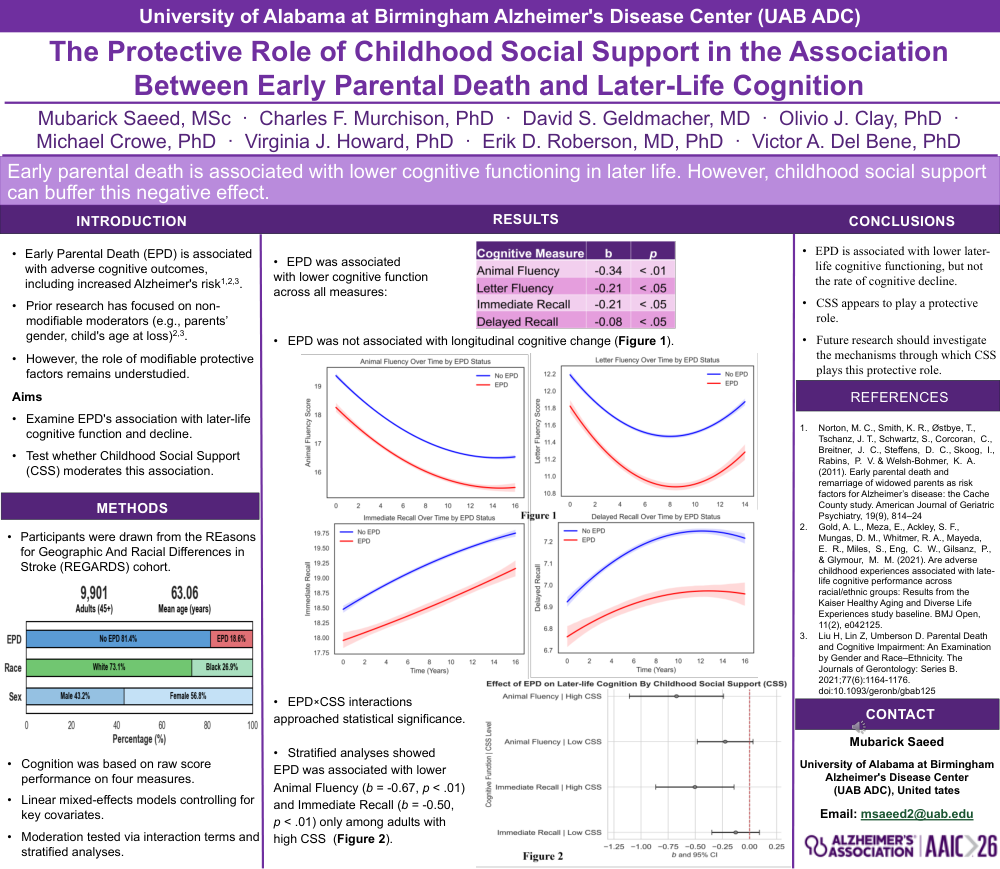
Background: Early parental death (EPD) is associated with adverse cognitive outcomes in later life. While prior research has examined demographic moderators like the gender of the deceased parent, the gender of the bereaved child, and the child's age at parental death, a gap remains regarding the potential moderating role of modifiable factors such as childhood social support (CSS).
Methods: This study included Black and White adults aged 45 and older from the REasons for Geographic and Racial Differences in Stroke (REGARDS) cohort study, who completed a Childhood and Family Life Questionnaire and underwent at least one cognitive assessment battery after enrollment. Participants with incident cognitive impairment or stroke before the assessment of the retrospective childhood variables were excluded. Linear mixed-effects models were used to examine the association between EPD and both average cognitive scores and longitudinal cognitive changes while controlling for age, education, race, sex, and childhood socioeconomic status. Moderating effects of CSS were tested using interaction and simple main effect analyses.
Results: Among 9,901 participants (mean age 63.06, men 43.20%, Blacks 26.90%) with follow-up through 09/2023, EPD was associated with lower performance on animal fluency (b= -0.34, p< .01), letter fluency (b= -0.21, p< .05), immediate recall (b= -0.21, p< .05), and delayed recall (b= -0.08, p< .05). EPD and CSS interactions were marginal. Simple main effect analyses revealed EPD was associated with lower Animal Fluency (b= -0.67, p< .01) and Immediate Recall (b= -0.50, p< .01) only among adults with high CSS. EPD was not associated with longitudinal cognitive change.
Conclusion: EPD is significantly associated with lower later-life cognitive functioning, but not the rate of cognitive decline. The findings provide some evidence of a protective role of CSS. Specifically, the findings suggest that the negative influence of EPD on later-life cognition may stem from the loss of a highly supportive parent, and that maintaining high levels of CSS following EPD can mitigate this negative impact. These findings provide a potential avenue for early intervention. Future research should investigate the underlying mechanisms through which EPD influences later-life cognitive health and how CSS provides a protective effect.
Comments
Email is required but is not shown publicly.
Loading comments...