4,068 posters, 219 videos, 101 topics, 69 sessions, 14,365 authors, 6,128 institutions
ePostersLive by SciGen Technologies S.A. All rights reserved.
Alzheimer's Association International Conference 2026
July 12-15, 2026 | London, United Kingdom, and Online

4708
Exploring Mealtime Difficulties And Family Caregiver Experiences In Dementia Through A Biopsychosocial Framework: A Pilot Study
Poster Presenter
Authors
Adithi G. Hegde, Usha Devadas, Vinita A. Acharya, Panambur Venkataraya Bhandary
Affiliations
PhD Scholar, Department of Speech and Hearing, Manipal College of Health Professions, Manipal Academy of Higher Education, Manipal, India, Professor and Head, Department of Speech and Hearing, Manipal College of Health Professions, Manipal Academy of Higher Education, Manipal, India, Additional Professor, Department of Occupational Therapy, Manipal College of Health Professions, Manipal Academy of Higher Education, Manipal, India, Consultant Psychiatrist and Medical Director, Department of Psychiatry, Dr. A V Baliga Memorial Hospital, Udupi, India
Part of Topic
Video
Abstract:
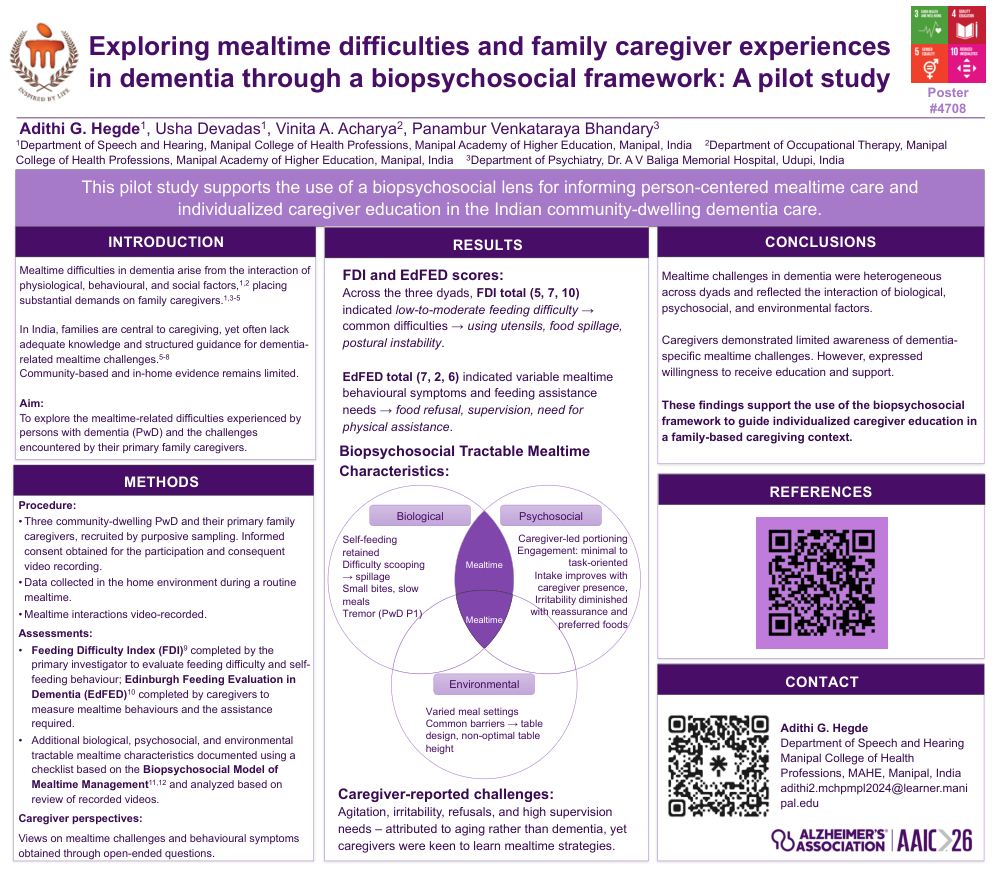
Background: Mealtime difficulties in dementia arise from the interaction of physiological, behavioral, and social factors and place substantial demands on family caregivers. In India, family caregivers play a central role in providing care, yet they may lack adequate knowledge and structured guidance on dementia-related mealtime challenges. Evidence from community-based and in-home contexts remains limited. Hence, this pilot study was conducted to explore the mealtime-related difficulties experienced by persons with dementia (PwD) and the challenges encountered by their primary family caregivers.
Methods: Three community-dwelling PwD and their family caregivers were recruited using purposive sampling. Data collection was conducted in the home environment during a routine mealtime. Mealtime interactions were video recorded with consent. The primary investigator assessed feeding difficulties using the Feeding Difficulty Index (FDI). Subsequently, caregivers completed the Edinburgh Feeding Evaluation in Dementia (EdFED) questionnaire. Additional biological, psychosocial, and environmental mealtime characteristics were documented using a Biopsychosocial framework-based checklist. Caregiver perspectives on mealtime challenges and behavioral symptoms were obtained through open-ended questions.
Results: Across the three dyads, FDI scores indicated low to moderate levels of feeding difficulties, with common observed challenges related to utensil use, spillage, posture, and tremors. EdFED scores reflected variability in behavioral and psychiatric symptoms as well as assistance needs. All PwD were observed to self-feed, whereas caregivers were entirely responsible for meal preparation and portioning. Mealtime context varied, with caregivers either remaining continuously present with limited interaction or providing intermittent assistance while attending to other tasks. Caregivers reported agitation, irritability, refusals, and increased supervision demands as the key challenges during mealtimes. During the interview, the caregivers expressed interest in learning strategies to improve mealtime experiences.
Conclusion: Mealtime challenges in dementia were heterogeneous across dyads and reflected the interaction of biological and psychosocial factors. Interaction with caregivers revealed a gap in their understanding of dementia-specific mealtime difficulties, alongside their readiness to receive education and support. These findings support the use of the Biopsychosocial framework to guide individualized caregiver education within a family-based caregiving context.
Comments
Email is required but is not shown publicly.
Loading comments...