4,068 posters, 219 videos, 101 topics, 69 sessions, 14,365 authors, 6,128 institutions
ePostersLive by SciGen Technologies S.A. All rights reserved.
Alzheimer's Association International Conference 2026
July 12-15, 2026 | London, United Kingdom, and Online

9075
Alterações Moleculares Heterogêneas Em NeurôNios TalâMicos Nos Estágios Da Doença De Alzheimer
Poster Presenter
Authors
Affiliations
Part of Topic
Video
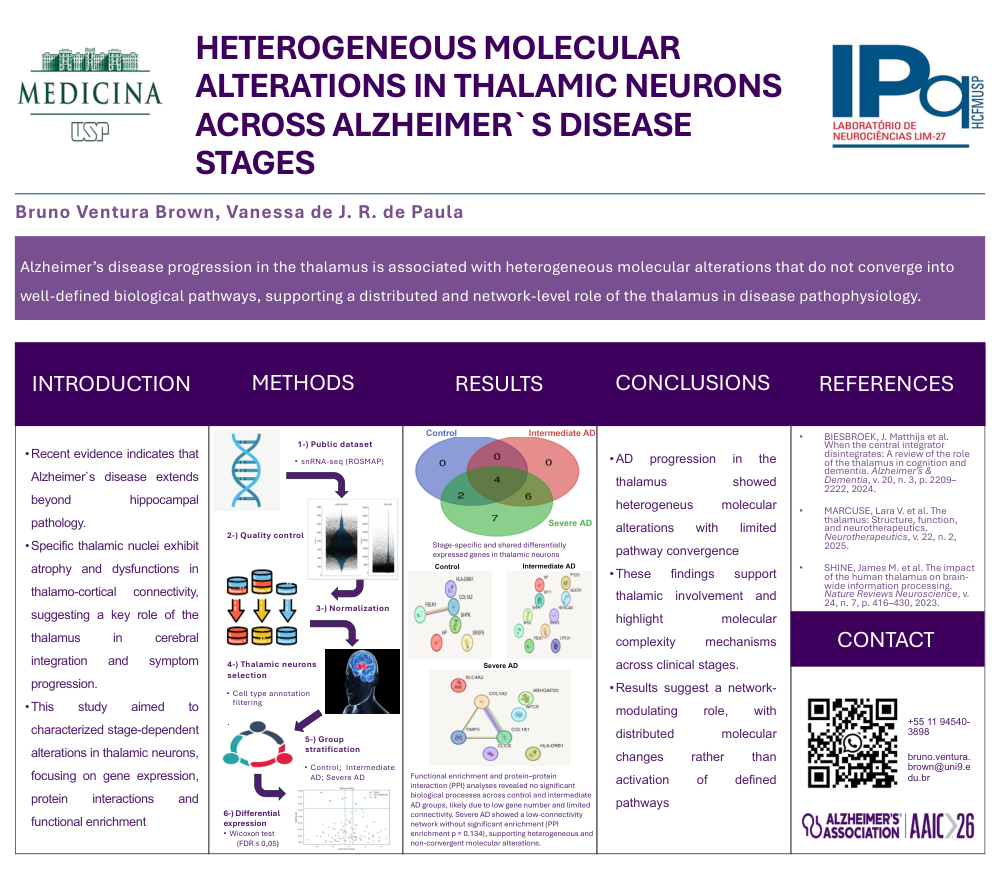
Alzheimer’s disease (AD) is a multifactorial neurodegenerative condition characterized by slow and progressive clinical evolution, involving multiple mechanisms of neurodegeneration across distinct brain regions. Beyond classical hippocampal pathology, increasing evidence indicates that AD is also associated with atrophy of specific thalamic nuclei and disruptions in thalamo-cortical connectivity, suggesting a relevant role of the thalamus in cerebral integration and symptom progression. This preliminary study aimed to characterize stage-dependent molecular alterations in thalamic neurons across Alzheimer’s disease progression, focusing on gene expression profiles, protein–protein interactions, and functional enrichment patterns.
Gene expression data underwent quality control procedures, including inspection of missing values and verification of gene identifier consistency. Analyses were restricted to thalamic neurons and stratified into control, intermediate Alzheimer’s disease, and severe Alzheimer’s disease groups. Differentially expressed genes were identified through comparisons with the control group. Genes exclusive to each disease stage were selected using Venn diagrams and subsequently analyzed for protein–protein interactions and functional enrichment using the STRING platform.
Functional enrichment and protein–protein interaction analyses of genes exclusive to each condition did not reveal significantly enriched biological processes in the control group (FDR ≤ 0.05), likely reflecting the limited number of genes and low functional connectivity. Similarly, genes exclusive to the intermediate Alzheimer’s disease group did not exhibit significant functional enrichment or detectable interaction networks, suggesting a disease stage characterized by dispersed molecular alterations without clear convergence into biological pathways. In the severe Alzheimer’s disease group, a sparse interaction network was observed, with no statistically significant functional enrichment (PPI enrichment p = 0.134), consistent with heterogeneous molecular changes associated with advanced-stage AD progression in the thalamus.
Overall, these preliminary findings indicate that Alzheimer’s disease progression within the thalamus is associated with heterogeneous and stage-dependent molecular alterations that show limited convergence into well-defined biological pathways. These results support the involvement of the thalamus in AD pathophysiology and provide a foundation for future integrative analyses aimed at identifying convergent molecular mechanisms underlying disease progression.
Comments
Email is required but is not shown publicly.
Loading comments...