4,068 posters, 219 videos, 101 topics, 69 sessions, 14,365 authors, 6,128 institutions
ePostersLive by SciGen Technologies S.A. All rights reserved.
Alzheimer's Association International Conference 2026
July 12-15, 2026 | London, United Kingdom, and Online

4891
Sensors And Robotics In Elderly Care: Professional Perspectives From Small-Town, Suburban And Rural Areas In The Netherlands
Poster Presenter
Authors
Maren Salzwedel, Corinna Glasner, Helianthe Kort, Sarah Janus
Affiliations
University Medical Center Groningen, Department of Primary and Long-term Care, the Netherlands, University Medical Center Groningen, Faculty of Medical Sciences, the Netherlands, Eindhoven University of Technology, Department of the Built Environment, Chair Building Lighting, the Netherlands
Part of Topic
Sensors and Robotics In Elderly Care: Perspectives From Small‑Town, Suburban And Rural Areas
Maren H. Salzwedel1, Corinna Glasner3, Helianthe Kort2, Sarah Janus1
1 University Medical Center Groningen, Department of Primary and Long-term Care, the Netherlands; 2 Eindhoven University of Technology, Department of the Built Environment, Chair Building Lighting, Eindhoven, the Netherlands; 3 University Medical Center Groningen, Faculty of Medical Sciences, the Netherlands
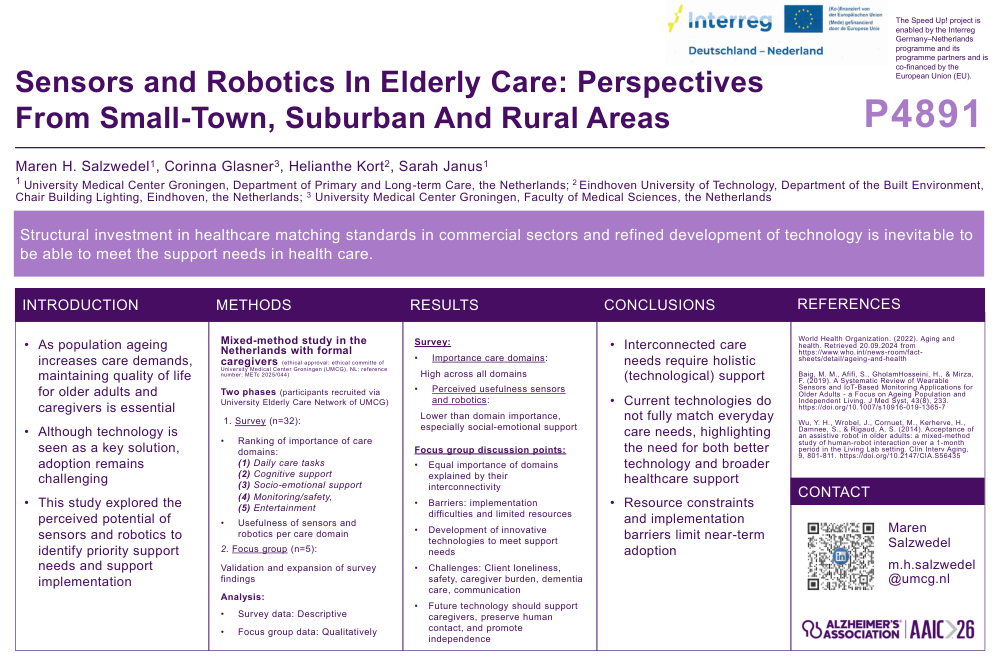
Structural investment in healthcare matching standards in commercial sectors and refined development of technology is inevitable to be able to meet the support needs in health care.
Introduction:
Mixed-method study in the Netherlands with formal caregivers (ethical approval: ethical committe of University Medical Center Groningen (UMCG), NL; reference number: METc 2025/044)
Two phases (participants recruited via University Elderly Care Network of UMCG)
1. Survey (n=32):
2. Focus group (n=5):
Validation and expansion of survey findings
Analysis:
Survey:
High across all domains
Lower than domain importance,
especially social-emotional support
Focus group discussion points:
Comments
Email is required but is not shown publicly.
Loading comments...