4,068 posters, 219 videos, 101 topics, 69 sessions, 14,365 authors, 6,128 institutions
ePostersLive by SciGen Technologies S.A. All rights reserved.
Alzheimer's Association International Conference 2026
July 12-15, 2026 | London, United Kingdom, and Online

370
Plasma Phosphorylated Tau 217 And Amyloid-β 42/40 Are Associated With Minimal Depressive Symptoms In Alzheimer's Disease
Poster Presenter
Authors
Affiliations
Part of Topic
Title: Plasma Phosphorylated Tau 217 and Amyloid-β 42/40 Are Associated With Minimal Depressive Symptoms in Alzheimer's Disease
Background: Depression is a recognized risk factor and potential prodromal feature of Alzheimer's disease (AD). Although associations between depressive symptoms and AD pathology have been reported using cerebrospinal fluid (CSF) biomarkers and PET imaging, it remains unclear whether these relationships can be captured by accessible blood-based biomarkers, particularly plasma phosphorylated tau-217 (p-Tau217).
Methods: We analyzed 615 participants from the Alzheimer's Disease Neuroimaging Initiative (ADNI) cohort, including 374 individuals with minimal depressive symptoms (MDS). Plasma biomarkers included phosphorylated tau-217 (p-Tau217), amyloid-β 42/40 ratio (Aβ42/Aβ40), neurofilament light chain (NfL), and glial fibrillary acidic protein (GFAP). Linear regression models and mediation analyses were used to examine the associations among MDS, plasma biomarkers, and cognitive impairment, with adjustment for age, sex, and APOE ε4 carrier status.
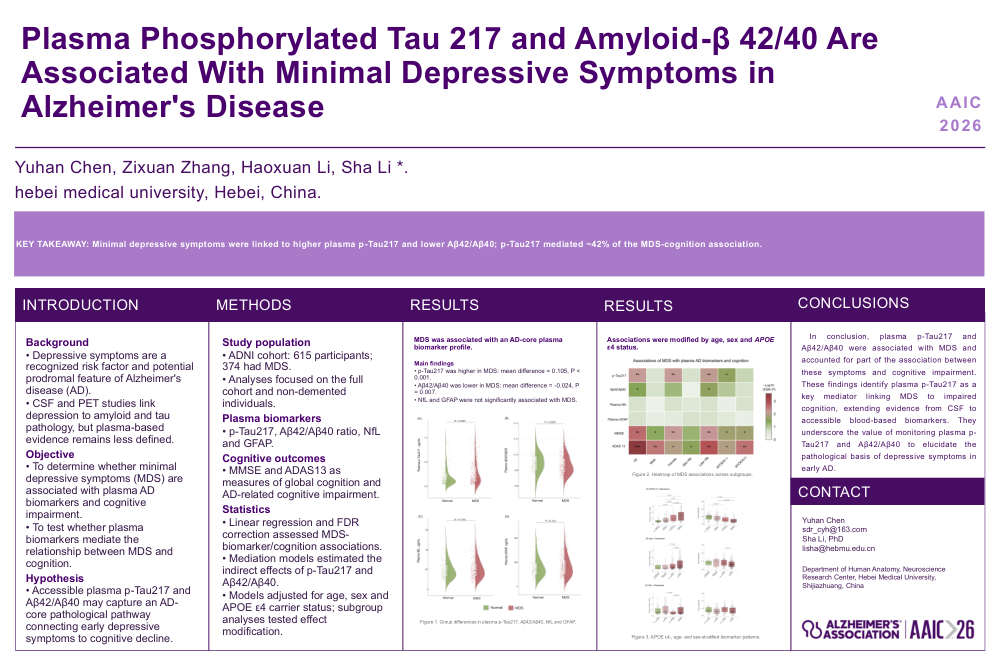
Results: Participants with MDS showed significantly higher plasma p-Tau217 levels than those without MDS (mean difference = 0.105, 95% CI: 0.046 to 0.163; P < 0.001) and significantly lower plasma Aβ42/Aβ40 ratio (mean difference = −0.024, 95% CI: −0.041 to −0.006; P = 0.007). These associations were mainly observed in non-demented individuals and were influenced by age, sex, and APOE ε4 status. In mediation analyses, plasma p-Tau217 accounted for 41.57%–42.18% of the association between MDS and cognitive impairment, whereas plasma Aβ42/Aβ40 mediated 7.13%–8.45% of this relationship.
Conclusions: Plasma p-Tau217 and Aβ42/Aβ40 are associated with minimal depressive symptoms and partially mediate their relationship with cognitive impairment. These findings identify plasma p-Tau217 as a key biomarker linking early depressive symptoms to cognitive impairment and extend previous evidence from CSF and PET studies to accessible blood-based biomarkers. Monitoring plasma p-Tau217 and Aβ42/Aβ40 may help clarify the pathological basis of depressive symptoms in the early stages of AD.
Comments
Email is required but is not shown publicly.
Loading comments...