4,068 posters, 219 videos, 101 topics, 69 sessions, 14,365 authors, 6,128 institutions
ePostersLive by SciGen Technologies S.A. All rights reserved.
Alzheimer's Association International Conference 2026
July 12-15, 2026 | London, United Kingdom, and Online

10324
Weekend Catch-up Sleep And Dementia Risk: Evidence From Multi-year Fitbit Tracking In The All Of Us Cohort
Poster Presenter
Authors
Part of Topic
Weekend Catch-Up Sleep and Dementia Risk: Evidence from Multi-Year Fitbit Tracking in the All of Us Cohort
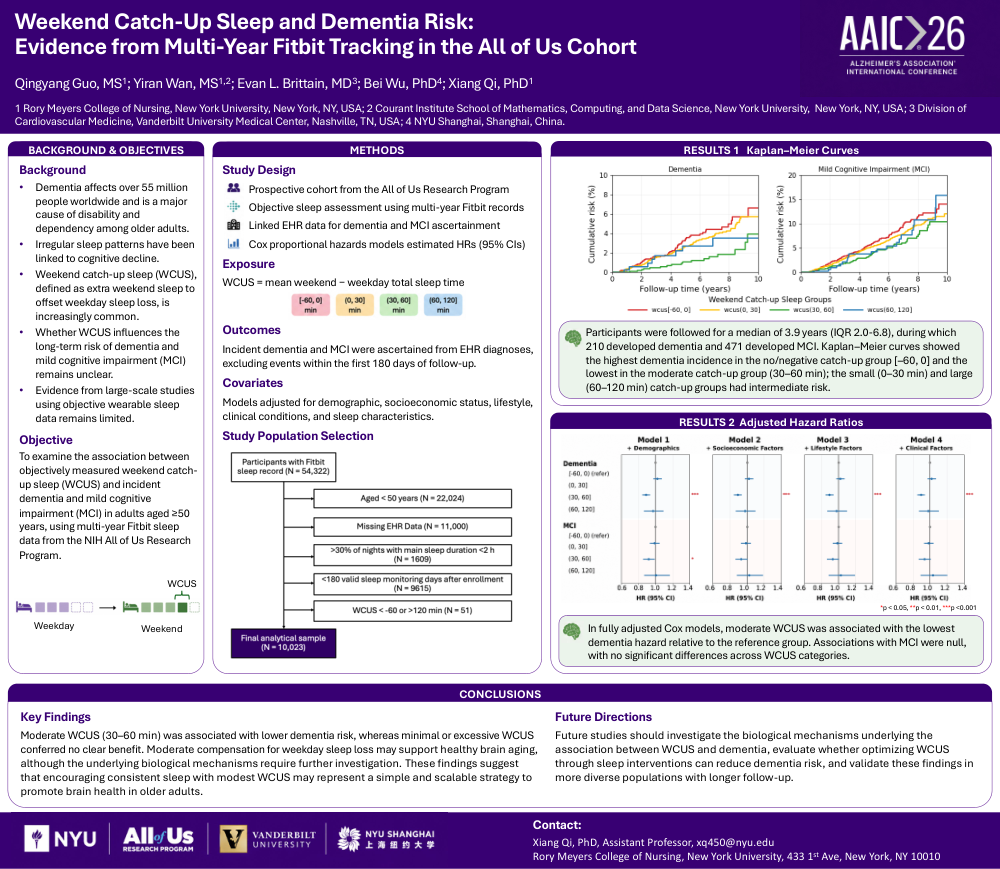
Background: Irregular sleep patterns have been linked to cognitive decline, but it is unknown whether “weekend catch-up sleep” (WCUS, extra weekend sleep to offset weekday shortfall) affects long-term dementia risk. We used multi-year objective sleep tracking (Fitbit) in a large, diverse cohort (NIH’s All of Us) to examine the association between WCUS and incident dementia and mild cognitive impairment (MCI) in older adults.
Methods: We analyzed 10,023 All of Us participants (aged ≥50 years) with at least 6 months of Fitbit sleep data and linked electronic health records. WCUS was defined as the difference between mean weekend and weekday total sleep time, categorized into four groups: [–60, 0] min (weekend deficit), (0, 30] min, (30, 60] min, and (60, 120] min. Incident dementia and MCI were ascertained from EHR diagnoses (ICD-9/10 codes mapped to phenotypic groups), excluding any diagnosed within the first 180 days of follow-up. Cox proportional hazards models estimated HRs and 95% CIs, adjusting for demographics, socioeconomic status, lifestyle, clinical conditions, and sleep characteristics.
Results: Participants were followed for a median of 3.9 years, during which 210 developed dementia and 471 developed MCI. Baseline characteristics varied by WCUS (Table 1): those with greater catch-up sleep (≥30 min) were younger and more often female than those with little or no catch-up. Kaplan–Meier curves (Figure 1) showed the highest dementia incidence in the no/negative catch-up group [–60, 0] and the lowest in the moderate catch-up group (30–60 min); the small (0–30 min) and large (60–120 min) catch-up groups had intermediate risk. In fully adjusted Cox models (Figure 2), moderate WCUS was associated with the lowest dementia hazard relative to the reference group. Associations with MCI were null, with no significant differences across WCUS categories.
Conclusions: Moderate WCUS was associated with lower dementia risk, whereas minimal or excessive WCUS conferred no clear benefit. Compensating for weekday sleep loss may reduce neurodegenerative processes (e.g., amyloid accumulation), providing a potential mechanism. From a public health perspective, encouraging consistent sleep with modest WCUS could be a simple strategy to support brain and cognitive health in older adults.
Comments
Email is required but is not shown publicly.
Loading comments...