4,068 posters, 219 videos, 101 topics, 69 sessions, 14,365 authors, 6,128 institutions
ePostersLive by SciGen Technologies S.A. All rights reserved.
Alzheimer's Association International Conference 2026
July 12-15, 2026 | London, United Kingdom, and Online

3633
Frequency Of The Apoe ε4 Allele In Alzheimer’s Disease In Brazil: A Meta-analysis Of Brazilian Studies
Poster Presenter
Authors
Part of Topic
TITLE: Frequency of the APOE ε4 Allele in Alzheimer's Disease in Brazil: A Meta-Analysis of Brazilian Studies
AUTHORS: Laura C. A. Duarte, Paola L. Schütz, Carolina M. Dagostini, Raphael M. Castilhos
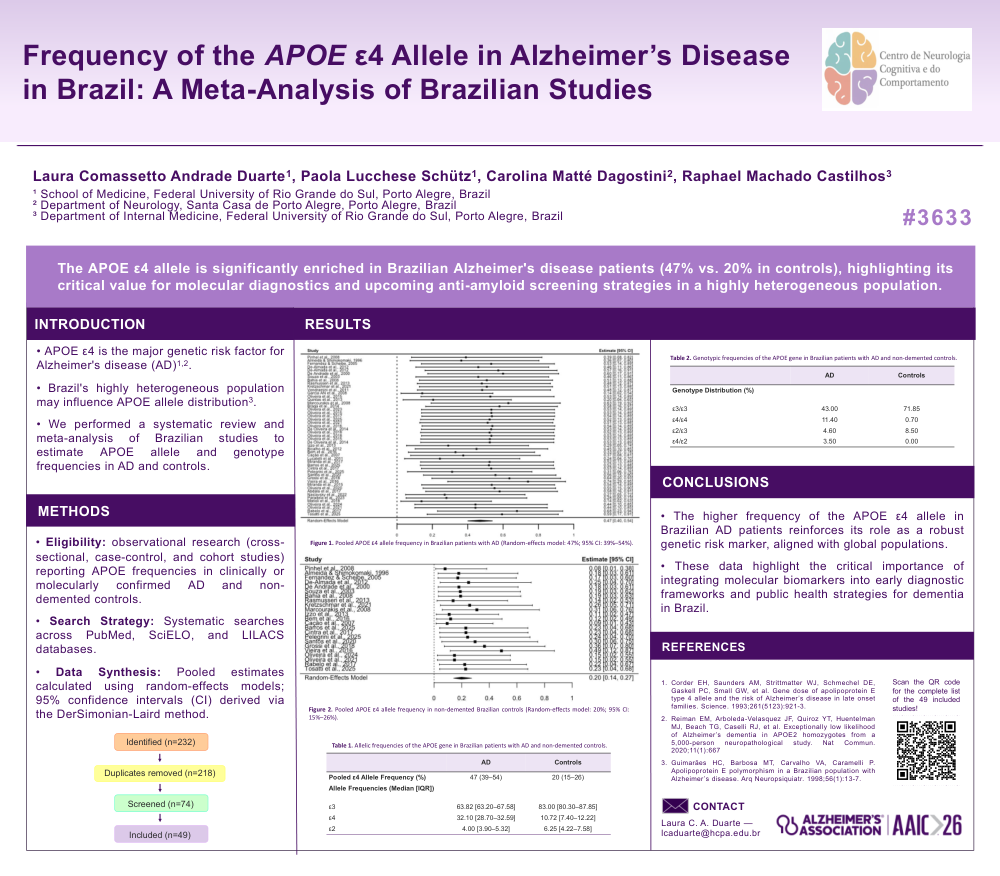
KEY TAKE-AWAY: The APOE ε4 allele is significantly enriched in Brazilian Alzheimer's disease patients (47% vs. 20% in controls), highlighting its critical value for molecular diagnostics and upcoming anti-amyloid screening strategies in a highly heterogeneous population.
INTRODUCTION:
• APOE ε4 is the major genetic risk factor for Alzheimer's disease (AD)1,2.
• Brazil's highly heterogeneous population may influence APOE allele distribution3.
• We performed a systematic review and meta-analysis of Brazilian studies to estimate APOE allele and genotype frequencies in AD and controls.
METHODS:
• Eligibility: observational research (cross-sectional, case-control, and cohort studies) reporting APOE frequencies in clinically or molecularly confirmed AD and non-demented controls.
• Search Strategy: Systematic searches across PubMed, SciELO, and LILACS databases.
• Data Synthesis: Pooled estimates calculated using random-effects models; 95% confidence intervals (CI) derived via the DerSimonian-Laird method.
Note: Study selection flowchart (PRISMA diagram) is available in the full visual poster.
RESULTS:
• Pooled ε4 frequency: 47% in AD vs. 20% in controls (β=1.27±0.25; p<0.0001).
Note: Forest plots for patients and controls are displayed in the full visual poster.
CONCLUSIONS: [
• The higher frequency of the APOE ε4 allele in Brazilian AD patients reinforces its role as a robust genetic risk marker, aligned with global populations.
• These data highlight the critical importance of integrating molecular biomarkers into early diagnostic frameworks and public health strategies for dementia in Brazil.
REFERENCES:
Note: Scan the QR code in the visual poster for the full list of the 49 included studies.
CONTACT: Laura C. A. Duarte — lcaduarte@hcpa.edu.br
Comments
Email is required but is not shown publicly.
Loading comments...