4,068 posters, 219 videos, 101 topics, 69 sessions, 14,365 authors, 6,128 institutions
ePostersLive by SciGen Technologies S.A. All rights reserved.
Alzheimer's Association International Conference 2026
July 12-15, 2026 | London, United Kingdom, and Online

9416
Life-course Socioeconomic Predictors Of Subjective Social Status In Older Adults
Poster Presenter
Part of Topic
Background
Late life subjective social status (SSS) is a robust predictor of physical and psychological outcomes and has been linked to cognitive functioning in later life.
Prior research has reported that SSS can correlate with socioeconomic status (SES). This study examined how early and late life SES indicators predict SSS.
Methods
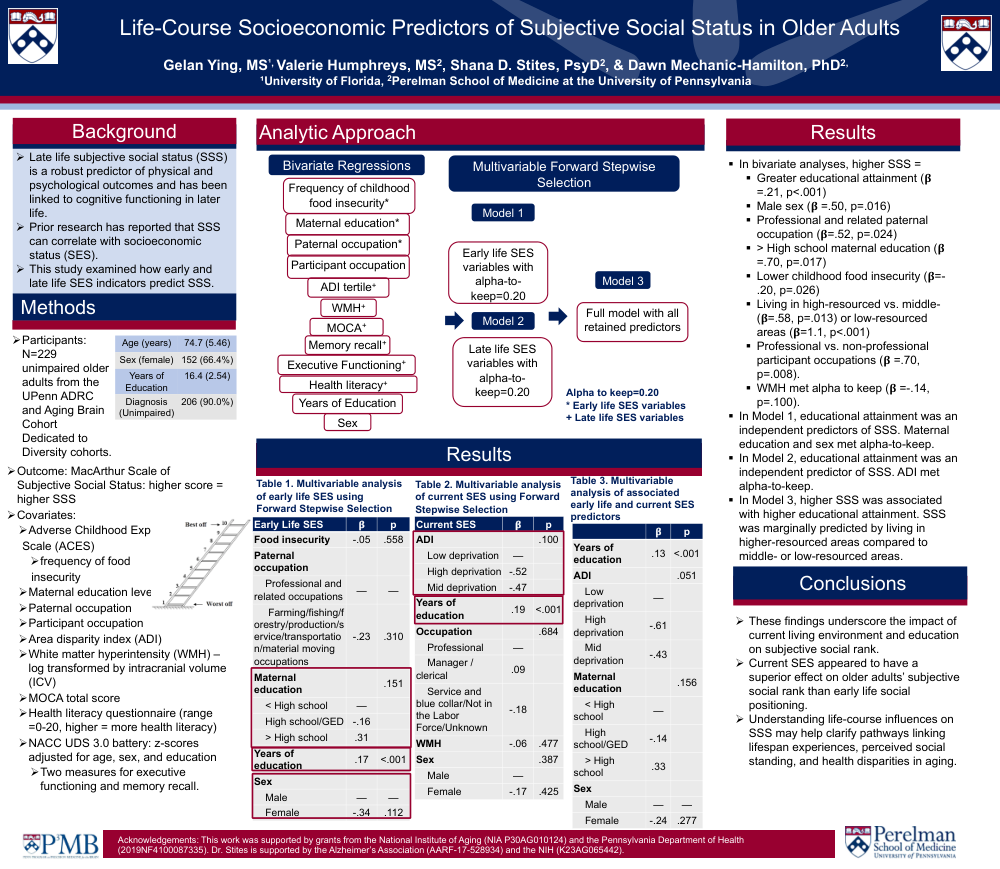
Participants: N=229 unimpaired older adults from the UPenn ADRC and Aging Brain Cohort Dedicated to Diversity cohorts.
Outcome: MacArthur Scale of Subjective Social Status: higher score = higher SSS
Covariates:
Adverse Childhood Experience Scale (ACES)
- frequency of food insecurity
Maternal education level
Paternal occupation
Participant occupation
Area disparity index (ADI)
White matter hyperintensity (WMH) –log transformed by intracranial volume (ICV)
MOCA total score
Health literacy questionnaire (range=0-20, higher = more health literacy)
NACC UDS 3.0 battery: z-scores adjusted for age, sex, and education
- Two measures for executive functioning and memory recall.
Results
In bivariate analyses, higher SSS =
- Greater educational attainment (β =.21, p<.001)
- Male sex (β =.50, p=.016)
- Professional and related paternal occupation (β=.52, p=.024)
- > High school maternal education (β=.70, p=.017)
- Lower childhood food insecurity (β=-.20, p=.026)
- Living in high-resourced vs. middle (β=.58, p=.013) or low-resourced areas (β=1.1, p<.001)
- Professional vs. non-professional participant occupations (β =.70, p=.008).
- WMH met alpha to keep (β =-.14, p=.100).
In Model 1, educational attainment was an independent predictors of SSS. Maternal education and sex met alpha-to-keep.
In Model 2, educational attainment was anindependent predictor of SSS. ADI met alpha-to-keep.
In Model 3, higher SSS was associated with higher educational attainment. SSS was marginally predicted by living in higher-resourced areas compared to middle- or low-resourced areas.
Conclusions
These findings underscore the impact of current living environment and education on subjective social rank. Current SES appeared to have a superior effect on older adults’ subjective social rank than early life social positioning.
Understanding life-course influences on SSS may help clarify pathways linking lifespan experiences, perceived social standing, and health disparities in aging.
Comments
Email is required but is not shown publicly.
Loading comments...