4,068 posters, 219 videos, 101 topics, 69 sessions, 14,365 authors, 6,128 institutions
ePostersLive by SciGen Technologies S.A. All rights reserved.
Alzheimer's Association International Conference 2026
July 12-15, 2026 | London, United Kingdom, and Online

6719
Interactions Between Vascular Factors, Stress, And Demographics On Cognition In Pacific Islander And White Older Adults
Poster Presenter
Authors
Maddy Mills, Justina Tavana, Gail Rattinger, Tahina Heimuli, Scott DeBerard, John Kauwe, JoAnn Tschanz, Perry Ridge
Affiliations
Brigham Young University, Department of Psychology, Utah State University, Binghamton University School of Pharmacy and Pharmaceutical Sciences, Brigham Young University-Hawaii
Part of Topic
Interactions Between Vascular Factors, Stress, and Demographics on Cognition in Pacific Islander and White Older Adults
Maddy Mills BS1*, Justina P. Tavana, Ph.D.2*, Gail B. Rattinger, PharmD, Ph.D.3, Tahina Heimuli, BS3, M. Scott DeBerard1, Ph.D., John S.K. Kauwe, Ph.D. 4, JoAnn T. Tschanz, Ph.D.1, Perry G. Ridge, Ph.D.2
1 Department of Psychology, Utah State University; 2Brigham Young University; 3Binghamton University School of Pharmacy and Pharmaceutical Sciences; 4Brigham Young University-Hawaii
*Co-first authors
Background: Cognitive impairment in late-life represents a major public health concern. Modifiable risk factors include vascular risk factors, psychosocial stress, and education, but limited research has examined their potential interactions, particularly among Pacific Islanders (PI), a population that has been historically underrepresented in health research. This study examined associations and interactions between these risk factors and cognition in a mixed sample of PI and predominantly white older adults.
Methods: Data were pooled from two community-based studies with a total sample of 93 participants [45 PI and 48 non-PI; 65.5% female, with mean (SD) age = 69.00 years (10.35)]. Endorsement of hypertension, hyperlipidemia, and diabetes was summed into a vascular risk index (VRI, 0 - 3). Psychosocial stress was assessed with the Perceived Stress Scale-10 (PSS-10) and cognition with the Montreal Cognitive Assessment (MoCA). Multiple linear regression examined the associations between VRI, PSS-10, demographic factors, and their interactions, with the MoCA. Age and sex were examined as covariates in all models.
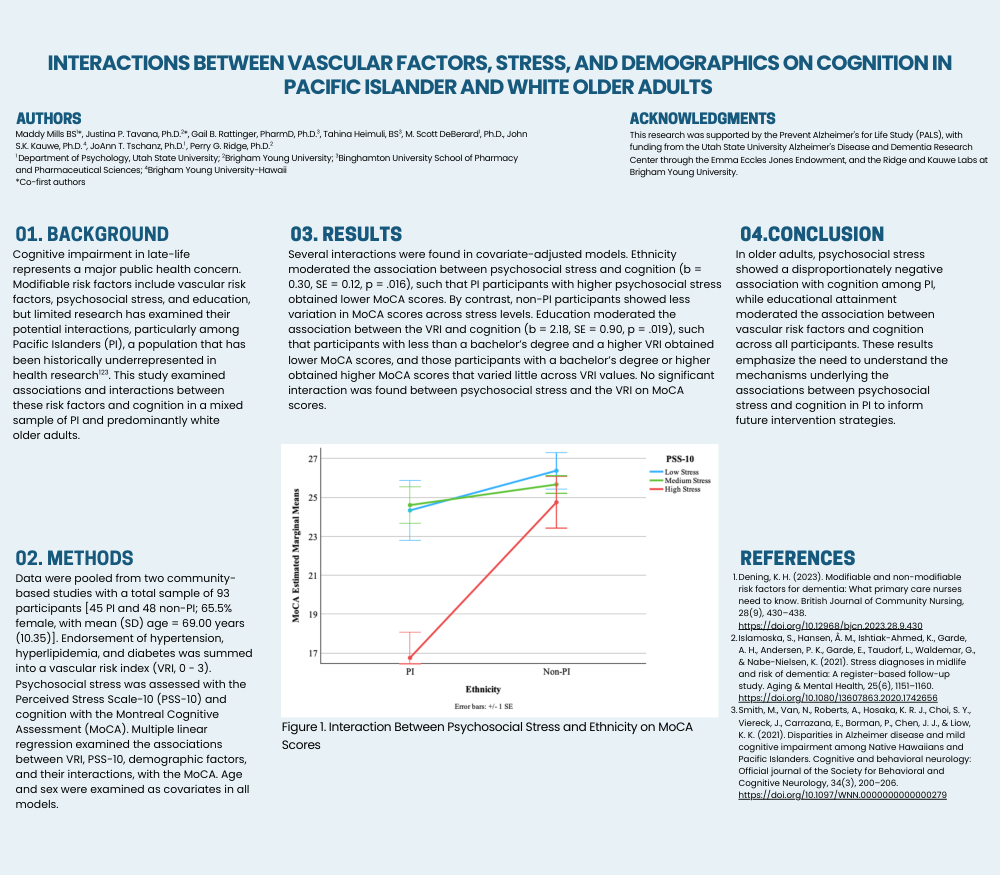
Results: Several interactions were found in covariate-adjusted models. Ethnicity moderated the association between psychosocial stress and cognition (b = 0.30, SE = 0.12, p = .016), such that PI participants with higher psychosocial stress obtained lower MoCA scores. By contrast, non-PI participants showed less variation in MoCA scores across stress levels. Education moderated the association between the VRI and cognition (b = 2.18, SE = 0.90, p = .019), such that participants with less than a bachelor’s degree and a higher VRI obtained lower MoCA scores, and those participants with a bachelor’s degree or higher obtained higher MoCA scores that varied little across VRI values. No significant interaction was found between psychosocial stress and the VRI on MoCA scores.
Conclusion: In older adults, psychosocial stress showed a disproportionately negative association with cognition among PI, while educational attainment moderated the association between vascular risk factors and cognition across all participants. These results emphasize the need to understand the mechanisms underlying the associations between psychosocial stress and cognition in PI to inform future intervention strategies.
Comments
Email is required but is not shown publicly.
Loading comments...