4,068 posters, 219 videos, 101 topics, 69 sessions, 14,365 authors, 6,128 institutions
ePostersLive by SciGen Technologies S.A. All rights reserved.
Alzheimer's Association International Conference 2026
July 12-15, 2026 | London, United Kingdom, and Online

6218
Determinants Of Completion And Dropout In A Community-based Smartphone Cognitive Intervention For Older Adults
Poster Presenter
Authors
Byung Hun Yun, Bo Hee Kim, Whani Kim, Hyun Jeong Ko, Ko Eun Shim, So Yoon Park, Jin Sung Kim, Yu Young Kim, Sang Kwon Lim, Bo Ri Kim, Jee Hang Lee, Geon Ha Kim, Jinwoo Kim
Affiliations
HAII Corp., Seoul, Republic of Korea; Yonsei University, Seoul, Republic of Korea, LG Electrics, Seoul, Republic of Korea, HAII Corp., Seoul, Republic of Korea, Sangmyung University, Seoul, Republic of Korea, Ewha Womans University, Seoul, Republic of Korea, Sangmyung University, Seoul, Republic of Korea; Institute for Advanced Intelligence Study, Daejeon, Republic of Korea, Ewha Womans University, Seoul, Republic of Korea; Ewha Womans University Mokdong Hospital, Ewha Womans University College of Medicine, Seoul, Republic of Korea
Part of Topic
Video
Title : Determinants of Completion and Dropout in a Community-Based Smartphone Cognitive Intervention for Older Adults
Background :
- Smartphone-based cognitive interventions can support cognitive health in older adults [1], but adherence is inconsistent, often depending on digital familiarity and available assistance [2].
- Education and household composition might shape engagement, yet evidence from large community-based samples remains limited [3,4].
- This study compared completers and droppouts across two community-based mobile cognitive intervention studies (2022, 2024).
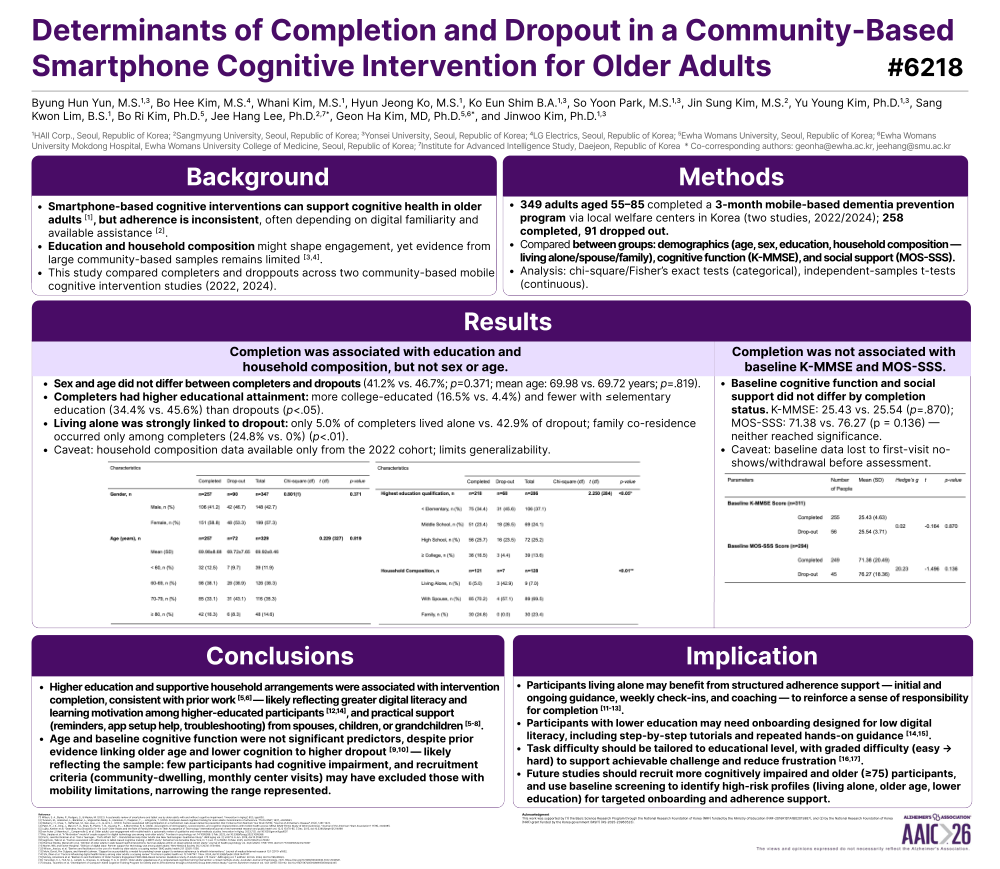
- 349 adults aged 55–85 completed a 3-month mobile-based dementia prevention program via local welfare centers in Korea (two studies, 2022/2024); 258 completed,91 dropped out.
- Compared between groups: demographics (age, sex, education, household composition — living alone/spouse/family), cognitive function (K-MMSE), and social support (MOS-SSS).
- Analysis: chi-square/Fisher’s exact tests (categorical), independent-samples t-tests (continuous).
- Sex and age did not differ between completers and dropouts (41.2% vs. 46.7%; p=0.371; mean age: 69.98 vs. 69.72 years; p=.819).
- Completers had higher educational attainment: more college-educated (16.5% vs. 4.4%) and fewer with ≤elementary education (34.4% vs. 45.6%) than dropouts (p<.05).
- Living alone was strongly linked to dropout: only 5.0% of completers lived alone vs. 42.9% of dropout; family co-residence occurred only among completers (24.8% vs. 0%) (p<.01).
- Caveat: household composition data available only from the 2022 cohort; limits generalizability.
- Baseline cognitive function and social support did not differ by completion status. K-MMSE: 25.43 vs. 25.54 (p=.870); MOS-SSS: 71.38 vs. 76.27 (p = 0.136) — neither reached significance.
- Caveat: baseline data lost to first-visit no-shows/withdrawal before assessment.
- Higher education and supportive household arrangements were associated with intervention completion, consistent with prior work [5,6] — likely reflecting greater digital literacy and learning motivation among higher-educated participants [12,14], and practical support (reminders, app setup help, troubleshooting) from spouses, children, or grandchildren [5-8].
- Age and baseline cognitive function were not significant predictors, despite prior evidence linking older age and lower cognition to higher dropout [9,10] — likely reflecting the sample: few participants had cognitive impairment, and recruitment criteria (community-dwelling, monthly center visits) may have excluded those with mobility limitations, narrowing the range represented.
- Participants living alone may benefit from structured adherence support — initial and ongoing guidance, weekly check-ins, and coaching — to reinforce a sense of responsibility for completion [11-13].
- Participants with lower education may need onboarding designed for low digital literacy, including step-by-step tutorials and repeated hands-on guidance [14,15].
- Task difficulty should be tailored to educational level, with graded difficulty (easy → hard) to support achievable challenge and reduce frustration [16,17].
- Future studies should recruit more cognitively impaired and older (≥75) participants, and use baseline screening to identify high-risk profiles (living alone, older age, lower education) for targeted onboarding and adherence support.
Comments
Email is required but is not shown publicly.
Loading comments...