4,068 posters, 219 videos, 101 topics, 69 sessions, 14,365 authors, 6,128 institutions
ePostersLive by SciGen Technologies S.A. All rights reserved.
Alzheimer's Association International Conference 2026
July 12-15, 2026 | London, United Kingdom, and Online

2631
Differences In 24-hour Movement Behaviors Between Community-dwelling And Nursing Home-dwelling People Living With Dementia
Poster Presenter
Authors
Selina Kasprzak, Charlotte Schmidt, Mandy Heuwekemeijer, Romée Nibbering, Sietske Sikkes, Erik Scherder
Affiliations
Kennemerhart, Haarlem, The Netherlands, Kennemerhart, Haarlem, The Netherlands; Vrije Universiteit, Faculty of Behavioral and Movement Sciences, Department of Clinical, Neuro- & Developmental Psychology, Vrije Universiteit, Faculty of Behavioral and Movement Sciences, Department of Clinical, Neuro- & Developmental Psychology; Alzheimer Center Amsterdam, Neurology, Vrije Universiteit Amsterdam, Amsterdam UMC location VUmc, Amsterdam, The Netherlands; Amsterdam Neuroscience, Neurodegeneration, Amsterdam, The Netherlands, Vrije Universiteit, Faculty of Behavioral and Movement Sciences, Department of Clinical, Neuro- & Developmental Psychology
Part of Topic
Differences in 24-Hour Movement Behaviors between Community-Dwelling and Nursing Home-Dwelling People Living with Dementia
Selina Kasprzak MSc,1,2 Charlotte B. Schmidt PhD,1 Mandy Heuwekemeijer MSc,1 Romée Nibbering MSc,1 Sietske A.M. Sikkes
PhD,2,3,4 Erik J.A. Scherder PhD2
#2631
1Kennemerhart , Haarlem, The Netherlands; 2Vrije Universiteit, Faculty of Behavioral and Movement Sciences, Department of Clinical, Neuro- & Developmental Psychology; 3Alzheimer Center Amsterdam, Neurology, Vrije Universiteit Amsterdam, Amsterdam UMC location VUmc, Amsterdam, The Netherlands; 4Amsterdam Neuroscience, Neurodegeneration, Amsterdam, The Netherlands
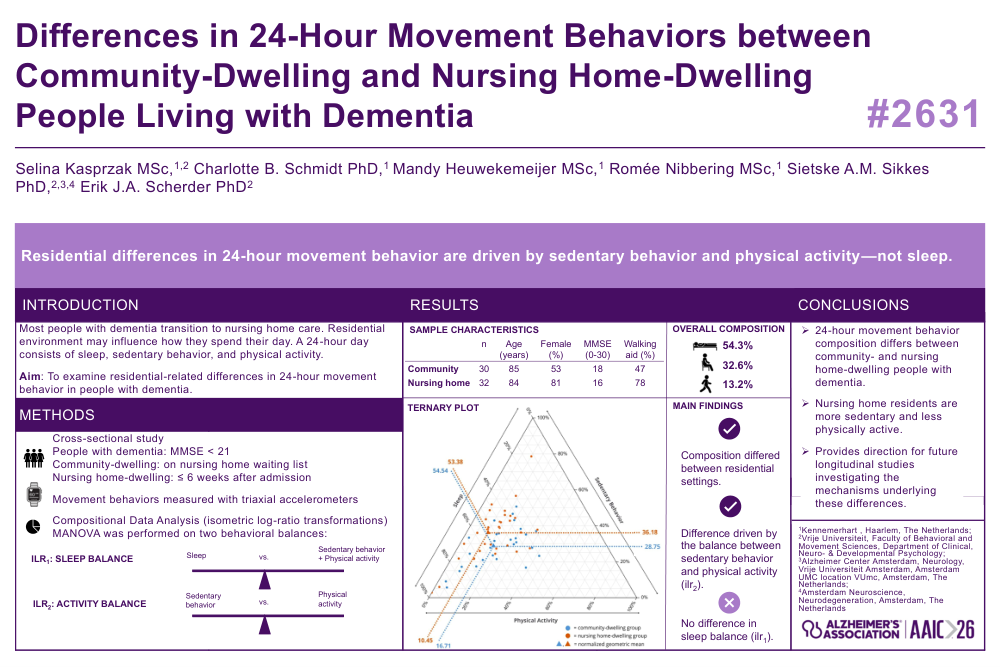
Residential differences in 24-hour movement behavior are driven by sedentary behavior and physical activity—not sleep.
INTRODUCTION
Most people with dementia transition to nursing home care. Residential environment may influence how they spend their day. A 24-hour day consists of sleep, sedentary behavior, and physical activity.
Aim: To examine residential-related differences in 24-hour movement behavior in people with dementia.
METHODS
Cross-sectional study
People with dementia: MMSE < 21
Community-dwelling: on nursing home waiting list
Nursing home-dwelling: ≤ 6 weeks after admission
Movement behaviors measured with triaxial accelerometers
Compositional Data Analysis (isometric log-ratio transformations) MANOVA was performed on two behavioral balances:
ILR1: SLEEP BALANCE (Sleep vs. Sedentary behavior + Physical activity), ILR2: ACTIVITY BALANCE (Sedentary behavior vs. Physical activity).
RESULTS
SAMPLE CHARACTERISTICS
setting, n, Age (years), Female (%), MMSE (0-30), Walking aid (%)
Community, 30, 85, 53, 18, 47
Nursing home, 32, 84, 81, 16, 78
OVERALL COMPOSITION
Sleep 54.3%
Sedentary behavior 32.6%
Physical activity 13.2%
TERNARY PLOT
MAIN FINDINGS
Composition differed between residential settings.
Difference driven by the balance between sedentary behavior and physical activity (ilr2).
No difference in sleep balance (ilr1).
CONCLUSIONS
➢ 24-hour movement behavior composition differs between community- and nursing home-dwelling people with dementia.
➢ Nursing home residents are more sedentary and less physically active.
➢ Provides direction for future longitudinal studies investigating the mechanisms underlying these differences.
Comments
Email is required but is not shown publicly.
Loading comments...