4,068 posters, 219 videos, 101 topics, 69 sessions, 14,365 authors, 6,128 institutions
ePostersLive by SciGen Technologies S.A. All rights reserved.
Alzheimer's Association International Conference 2026
July 12-15, 2026 | London, United Kingdom, and Online

9311
Identification Of Transcriptional Regulators Of Specific Microglial States In Alzheimer’S Disease Using Single-nucleus Multi-omic Data
Poster Presenter
Authors
Affiliations
Part of Topic
Background & Motivation
-
Alzheimer's disease (AD) is the most common cause of dementia, affecting tens of millions worldwide, yet no disease-modifying treatment exists
-
Microglia, the brain's resident immune cells, play a central role in AD by clearing amyloid plaques and regulating neuroinflammation
-
Single-nucleus RNA sequencing (snRNA-seq) has revealed that microglia are not a single uniform population; they adopt distinct functional substates in disease
-
Two such substate, MG4 and MG8, have been identified as being selectively enriched in AD and is characterized by upregulation of lipid-processing and inflammatory programs respectively
Key Findings
-
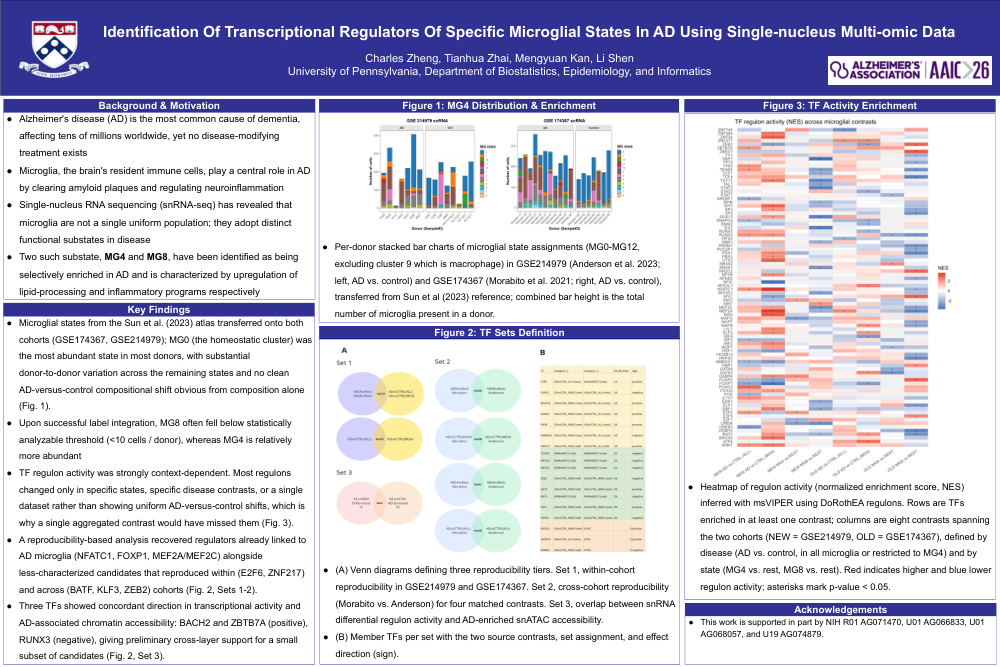
Microglial states from the Sun et al. (2023) atlas transferred onto both cohorts (GSE174367, GSE214979); MG0 (the homeostatic cluster) was the most abundant state in most donors, with substantial donor-to-donor variation across the remaining states and no clean AD-versus-control compositional shift obvious from composition alone (Fig. 1).
-
Upon successful label integration, MG8 often fell below statistically analyzable threshold (<10 cells / donor), whereas MG4 is relatively more abundant
-
TF regulon activity was strongly context-dependent. Most regulons changed only in specific states, specific disease contrasts, or a single dataset rather than showing uniform AD-versus-control shifts, which is why a single aggregated contrast would have missed them (Fig. 3).
-
A reproducibility-based analysis recovered regulators already linked to AD microglia (NFATC1, FOXP1, MEF2A/MEF2C) alongside less-characterized candidates that reproduced within (E2F6, ZNF217) and across (BATF, KLF3, ZEB2) cohorts (Fig. 2, Sets 1-2).
-
Three TFs showed concordant direction in transcriptional activity and AD-associated chromatin accessibility: BACH2 and ZBTB7A (positive), RUNX3 (negative), giving preliminary cross-layer support for a small subset of candidates (Fig. 2, Set 3).
Figure 1: MG4 Distribution & Enrichment
-
Per-donor stacked bar charts of microglial state assignments (MG0-MG12, excluding cluster 9 which is macrophage) in GSE214979 (Anderson et al. 2023; left, AD vs. control) and GSE174367 (Morabito et al. 2021; right, AD vs. control), transferred from Sun et al (2023) reference; combined bar height is the total number of microglia present in a donor.
Figure 2: TF Sets Definition
-
(A) Venn diagrams defining three reproducibility tiers. Set 1, within-cohort reproducibility in GSE214979 and GSE174367. Set 2, cross-cohort reproducibility (Morabito vs. Anderson) for four matched contrasts. Set 3, overlap between snRNA differential regulon activity and AD-enriched snATAC accessibility.
-
(B) Member TFs per set with the two source contrasts, set assignment, and effect direction (sign).
Figure 3: TF Activity Enrichment
-
Heatmap of regulon activity (normalized enrichment score, NES) inferred with msVIPER using DoRothEA regulons. Rows are TFs enriched in at least one contrast; columns are eight contrasts spanning the two cohorts (NEW = GSE214979, OLD = GSE174367), defined by disease (AD vs. control, in all microglia or restricted to MG4) and by state (MG4 vs. rest, MG8 vs. rest). Red indicates higher and blue lower regulon activity; asterisks mark p-value < 0.05.
Acknowledgements
-
This work is supported in part by NIH R01 AG071470, U01 AG066833, U01 AG068057, and U19 AG074879.
Comments
Email is required but is not shown publicly.
Loading comments...