141 posters, 8 videos, 8 audios, 5 topics, 442 authors, 228 institutions
ePostersLive by SciGen Technologies S.A. All rights reserved.
6th World Congress on Vascular Access 2021
April 29 - 30, 2021 | Virtual

P091
Peripheral Intravenous Catheters Failure In Adults In China: Current Situation And Influence Factors
Poster Presenter
Part of Topic
Prevention
Peripheral Intravenous Catheters Failure In Adults In China: Current Situation And Influence Factors
Introduction
IV therapy is one of the most common interventions in the acute care setting, with up to 90% of inpatients receiving their treatments through peripheral intravenous catheters (PIVCs)1. Over 228 million PIVCs are placed annually in China2.
Inappropriate maintenance of PIVCs which caused increasing rate of failure and related complications, lead to patient safety issues and heavy nursing workload. Around 35-50% of PIVC replaced due to avoidable complications, like phlebitis, occlusion and infections, prior to the completion of therapy.
The objective of this study was to investigate the current indwelling situation of PIVCs in a tertiary hospital and to analyze the influence factors of PIVCs failure in adults.
Methods
An observational prospective study was conducted from June 2017 to January 2018 in 10 wards of one tertiary hospital. Trained nurses helped collect information of injection, patients general background and indwelling data with a self-designed observational table.
Adults (age ≥ 18 years old) with PIVCs were included. Statistical analyses were performed using SAS 9.4.
Results
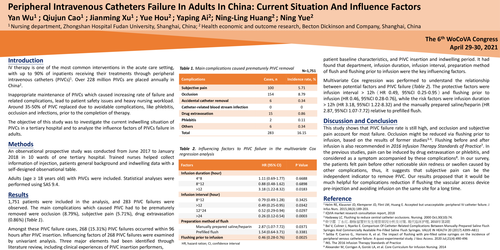
1,751 patients were included in the analysis, and 283 PIVC failures were observed. The main complications which caused PIVC had to be prematurely removed were occlusion (8.79%), subjective pain (5.71%), drug extravasation (0.86%) (Table 1).
Amongst these PIVC failure cases, 268 (15.31%) PIVC failures occurred within 96 hours after PIVC insertion. Influencing factors of 268 PIVC failures were examined by univariant analysis. Three major elements had been identified through literature review, including clinical experiences of PIVC insertion performers, patient baseline characteristics, and PIVC insertion and indwelling period. It had found that department, infusion duration, infusion interval, preparation method of flush and flushing prior to infusion were the key influencing factors.
Multivariate Cox regression was performed to understand the relationship between potential factors and PIVC failure (Table 2). The protective factors were infusion interval > 12h(HR 0.49, 95%CI 0.25-0.95)and flushing prior to infusion (HR 0.46, 95%CI 0.28-0.76), while the risk factors were infusion duration > 12h (HR 3.18, 95%CI 1.22-8.32) and the manually prepared saline/heparin (HR 2.87, 95%CI 1.07-7.72) relative to prefilled flush.
Discussion and Conclusion
This study shows that PIVC failure rate is still high, and occlusion and subjective pain account for most failure. Occlusion might be reduced via flushing prior to infusion, based on the results of former studies3-6. Flushing before and after infusion is also recommended in 2016 Infusion Therapy Standards of Practice7. In the previous studies, pain can be induced by drug extravasation or phlebitis, and considered as a symptom accompanied by these complications8. In our survey, the patients felt pain before other noticeable skin redness or swollen caused by other complications, thus, it suggests that subjective pain can be the independent indicator to remove PIVC. Our results proposed that it would be much helpful for complications reduction if flushing the vascular access device pre-injection and avoiding infusion on the same site for a long time.
Reference
1 Helm RE, Klausner JD, Klemperer JD, Flint LM, Huang E. Accepted but unacceptable: peripheral IV catheter failure. J Infus Nurs. 2015;38(3):189-203.
2 IQVIA market research consultation report, 2018
3 Hadaway LC. Flushing to reduce central catheter occlusions. Nursing. 2000 Oct;30(10):74.
4 柴守霞 丁永红. 静脉留置针发生堵管原因分析及对策. 现代临床护理, 2010年第2期
5 Bal V, Culiner J, Nyarko E. Comparison Of Catheter-Related Complications Between Manually-Prepared Saline Flush Syringes And Commercially Available Pre-Filled Saline Flush Syringes. VALUE IN HEALTH 20 (2017) A399–A811
6 Saliba P, Cuervo G,. Hornero A, et al. The impact of flushing with pre-filled saline syringes on the incidence of peripheral venous catheter failure: A quasi-experimental study. J Vasc Access. 2020 Jul;21(4):490-496
7 INS. The 2016 Infusion Therapy Standards of Practice
8 Alexander M, Corrigan A, Gorski LA, et al. Core Curriculum for Infusion Nursing. 2014