141 posters, 8 videos, 8 audios, 5 topics, 442 authors, 228 institutions
ePostersLive by SciGen Technologies S.A. All rights reserved.
6th World Congress on Vascular Access 2021
April 29 - 30, 2021 | Virtual

PP13
Experiences of introducing a dedicated neonatal nurse-led vascular access team in Qatar
Poster Presenter
Authors
Affiliations
Part of Topic
Prevention
Experiences of introducing a dedicated neonatal nurse-led vascular access team in Qatar
Krisha Leigh P. Garcia, RN; Airene Lou V. Francia, RN; Matheus van Rens, MaANP
Hamad Medical Corporation, Doha, Qatar
Abstract:
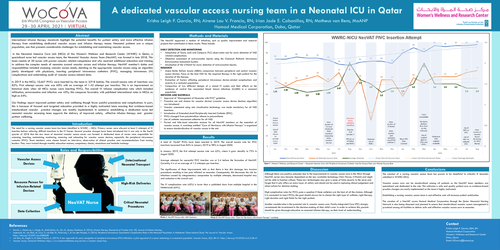
International infusion therapy standards highlight the potential benefits for patient safety and more effective infusion therapy from establishing dedicated vascular access and infusion therapy teams. Neonatal patients are a unique population, one that presents considerable challenges for establishing and maintaining vascular access.
In the Neonatal Intensive Care Unit (NICU) of the Women’s Wellness and Research Center (WWRC) in Qatar, a specialized nurse led vascular access team, the Neonatal Vascular Access Team (NeoVAT) was formed in late 2018. This team consists of 30 nurses with proven vascular related competence and who received additional education and training to address the complex needs of neonates around vascular access and infusion therapy. NeoVAT member’s duties and responsibilities included assessing vascular access needs, deciding on the appropriate vascular access using an algorithm jointly developed with physicians, inserting peripheral intravenous catheters (PIVC), managing intravenous (IV) complications and undertaking audit of vascular access-related data.
In 2019 in the NICU, 10,467 PIVCs were inserted by the team in 3,918 babies. The overall success rate of insertions was 82%. First attempt success rate was 60% with an average of 1.45 attempt per insertion. This is an improvement on historical data when all NICU nurses were inserting PIVCs. The overall IV infusion complication rate which included infiltration, extravasation and infection was 45%; this compares favorably with published international rates in NICUs as high as 64%.
Our findings report improved patient safety and wellbeing though fewer painful procedures and complications. In part, this is because of focused and targeted education provided to a highly motivated team ensuring that evidence-based standardized vascular practice changes are readily implemented. In summary: establishing a dedicated nurse led neonatal vascular accessing team supports the delivery of improved safety, effective infusion therapy and greater patient wellbeing.
Introduction:
The need for a nursing vascular access team has been identified in WWRC – NICU. Primary nurses were allowed at least 2 attempts of IV insertion before referring difficult insertions to the IV Nurses. Several practice changes have been introduced but it was only in the fourth quarter of 2018 that the new team of neonatal vascular access nurses was formed. A dedicated team of nurses were responsible for assessing, inserting, maintaining, monitoring, removing and educating for vascular access devices, especially the peripheral intravenous cannulas (PIVC). Team members were chosen based on interviews, observation of clinical practice and recommendations from nursing leaders. They were trained through monthly education sessions, competency checks, simulations and bedside trainings.
Methods and Materials:
The NeoVAT supported a number of initiatives, such as quality improvement and research projects that contributed to these results. These include:
EARLY DETECTION AND MONITORING
RESEARCH
METHODS AND MATERIALS
Although there are positive outcomes due to the improvements in vascular access care in the NICU through NeoVAT, nurses may become dependent on the new available technology (Vein Viewer, ivWatch) and might not be able to function without. These new technologies may give a sense of false security to the nurse and forget that it only offers an extra layer of safety and should not be used in replacing clinical judgement and observations for decision-making.
High complication rates for PIVCs pose a question if these catheters are the best of all the choices. Although it is convenient to insert PIVCs, the goal should always be to choose the right type of catheter, right therapy, right duration and right fluids for the right patient.
Another consideration is the parental role in vascular access care. Family-Integrated Care (FIC) strongly recommends the involvement in the decision-making of their child’s care. In order to achieve this, parents should be given thorough education on neonatal infusion therapy, on their level of understanding.
Conclusion:
The creation of a nursing vascular access team has proven to be beneficial to critically ill neonates admitted in WWRC-NICU.
Vascular access care can be standardized among all patients as the NeoVAT team members are specialized and dedicated to the role. This cultivates a safe and quality patient care as evidence-based practice changes are easily implemented as the team is highly motivated.
Establishing a nursing vascular access team is cost-effective and will increase patient satisfaction.
The creation of a NeoVAT across Hamad Medical Corporation through the Qatar Neonatal Nursing Network is also being discussed and planned to ensure that standardized vascular access management is practiced among all facilities to deliver safe and effective vascular access care to neonates.
References: