141 posters, 8 videos, 8 audios, 5 topics, 442 authors, 228 institutions
ePostersLive by SciGen Technologies S.A. All rights reserved.
6th World Congress on Vascular Access 2021
April 29 - 30, 2021 | Virtual

PP09
Central Venous Access Devices (CVADs) in 935 Pediatric Oncology Patients: complications and amicable settlement
Part of Topic
Prevention
Central Venous Access Devices (CVADs) in 935 Pediatric Oncology Patients: complications and amicable settlement
Introdution:CVAD have a prominent role in the management of pediatric oncology patients.However,data from large pediatric cohorts receiving CVADs are scarce.Therefore,we aimed to systematically analyze existing evidence of the incidence of CVAD failure and complications across CVAD types within a large cohort and implement treatment protocols for preventing the occurrence and promptly treating the most common complications.
Methods:In this context,we analyzed 935 patients received 1326 CVADs in Dmitry Rogachev National Research Center over a period of 1 year(2018-2019),focused on CVAD-related complications,divided into groups according to the CVAD-types,as well as the long-term catheter survival rates.The incident rate(IR)per1,000 catheter days(CD) was estimeted either.
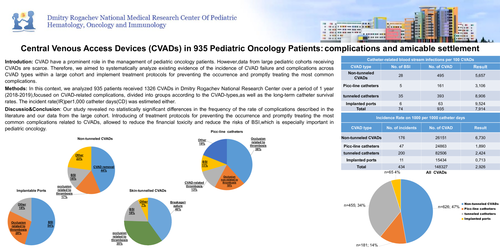
Results:Inadvertent CVAD removal 12.3%(n=77)were most prevalent complications related to non-tunneled CVADs(n=626),followed by CVAD occlusion related to thrombosis 4.9%(n=31),catheter-related blood stream infections(BSI)4.4%(n=28)and other complications 6.3%(n=40).
CVAD occlusion related to thrombosis 9.9%(n=18)were most prevalent related to peripherally inserted central catheters (PICCs)(n=181),followed by incidences of CVAD-related occlusion non-related to thrombosis 4.9%(n=9),CVAD-related thrombosis 3.3%(n=6)and other causal events 7.7%(n=14).
Breakage/rapture 17.5%(n=80)were most prevalent complications related to skin-tunnelled (TCVADs)(n=455),followed by TCVAD occlusion related to thrombosis 15.6 %(n=71),BSI 7.6%(n=35)and other complications 3%(n=14).
BSI 9.3%(n=6)were most prevalent complications related to implantable Ports(Ports),followed by CVAD occlusion related to thrombosis 4.6%(n=3)and other causal events 3.1%(n=2).
In total 148,327 CD were recorded in 935 patients with a median of 16CD(0-395)documented in non-tunneled,181CD(1-456)in PICCs,167CD(0-454)in TCVADs and 231CD(32-450)in Ports.Overall,total number of BSI was low-5,5%(n=73).
Based on the data obtained,treatment protocols for the most common complications were developed and introduced in routine clinical practise.
Discussio&Conclusion:Our study revealed no statistically significant differences in the frequency of the rate of complications described in the literature and our data from the large cohort.Introducing of treatment protocols for preventing the occurrence and promptly treating the most common complications related to CVADs,allowed to reduce the financial toxicity and reduce the risks of BSI,which is especially important in pediatric oncology.