141 posters, 8 videos, 8 audios, 5 topics, 442 authors, 228 institutions
ePostersLive by SciGen Technologies S.A. All rights reserved.
6th World Congress on Vascular Access 2021
April 29 - 30, 2021 | Virtual

P131
Clinical, economic and emotional burden of needlestick injuries and blood exposure on healthcare workers in the Middle East and Africa
Poster Presenter
Authors
Affiliations
Part of Topic
Prevention
Title:
Clinical, economic and emotional burden of needlestick injuries and blood exposure
on healthcare workers in the Middle East and Africa
Introduction
• Bloodborne pathogen exposure from needlestick injuries (NSIs) and blood
exposure pose a significant occupational health risk and creates a significant
burden to healthcare workers (HCWs), patients, hospitals and
healthcare systems.
• The World Health Organization (WHO) estimated that almost 3 million of
37 million HCWs experienced at least 1 NSI.
• Over 25 pathogens can be transmitted via needles.
• Blood exposure occurring from patients who tested positive for bloodborne
viruses, such as HIV, HCV and HBV, can put HCWs at a higher risk of
contracting the same bloodborne infections.
• Use of safety-engineered devices (SEDs) can reduce the risk of NSIs and blood
exposure among HCWs, reducing the cost burden on healthcare systems.
• This literature review aims to aggregate and investigate the available evidence
on NSI and blood exposure among HCWs as well as impact of SEDs in the
Middle East and Africa as no previous review has been conducted for
this region.
Methods
• A targeted literature review of studies published in English from 2009 to 2019
was conducted using PubMed, Cochrane Central Register of Controlled Trials
(CENTRAL).
• The review was conducted in accordance with the Preferred Reporting Items
for Systematic Reviews and Meta-Analyses (PRISMA) checklist (Figure 1).
The searches were developed using key terms and Medical Subject Heading
(MeSH) terms.
• Only high-quality studies that reported clinical, economic or emotional burden
of NSI or blood exposure in HCWs were included. Studies were limited to human
subjects. Eligibility criteria details are provided in Table 1.
• Titles and abstracts identified by the search were screened by one reviewer and
verified by another reviewer. The qualifying full texts of relevant studies were then
screened for inclusion with strict eligibility criteria.
Results
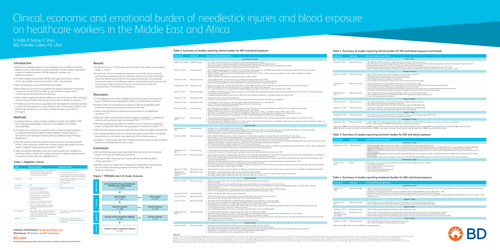
• A total of 32 out of 1,330 studies were included. Distributions of outcome type and
countries are provided in Figures 2 and 3, respectively. Study details are provided in
Tables 2, 3 and 4.
• A significant risk for occupational exposures such as NSI, blood exposure, mucocutaneous
exposure and percutaneous injuries is found among HCWs within the Middle East and
Africa. Occupational exposures are associated with certain healthcare professions, devices,
lack of safety device use, training and improper safety practices. Economic and emotional
burden are underreported in the Middle East and Africa.
Discussion
• The targeted literature review highlights the clinical, economic and emotional burden of NSIs
and blood exposure for HCWs in the Middle East and Africa.
• Burden of NSI and mucocutaneous exposure is high among Middle Eastern and African
countries, and nurses are impacted the most.
• Severe underreporting of occupational exposure exists in the Middle East and Africa.
• Majority of NSIs occurred during needle recapping. Knowledge of consequences, protocols
and practices remains low among HCWs.
• Although prevalence of bloodborne infections is low, it represents a significant burden
among HCWs. SEDs and training programs can reduce the burden.
• NSIs and blood exposures are associated with fear, anxiety and stigma among HCWs.
• This targeted literature review can improve the awareness of HCWs in the Middle East and
Africa on the burden associated with NSI and blood exposure.
• Limitation of these results stem from limited evidences for economic and emotional burdens in
the Middle East and Africa region.
Conclusion
• NSI and blood exposure imposes significant clinical, economic and emotional burden on HCWs
in the Middle East and Africa.
• Training and SEDs may reduce such burden and are cost-effective within certain parameters.
• Decision- and policy-makers at the hospital and national level should promote the use of SEDs
and training programs to enhance HCWs’ safety in healthcare institutions.