141 posters, 8 videos, 8 audios, 5 topics, 442 authors, 228 institutions
ePostersLive by SciGen Technologies S.A. All rights reserved.
6th World Congress on Vascular Access 2021
April 29 - 30, 2021 | Virtual

P121
Appropriateness and cost-effectiveness in the management of vascular accesses: before and after the constitution of a Vascular Access Team (VAT)
Poster Presenter
Authors
Affiliations
Part of Topic
Prevention
APPROPRIATENESS AND COST-EFFECTIVENESS IN THE MANAGEMENT OF VASCULAR ACCESSES: BEFORE AND AFTER THE CONSTITUTION OF A VASCULAR ACCESS TEAM (VAT).
E. Deganello, F. Gastaldo, S. Masiero, M. Fasson, S. Danese, I. Colopi, M. Sedocco, L. Girotto, ME. Buggio, A. Rigo, D. Montemurro, P. Benini, F. Baratto.
Ospedali Riuniti Padova Sud, MONSELICE, Italy
Introduction
Organization of vascular accesses was historically guaranteed by different Units with low appropriateness in device choice, too many ”urgent” CICCs/FICCs, long waiting list, underutilization of nursing skills. During 2017 a dedicated multidisciplinary and multi-professional medical-nursing group (VAT) was developed.
Method
The following data for the 2015-2016 pre VAT years were compared with those of the 2018-2019 period: type and number of catheters, appropriateness of CICC positioning, % of catheters positioned by nurses, % of catheters positioned by VAT’s physicians or nurses. Cost analysis considered: devices and accessories costs, medical and nursing time, setting, patient transport, chest x-ray or intracavitary ECG cost, reimbursement of the procedures.
Results
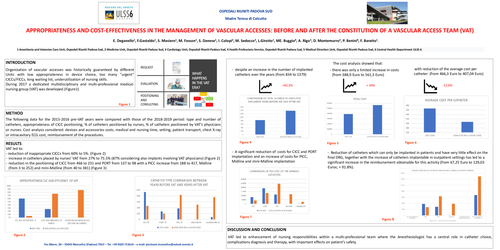
VAT led to: - reduction of inappropriate CICCs from 60% to 5%. - increase in catheters placed by nurses’ VAT from 27% to 75.5% (87 % considering also implants involving VAT physicians). - reduction in the positioning of CICC from 466 to 231 and PORT from 137 to 98 with a PICC increase from 188 to 417, Midline (from 3 to 252) and minimidline (from 40 to 381). - Despite an increase of implanted catheters (from 834 to 1379, + 65.3%), cost analysis showed only a limited costs increase (from 388,887 euros to 561,313 euros Euro, + 44%) with reduction of the average cost per catheter (from 466.29 euros to 407.04 euros). Reduction of catheters which can only be implanted in patients and have very little effect on the final DRG, together with the increase of catheters implantable in outpatient settings has led to a significant increase in the reimbursement obtainable for this activity (from 67.255 Euro to 129,030 Euros; + 91.8%).
Discussion & Conclusion
VAT led to enhancement of nursing responsibilities within a multi-professional team where the Anesthesiologist has a central role in catheter choice, complications diagnosis and therapy, with important effects on patient’s safety.