141 posters, 8 videos, 8 audios, 5 topics, 442 authors, 228 institutions
ePostersLive by SciGen Technologies S.A. All rights reserved.
6th World Congress on Vascular Access 2021
April 29 - 30, 2021 | Virtual

P117
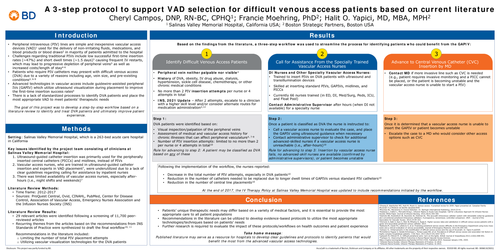
A 3-step protocol to support VAD selection for difficult venous access patients based on the current literature
Poster Presenter
Authors
Affiliations
Part of Topic
Prevention
Audio
A 3-step protocol to support VAD selection for difficult venous access patients based on current literature
Cheryl Campos, DNP, RN-BC, CPHQ1; Francie Moehring, PhD2; Halit O. Yapici, MD, MBA, MPH2
1 Salinas Valley Memorial Hospital, California USA; 2 Boston Strategic Partners, Boston USA
Peripheral intravenous (PIV) lines are simple and inexpensive vascular access devices (VAD)1 used for the delivery of non-irritating fluids, medications, and blood products or blood draws2 in majority of patients admitted to the hospital • Challenges regarding traditional PIVs include low successful first-time insertion rates (~47%) and short dwell times (~1.5 days)3 causing frequent IV restarts, which may lead to progressive depletion of peripheral veins5 as well as increased costs/length of stay4-6 • Patients who require PIV catheters may present with difficult venous access (DVA) due to a variety of reasons including age, vein size, and pre-existing conditions4, 6-9 • Advanced technologies in vascular access include guidewire-assisted peripheral IVs (GAPIV) which utilize ultrasound visualization during placement to improve the first-time insertion success rates4 • There is a lack of standardized processes to identify DVA patients and place the most appropriate VAD to meet patients’ therapeutic needs The goal of this project was to develop a step-by-step workflow based on a literature review to identify and treat DVA patients and ultimately improve patient experience. Setting: Salinas Valley Memorial Hospital, which is a 263-bed a