141 posters, 8 videos, 8 audios, 5 topics, 442 authors, 228 institutions
ePostersLive by SciGen Technologies S.A. All rights reserved.
6th World Congress on Vascular Access 2021
April 29 - 30, 2021 | Virtual

P113
Exploration of optimizing management of Vascular Access Devices for patients based on real world data analysis
Poster Presenter
Authors
Yaping Ai, Haowen Yuan, Smeet Gala, Hanbo Xu, Ning Yue, Ning-Ling Huang, Xiaolu Fei
Affiliations
Part of Topic
Prevention
Exploration of optimizing management of Vascular Access Devices for patients based on real world data analysis
Yaping Ai1, Haowen Yuan1 , Smeet Gala2, Hanbo Xu1, Ning-Ling Huang1, Ning Yue1, Xiaolu Fei3
1 Becton Dickinson and Company, Shanghai, China 2 Becton Dickinson and Company, Franklin Lakes, The United States of America 3 Xuanwu Hospital Capital Medical University, Beijing, China
Introduction
Peripherally inserted central catheters (PICCs) and central venous catheters (CVC) are both vascular access device (VAD) which are commonly used in critically ill patients who need long-term therapy.1 Various VAD solutions have been practiced clinically, however the most appropriate VAD solution based on clinical scenarios has not been well evaluated.
Based on the real-world data, this study is aiming to identify the most appropriate VAD solution for patients, as well as to explore the optimizing management pattern of VADs.
Methods
This study extracted VAD-specific data of deidentified patients from one large tertiary hospital in China from January 2016 to December 2018. General information (age, sex, diagnosis, hospital stay) and clinical information (CVC usage, PICC usage and all relevant nursing records, medical costs) were extracted. Patients were divided into three groups based on the device they received: CVC&PICC, PICC only and CVC only. Exploratory Data Analysis (EDA) and nonparametric tests were used for data analysis.
Results
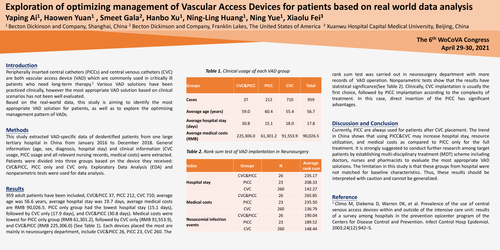
959 adult patients have been included, CVC&PICC 37, PICC 212, CVC 710; average age was 56.6 years, average hospital stay was 19.7 days, average medical costs are RMB 90,026.5. PICC only group had the lowest hospital stay (15.1 days), followed by CVC only (17.9 days), and CVC&PICC (30.8 days). Medical costs were lowest for PICC only group (RMB 61,301.2), followed by CVC only (RMB 91,553.9), and CVC&PICC (RMB 225,306.0) (See Table 1). Each devices placed the most are mainly in neurosurgery department, include CVC&PICC 26, PICC 23, CVC 260. The rank sum test was carried out in neurosurgery department with more records of VAD operation. Nonparametric tests show that the results have statistical significance(See Table 2). Clinically, CVC implantation is usually the first choice, followed by PICC implantation according to the complexity of treatment. In this case, direct insertion of the PICC has significant advantages.
Discussion and Conclusion
Currently, PICC are always used for patients after CVC placement. The trend in China shows that using PICC&CVC may increase hospital stay, resource utilization, and medical costs as compared to PICC only for the full treatment. It is strongly suggested to conduct further research among target patients by establishing multi-disciplinary treatment (MDT) scheme including doctors, nurses and pharmacists to evaluate the most appropriate VAD solutions. The limitation in this study is that these groups from hospital were not matched for baseline characteristics. Thus, these results should be interpreted with caution and cannot be generalized.
Reference
1 Climo M, Diekema D, Warren DK, et al. Prevalence of the use of central venous access devices within and outside of the intensive care unit: results of a survey among hospitals in the prevention epicenter program of the Centers for Disease Control and Prevention. Infect Control Hosp Epidemiol. 2003;24(12):942–5.