141 posters, 8 videos, 8 audios, 5 topics, 442 authors, 228 institutions
ePostersLive by SciGen Technologies S.A. All rights reserved.
6th World Congress on Vascular Access 2021
April 29 - 30, 2021 | Virtual

P106
Evaluation of clinically indicated removal versus routine replacement of peripheral venous catheters
Poster Presenter
Authors
Affiliations
Part of Topic
Prevention
Evaluation of clinically indicated removal versus routine replacement of peripheral venous catheters
Rose McGuire RN, Angela Coronado RN
King’s College Hospital NHS Foundation Trust, London, UK
Abstract
Introduction
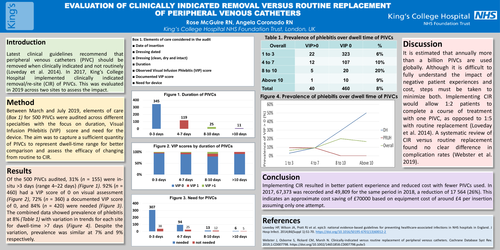
Latest clinical guidelines recommend that peripheral venous catheters (PIVC) should be removed when clinically indicated and not routinely (Loveday et al. 2014). In 2017, King’s College Hospital implemented clinically indicated removal/re-site (CIR) of PIVCs. This was evaluated in 2019 across two sites to assess the impact.
Method
Between March and July 2019, elements of care (Box 1) for 500 PIVCs were audited across different specialties with the focus on duration, Visual Infusion Phlebitis (VIP) score and need for the device. The aim was to capture a sufficient quantity of PIVCs to represent dwell-time range for better comparison and assess the efficacy of changing from routine to CIR.
Results
Of the 500 PIVCs audited, 31% (n = 155) were in-situ >3 days (range 4–22 days) (Figure 1). 92% (n = 460) had a VIP score of 0 on visual assessment (Figure 2), 72% (n = 360) a documented VIP score of 0, and 84% (n = 420) were needed (Figure 3). The combined data showed prevalence of phlebitis at 8% (Table 1) with variation in trends for each site for dwell-time >7 days (Figure 4). Despite the variation, prevalence was similar at 7% and 9% respectively.
Discussion
It is estimated that annually more than a billion PIVCs are used globally. Although it is difficult to fully understand the impact of negative patient experiences and cost, steps must be taken to minimize both. Implementing CIR would allow 1:2 patients to complete a course of treatment with one PIVC, as opposed to 1:5 with routine replacement (Loveday et al. 2014). A systematic review of CIR versus routine replacement found no clear difference in complication rates (Webster et al. 2019).
Conclusion
Implementing CIR resulted in better patient experience and reduced cost with fewer PIVCs used. In 2017, 67,373 was recorded and 49,809 for the same period in 2018, a reduction of 17 564 (26%). This indicates an approximate cost saving of £70000 based on equipment cost of around £4 per insertion assuming only one attempt.
References
Loveday HP, Wilson JA, Pratt RJ et al. epic3: national evidence-based guidelines for preventing healthcare-associated infections in NHS hospitals in England. J Hosp Infect. 2014;86(Suppl 1):S1-70. https://doi.org/10.1016/S0195-6701(13)60012-2
Webster J, Osborne S, Rickard CM, Marsh N. Clinically-indicated versus routine replacement of peripheral venous catheters. Cochrane Database Syst Rev. 2019;1:CD007798. https://doi.org/10.1002/14651858.CD007798.pubs5