145 posters, 12 topics, 25 sessions, 145 authors
ePostersLive by SciGen Technologies S.A. All rights reserved.
UCSF 2023 Inquiry Symposium
10 May | University of San Francisco

P144
Exploring the spontaneous creative process: an EEG study in musical composers.
Poster Presenter
Authors
Part of Topic
Clinical Science
Introduction:The neural substrates of spontaneous improvisation in jazz musicians have been studied using fMRI, but there is limited research on the neural networks and patterns of activity involved in novel musical composition. The process of novel music creation is typically divided into three stages: idea generation, revision, and evaluation. While the idea generation stage resembles spontaneous improvisation, the later stages are heavily reliant on executive function. The complex interplay between creative freedom and top-down evaluation makes this a challenging process that mimics how creativity is used in daily life. Investigating the unique interplay involved in music composition could offer insight into cognitive interactions and dissociations intrinsic to the creative process.
Hypothesis/Question:Our study aimed to compare EEG signals across three tasks (composition, scales, and rest) in musical composers to better understand the neural signatures of creative behaviors.
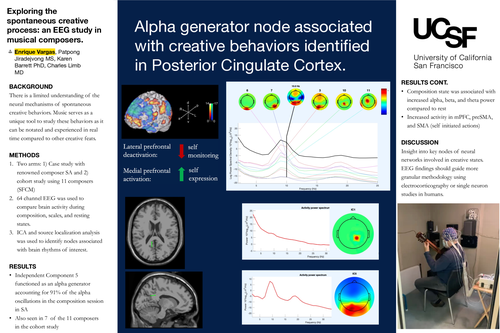
Methods: Our study included 12 composers. A case study with Sergio Assad, a world-renowned composer known for his ability to effortlessly compose intricate music, provided insight into the extremes of a creative brain in real-time. Five sessions of three alternating one-minute blocks (rest, scale, composition) were conducted, and at the end of each session, Assad was asked to compose a new piece of music in a given style and key. For the final two-minute session, Assad was asked to compose without any restrictions on structure or key. The cohort study arm included participants from the San Francisco Conservatory Composition department. Participants completed a resting baseline two-minute block, followed by five minutes of given scales, and five minutes of composition without a piano available. After another two-minute block, the same five-minute blocks were repeated with a piano available.
Results: During the case study with Assad, the composition condition showed increased alpha, beta, and theta power compared to resting and scale conditions. Independent component analysis identified a channel, IC5, which explained 41% of the variance of the overall signal. When filtering across the alpha band, IC5 accounted for 91% of the alpha power seen during composition sessions. Source localization of IC5 localized to the posterior cingulate cortex (PCC). LORETA analysis was used to describe the dynamic interactions of ROIs across conditions. Imaginary component of coherency identified the IC5 node as a key network communicating with the prefrontal cortex. Cohort analysis yielded similar results, with increased alpha, beta, and theta power seen in participants during the composition task compared to resting or scale sessions. A component localized in the PCC contributed greater than 50% of the alpha power during composition tasks and could be isolated in a majority of participants.
Conclusion: Our findings provide insight into the neural patterns of activity involved in novel musical composition and suggest that the creative process involves a unique interplay between creative freedom and top-down evaluation. Our results suggest that the PCC may play a critical role in the creative process, and further investigation of this region is warranted. Although the study's limitations include a small sample size and the use of a single case study, our findings have important implications for understanding the neural basis of creativity and may inform future research and interventions aimed at promoting creative behaviors.