10 posters, 4 topics, 12 authors, 8 institutions
ePostersLive by SciGen Technologies S.A. All rights reserved.
39th Annual Meeting of the Society for Radiation Oncology Administrators
October 23-26, 2022 | San Antonio, TX

P005
Clinic-Ready Solutions for Efficiency and Productivity
Poster Presenter
Authors
Affiliations
Part of Topic
Technology, Clinical & Ancillary Services
Contour
Autosegmentation
-
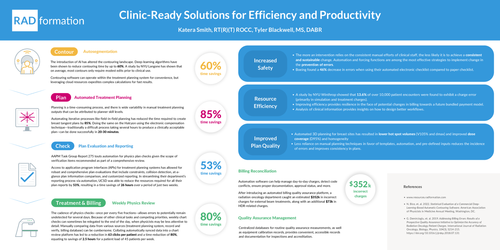
The introduction of AI has altered the contouring landscape. Deep-learning algorithms have been shown to reduce contouring time by up to 60%. A study by NYU Langone has shown that on average, most contours only require modest edits prior to clinical use.
-
Contouring software can operate within the treatment planning system for convenience, but leveraging cloud resources expedites complex calculations for fast results.
Plan
Automated Treatment Planning
-
There is wide variability in manual treatment planning outputs attributed to planner skill levels, and planning can be time-consuming.
-
Automating iterative processes like field-in-field planning has reduced the time required to create breast tangent plans by 85%. Doing the same on the Halcyon using electronic compensation—traditionally a difficult process taking several hours to produce a clinically acceptable plan—can be done successfully in 20-30 minutes.
Check
Plan Evaluation and Reporting
-
AAPM Task Group Report 275 touts automation for physics plan checks given the scope of verification recommended as part of a comprehensive review.
-
Access to application program interfaces (APIs) for treatment planning systems has allowed for robust and comprehensive plan evaluations that include constraints, collision detection, at-a-glance plan information comparison, and customized reporting. In streamlining their department’s reporting process via automation, UCSD was able to reduce the resources required for all their plan reports by 53%, resulting in a time savings of 26 hours over a period of just two weeks.
Treat
Weekly Physics Review
-
The cadence of physics checks—once per every five fractions—allows errors to potentially remain undetected for several days.
-
Because of other clinical tasks and competing priorities, weekly chart checks can sometimes be relegated to the end of the day, when physicists may be less attentive to detail.
-
Manually comparing data from various sources (treatment planning system, record and verify, billing database) can be cumbersome.
-
Collating automatically synced data into a chart review platform has led to a reduction in 63 clicks per patient and a time reduction of 80%, equating to savings of 2.5 hours for a patient load of 45 patients per week.
Billing Reconciliation
-
Automation software can help manage day-to-day charges, detect code conflicts, ensure proper documentation, approval status, and more.
-
After introducing an automated billing quality assurance platform, a radiation oncology department caught an estimated $352k in incorrect charges for external beam treatments, and an additional $73k in HDR-related charges.
-
A study by NYU Winthrop showed that 13.6% of over 10,000 patient encounters were found to exhibit a charge error (primarily in simulation and treatment charges)
Quality Assurance Management
-
Centralized databases for routine quality assurance measurements, as well as equipment calibration records, provides convenient, accessible records and documentation for inspections and accreditation.
Safety
-
The more an intervention relies on the consistent manual efforts of clinical staff, the less likely it is to achieve a consistent and sustainable change. Automation and forcing functions are among the most effective strategies to implement change in the prevention of errors.
-
Boeing found a 46% decrease in errors when using their automated electronic checklist compared to paper checklist.
Resource Efficiency
-
After introducing an automated billing quality assurance platform, a radiation oncology department caught an estimated $352k in incorrect charges for external beam treatments and an additional $73k in HDR.
-
Improving efficiency provides resilience in the face of potential changes in billing towards a bundled payment model.
-
Analysis of clinical information provides insights on how to design better workflows.
Improved Plan Quality
-
Automated 3D planning has resulted in lower hot spot volumes (V105% and dmax) and dose coverage (D95%)
-
Less reliance on manual techniques in favor of templates, automation, and pre-defined inputs improves consistency in plans.
References:
-
Resources.radformation.com
-
N. Bice, et. al. 2022. Statistical Evaluation of a Commercial Deep-Learning-Based Automatic Contouring Software. American Association of Physicists in Medicine Annual Meeting, Washington, DC.
-
G. Demircioglu, et. al. 2019. Addressing Billing Errors: Results of a Prospective Quality Assurance Initiative to Optimize the Accuracy of Radiation Oncology Patient Charges. International Journal of Radiation Oncology, Biology, Physics, 104(3), S214-215. https://doi.org/10.1016/j.ijrobp.2018.07.131