10 posters, 4 topics, 12 authors, 8 institutions
ePostersLive by SciGen Technologies S.A. All rights reserved.
39th Annual Meeting of the Society for Radiation Oncology Administrators
October 23-26, 2022 | San Antonio, TX

P009
The Effects of COVID 19 on Oncology Nationally
Poster Presenter
Authors
Affiliations
Part of Topic
Quality & Safety
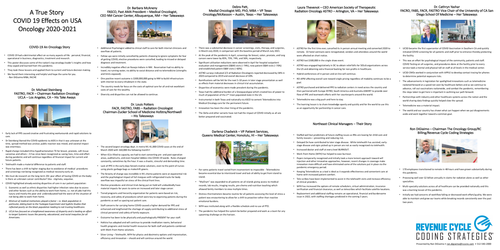
A True Story COVID 19 Effects on USA Oncology 2020-2021
-------------------------------------------------------------------------------------------------------------------------------------------------------------------------
COVID 19 had a detrimental affect on so many aspects of life: personal, financial, operational in business, diagnostics, treatment and research.
• This poster discusses some of the nation’s top oncology leader’s insights and how they coped and learned from this pandemic.
• They took these lessons and applied them to current and future decision making.
• We found them interesting and helpful and hope the same for you.
- Ron DiGiaimo MBA, FACHE
------------------------------------------------------------------------------------------------------------------------------------------------------------------------
Dr. Michael Steinberg FASTRO, FACR – Chairman Radiation Oncology UCLA – Los Angeles, CA – His Take Aways
• Early lack of PPE caused creative and frustrating workarounds and rapid solutions to care.
• Dr Steinberg likened the COVID epidemic to AIDS in that it was unknown at the time, spread method was unclear, public reaction was mixed, and societal impact was enormous.
• Rapid change included Ultra-hypofractionation TX for breast, prostate, soft tissue sarcomas and others – It has since been recognized as saving lives, time and effort
during pandemic and will continue regardless of financial impact for current and future patients.
• Telehealth made a material difference to patients and staff.
• There has been a shift to higher staging due to avoidance of medical procedures and screenings not being recognized as medical necessity early on.
• We must do research on the long-term 20+ year effect of having COVID on the body: Is there an unknown cancer contributor? Aka - stigmata, sequelae.
• COVID highlighted already existing disparities of care in our patient population:
1. Economic as well as ethnic disparities had higher infection rates due to access and other factors such as the ability to work from home, i.e. not all jobs had this luxury and mostly the poor and undereducated had the worst of the situation of not being able to work from home.
2. Mistrust of medical institutions played a factor – ie. black population in particular, dating back to the Tuskegee Experiment and Syphilis Studies that reflected poorly on the black population leading to not trusting healthcare.
3. UCLA has focused on a heightened awareness of disparity and is leading an effort to target Systemic Issues like poverty, educational, and racial inequities for all Americans.
------------------------------------------------------------------------------------------------------------------------------------------------------------------------
Dr. Barbara McAneny FASCO, Past AMA President – Medical Oncologist, CEO NM Cancer Center, Albuquerque, NM – Her Takeaways
Additional Psychologist added to clinical staff to care for both internal clinicians and overflow of patients.
• Follow ups were initially cancelled by patients choosing to ignore symptoms for fear of getting COVID, elective procedures were cancelled, leading to missed or delayed diagnosis and treatment.
• Incredibly negative effect on Navajo Indians in NM. Reservation had no ability to travel, no running water, no ability to social distance and no telemedicine (strengths and limits exposed).
• One positive recent outcome is $300,000,000 going to NM to build infrastructure with internet to every inhabitant in the state.
• The country needs for focus on the costs of optimal care for all and not exorbitant costs of care for the wealthy.
• Diversity and disparities can not be allowed to continue.
------------------------------------------------------------------------------------------------------------------------------------------------------------------------
The second largest oncology dept. in metro NY, 41,000 COVID cases at the end of March 2020 with 160,000 the following month!!
• When ICUs filled to capacity, we had to start converting pre- and post-operation areas, auditoriums, and even hospital lobbies into COVID-19 wards. Rules changed constantly, sometimes by the hour. It was a chaotic, stressful and demanding time.
• Lack of PPE in the early days forced creative solutions, even to the point of nurses using plastic garbage bags as makeshift gowns.
• The ferocity of change was incredible in NY, chemo patients were at exponential risk and the psychological impact of full morgues with refrigerated trucks for body overflow was impactful on stress of the clinical front lines.
• Elective procedures and clinical trials being put on hold will undoubtedly have material impacts for years to come on increased and later stage cancer.
• Tiered programs and hierarchy organization for patients were based on risk, necessity, and safety of procedures which were key to organizing patients during the pandemic as well as spacing out patient care.
• Staff concerns for carrying home COVID caused a higher demand for PPE and enhanced and lengthened the shortage of supply contributing to additional stress of clinical personnel and safety of family exposure.
• Outcome has been to be physically and psychologically PRESENT for your staff.
• Hofstra has adopted and will continue to provide meditation rooms, behavioral health programs and mental health resources for both staff and patients combined with Work From Home solutions.
• Silver Lining – Telehealth, WFH for physics and dosimetry options and improvisation, efficiency and Innovation – should and will continue around the world.
------------------------------------------------------------------------------------------------------------------------------------------------------------------------
• There was a substantial decrease in cancer screenings, visits, therapy, and surgeries, in March-July 2020, in comparison with the baseline period of March-July 2021.
• At the peak of the pandemic in April, screenings for breast, colon, prostate, and lung cancers were lower by 85%, 75%, 74%, and 56%, respectively.
• Significant utilization reductions were observed in April for hospital outpatient evaluation and management (E&M) visits (−74%), new patient E&M visits (−70%) and established patient E&M visits (−60%).
• ASTRO surveys indicated 2/3 of Radiation Oncologists reported decreased by 58% in 2020 compared to 2019 and overall decrease of 30%.
• Ramifications will be felt for the next 5-10 years in later stage presentation as well as effects from material decreases in clinical trial accumulation.
• Disparities of economics were made prevalent during the pandemic.
• Texas had the additional burden of a Snowpacolypse which created loss of power to much of population of the 2nd most populated state in the US.
• Instrumental in both Texas and nationally via ASCO to cement Telemedicine into Medical Oncology care for the permanent future.
• Innovation has been the silver lining of the pandemic.
• The Delta and other variants have not had the impact of COVID initially as all are better prepared and vaccinated.
------------------------------------------------------------------------------------------------------------------------------------------------------------------------
Darlena Chadwick – VP Patient Services, Queens Medical Center, Honolulu, HI – Her Takeaways
For some patients travel varied from inconvenient to impossible - Telemedicine became essential due to interisland travel and lack of ability to get from island to island.
• “MyChart” was expanded to all patients on all islands giving access to medical records, lab results, imaging results, pre-chemo and nutrition teaching which allowed family members to view multiple times.
• Distress thermometers became routine for all patients accessing the level of stress a patient was encountering to allow for a shift to proactive rather than reactive emotional burdens.
• WFH was instituted along with a flexible schedule and no use of PTO.
• The pandemic has helped the system be better prepared and work as a team for any upcoming challenge on the horizon.
------------------------------------------------------------------------------------------------------------------------------------------------------------------------
ASTRO for the first time ever, cancelled its in person annual meeting and converted 2020 to remote. 33 hotel contracts were renegotiated, vendors and attendees around the world were affected on short notice.
• ASTRO lost $500,000 in the single show event.
• ASTRO was engaged legislatively in DC to obtain relief bills for 501c6 organizations across the US and obtaining extra financial backing for non-profits in healthcare.
• Hybrid conferences of in-person and on-line will continue.
• RO-APM affecting overall care toward single pricing regardless of modality continues to be a goal.
• ASTRO purchased and delivered PPE to radiation centers in need across the country and then partnered with Europe ESTRO, South America and Australia ASMIRT to provide over flow of PPE and teamwork efforts with her counterparts around the world.
• Telemedicine was a big push and here to stay.
• The learning lesson is to share knowledge openly and quickly and for the world to use this as an opportunity for partnership in cancer care.
------------------------------------------------------------------------------------------------------------------------------------------------------------------------
Staffed well but predictions of future staffing issues as RNs are leaving for child-care and family reasons – preventing and reducing risk.
• Delayed Dx have contributed to later stage disease. While telehealth has assisted, earlystage disease and signs picked up in person are not as easily recognized via telehealth.
• Increased doctor and staff at every level BURNOUT.
• Work From Home (WFH) has helped to ease burnout.
• Payers temporarily recognized and initially took a more lenient approach toward self injection and other innovative approaches, however, recent changes in coverage make innovation more difficult and have eliminated some of the solutions put in place via the pandemic emergency period.
• Keeping Telemedicine as a tool is ideal as it expands effectiveness and convenient care at home with increased patient comfort.
• Tele-scribes have been implemented to assist in the telehealth visits and increase efficiency of clinical providers.
• WFH has increased the options of remote schedulers, virtual administration, insurance verification and financial clearance, as well as telescribes which facilitate satellite locations.
• Replacement and additional staffing remains an operational, financial and burdensome issue in 2022, with staffing shortages predicted in the coming 5 years.
------------------------------------------------------------------------------------------------------------------------------------------------------------------------
UCSD became the first supercenter of COVID Vaccination in Southern CA and quickly initiated COVID screening for all patients and staff prior to entrance thereby protecting the facility.
• This was an effort for psychological impact of the community, patients and staff. COVID Testing on all surgeries, and procedures done at the facility prior to every service took a mental and physical toll on staff at all levels in the medical center.
• UCSD CMOs worked in conjunction with APPLE to develop contact tracing for phones to determine potential exposure risks.
• The advancements in legislation for spotlighted innovations such as telemedicine rocketed forward at a speed not seen by healthcare before and as we continue to advance, roll out vaccinations nationwide, and combat the pandemic, remembering the steps taken to get here is important in outlining our path forward.
• Partnerships with industry and other healthcare systems across the nation and the world sharing data findings quickly helped slow the spread.
• Telemedicine was a material impact.
• The world and our country has shown what can happen when we put disagreements aside and work together toward a common goal.
------------------------------------------------------------------------------------------------------------------------------------------------------------------------
• 170 employees transitioned to remote in 48 hours and have grown substantially during the pandemic.
• Processing well over $2 billion annually in claims for radiation alone as well as other specialties.
• Multi-specialty solutions across all of healthcare can be provided nationally and this was a learning lesson of the pandemic.
• Initially we had concerns of workflow falling or decreased work effort/quality. We were able to maintain and grow our teams while breaking records consistently over the past two years.
------------------------------------------------------------------------------------------------------------------------------------------------------------------------
REVENUE CYCLE CODING STRATEGIES
Presented by Ron DiGiaimo • ron.digiaimo@rccsinc.com • 512-583-2000