1,267 posters, 47 videos, 13 topics, 4 sessions, 853 authors
ePostersLive by SciGen Technologies S.A. All rights reserved.
SOHO 2026 Annual Meeting
September 9 - 12, 2026 | George R. Brown Convention Center, Houston, Texas

MPN - 1691
Ropeginterferon Alfa-2b vs Hydroxyurea in Polycythemia Vera: A Propensity Score-Matched Real-World Analysis of Thrombotic Events and Phlebotomy Burden
Poster Presenter
Authors
Part of Topic
Myeloproliferative Neoplasms (MPN)
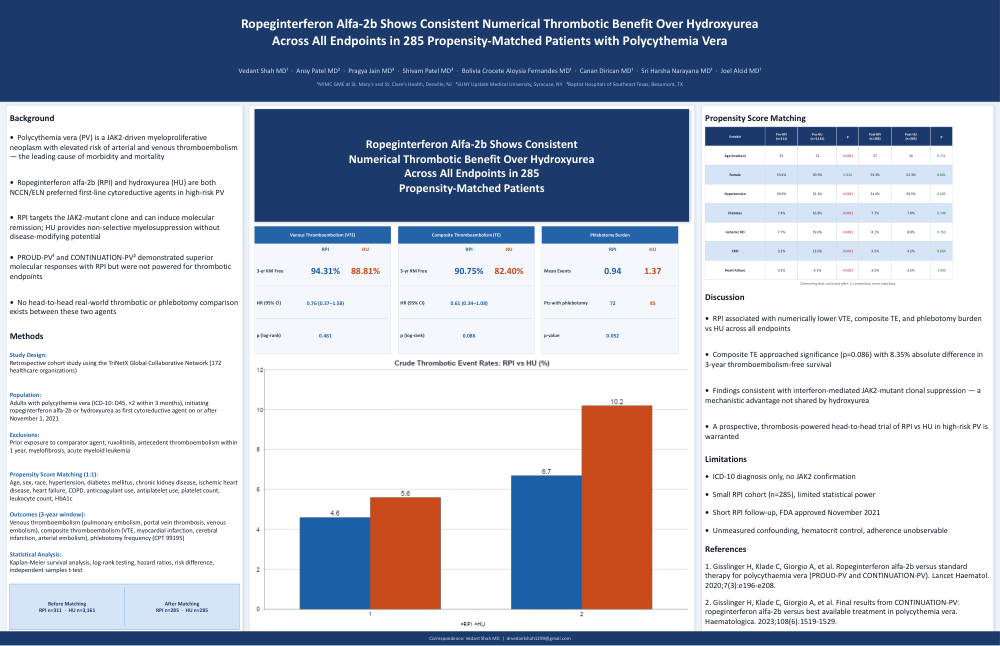
Ropeginterferon Alfa-2b Shows Consistent Numerical Thrombotic Benefit Over Hydroxyurea Across All Endpoints in 285 Propensity-Matched Patients with Polycythemia Vera
AUTHORS
Vedant Shah MD¹ · Ansy Patel MD² · Pragya Jain MD³ · Shivam Patel MD³ · Bolivia Crocete Aloysia Fernandes MD¹ · Canan Dirican MD¹ · Sri Harsha Narayana MD¹ · Joel Alcid MD¹
AFFILIATIONS
¹NYMC GME at St. Mary's and St. Clare's Health, Denville, NJ · ²SUNY Upstate Medical University, Syracuse, NY · ³Baptist Hospitals of Southeast Texas, Beaumont, TX
BACKGROUND
- Polycythemia vera (PV) is a JAK2-driven myeloproliferative neoplasm with elevated risk of arterial and venous thromboembolism — the leading cause of morbidity and mortality
- Ropeginterferon alfa-2b (RPI) and hydroxyurea (HU) are both NCCN/ELN preferred first-line cytoreductive agents in high-risk PV
- RPI targets the JAK2-mutant clone and can induce molecular remission; HU provides non-selective myelosuppression without disease-modifying potential
- PROUD-PV¹ and CONTINUATION-PV² demonstrated superior molecular responses with RPI but were not powered for thrombotic endpoints
- No head-to-head real-world thrombotic or phlebotomy comparison exists between these two agents
METHODS
Study Design: Retrospective cohort study using the TriNetX Global Collaborative Network (172 healthcare organizations)
Population: Adults with polycythemia vera (ICD-10: D45, ×2 within 3 months), initiating ropeginterferon alfa-2b or hydroxyurea as first cytoreductive agent on or after November 1, 2021
Exclusions: Prior exposure to comparator agent, ruxolitinib, antecedent thromboembolism within 1 year, myelofibrosis, acute myeloid leukemia
Propensity Score Matching (1:1): Age, sex, race, hypertension, diabetes mellitus, chronic kidney disease, ischemic heart disease, heart failure, COPD, anticoagulant use, antiplatelet use, platelet count, leukocyte count, HbA1c
Outcomes (3-year window): Venous thromboembolism (pulmonary embolism, portal vein thrombosis, venous embolism), composite thromboembolism (VTE, myocardial infarction, cerebral infarction, arterial embolism), phlebotomy frequency (CPT 99195)
Statistical Analysis: Kaplan-Meier survival analysis, log-rank testing, hazard ratios, risk difference, independent samples t-test
Before Matching: RPI n=311 · HU n=3,161
After Matching: RPI n=285 · HU n=285
CENTRAL HEADLINE
Ropeginterferon Alfa-2b Shows Consistent Numerical Thrombotic Benefit Over Hydroxyurea Across All Endpoints in 285 Propensity-Matched Patients
RESULTS
Venous Thromboembolism (VTE)
3-year KM free: RPI 94.31% vs HU 88.81%
HR (95% CI): 0.76 (0.37–1.58)
p (log-rank): 0.461
Composite Thromboembolism (TE)
3-year KM free: RPI 90.75% vs HU 82.40%
HR (95% CI): 0.61 (0.34–1.08)
p (log-rank): 0.086
Phlebotomy Burden
Mean events: RPI 0.94 vs HU 1.37
Patients with phlebotomy: RPI 72 vs HU 85
p-value: 0.052
Crude Thrombotic Event Rates:
VTE crude rate: RPI 4.6% vs HU 5.6%
Composite TE crude rate: RPI 6.7% vs HU 10.2%
PROPENSITY SCORE MATCHING: BEFORE AND AFTER
Age (median): Pre-RPI 55, Pre-HU 71 (p<0.001) → Post-RPI 57, Post-HU 56 (p=0.711)
Female: Pre-RPI 53.4%, Pre-HU 50.5% (p=0.326) → Post-RPI 53.3%, Post-HU 52.3% (p=0.801)
Hypertension: Pre-RPI 30.9%, Pre-HU 51.1% (p<0.001) → Post-RPI 31.6%, Post-HU 29.5% (p=0.585)
Diabetes: Pre-RPI 7.4%, Pre-HU 16.8% (p<0.001) → Post-RPI 7.7%, Post-HU 7.0% (p=0.748)
Ischemic HD: Pre-RPI 7.7%, Pre-HU 19.0% (p<0.001) → Post-RPI 8.1%, Post-HU 8.8% (p=0.763)
CKD: Pre-RPI 3.2%, Pre-HU 13.0% (p<0.001) → Post-RPI 3.5%, Post-HU 4.2% (p=0.664)
Heart Failure: Pre-RPI 3.2%, Pre-HU 9.1% (p<0.001) → Post-RPI 3.5%, Post-HU 3.5% (p=1.000)
Channeling bias corrected after 1:1 propensity score matching
DISCUSSION
- RPI associated with numerically lower VTE, composite TE, and phlebotomy burden vs HU across all endpoints
- Composite TE approached significance (p=0.086) with 8.35% absolute difference in 3-year thromboembolism-free survival
- Findings consistent with interferon-mediated JAK2-mutant clonal suppression — a mechanistic advantage not shared by hydroxyurea
- A prospective, thrombosis-powered head-to-head trial of RPI vs HU in high-risk PV is warranted
LIMITATIONS
- ICD-10 diagnosis only, no JAK2 confirmation
- Small RPI cohort (n=285), limited statistical power
- Short RPI follow-up, FDA approved November 2021
- Unmeasured confounding, hematocrit control, adherence unobservable
REFERENCES
- Gisslinger H, Klade C, Giorgio A, et al. Ropeginterferon alfa-2b versus standard therapy for polycythaemia vera (PROUD-PV and CONTINUATION-PV). Lancet Haematol. 2020;7(3):e196-e208.
- Gisslinger H, Klade C, Giorgio A, et al. Final results from CONTINUATION-PV: ropeginterferon alfa-2b versus best available treatment in polycythemia vera. Haematologica. 2023;108(6):1519-1529.