1,267 posters, 47 videos, 13 topics, 4 sessions, 853 authors
ePostersLive by SciGen Technologies S.A. All rights reserved.
SOHO 2026 Annual Meeting
September 9 - 12, 2026 | George R. Brown Convention Center, Houston, Texas

MPN - 1634
Targeting Metabolic-Inflammatory Signaling in Chronic Myelomonocytic Leukemia: Association of GLP-1 Receptor Agonist Therapy with Improved Real-World Outcomes
Poster Presenter
Authors
Part of Topic
Myeloproliferative Neoplasms (MPN)
Background
CMML is a clonal myeloid neoplasm with overlapping myelodysplastic and myeloproliferative features, characterized by persistent monocytosis, cytopenias, venous thromboembolism (VTE), and risk of progression to AML. Glucagon-like peptide-1 agonists (GLP-1a), primarily indicated for glycemic control, have demonstrated antineoplastic effects in preclinical studies by inhibiting the PI3K/AKT/mTOR and ERK/MAPK pathways, leading to cell cycle arrest. Furthermore, activation of GLP1R has been shown to suppress NF-κB signaling, limit NLRP3 inflammasome priming, and mitigate oxidative stress. This study evaluates the association between GLP-1a therapy and key clinical outcomes in a large global cohort of CMML patients.
Methods
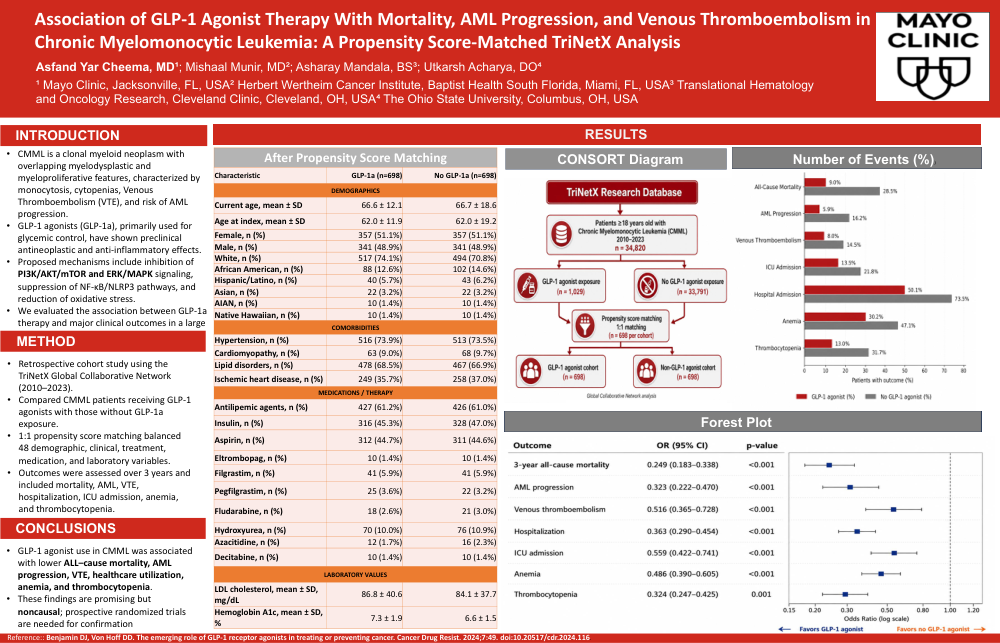
We performed a retrospective propensity score-matched (PSM) cohort study using the TriNetX Analytics Network database, including CMML patients treated with GLP-1a (n=1029) and matched controls without GLP-1a (n=33 791) from 2010 to 2023. PSM (1:1) was applied using a greedy nearest-neighbor method with a caliper of 0.1 pooled standard deviations, adjusting for demographics, CMML-directed therapy, comorbidities, laboratory values, and cardiovascular medications. Primary outcomes were all-cause mortality, AML, and VTE. Secondary outcomes included hospitalizations, ICU admissions, anemia, and thrombocytopenia. Odds ratios (ORs) with 95% confidence intervals (CIs) were calculated over a 3-year follow-up.
Results
After PSM, we analyzed 698 matched pairs (mean age, 66.6 ± 12.1 years for GLP-1a users and 66.7 ± 18.6 years for nonusers; 51% female in both groups). GLP-1a therapy was associated with significantly lower odds of all-cause mortality (OR, 0.249; 95% CI, 0.183–0.338; P<0.001), AML progression (OR, 0.323; 95% CI, 0.222–0.470; P<0.001), and VTE (OR, 0.516; 95% CI, 0.365–0.728; P<0.001). Additionally, GLP-1a users demonstrated reduced odds of all-cause hospitalizations (OR, 0.363; 95% CI, 0.290–0.454; P<0.001), ICU admissions (OR, 0.559; 95% CI, 0.422–0.741; P<0.001), anemia (OR, 0.486; 95% CI, 0.390–0.605; P<0.001), and thrombocytopenia (OR, 0.324; 95% CI, 0.247–0.425; P=0.001).
Conclusion
GLP-1 agonist therapy in CMML patients was associated with significantly reduced risks of all-cause mortality, AML, VTE, and healthcare utilization. Despite limitations such as limited detailed clinical granularity and an observational design that precludes causal inference, these findings suggest that GLP-1a offers therapeutic benefits for this high-risk population, warranting urgent randomized controlled trials to confirm its efficacy and safety in CMML.