1,267 posters, 47 videos, 13 topics, 4 sessions, 853 authors
ePostersLive by SciGen Technologies S.A. All rights reserved.
SOHO 2026 Annual Meeting
September 9 - 12, 2026 | George R. Brown Convention Center, Houston, Texas

ABCL - 1502
Infectious Mortality in Hematologic Malignancies in the United States: A 25-Year Analysis of Pathogen-Specific Underlying Causes of Death Using CDC WONDER Data, 1999-2024
Poster Presenter
Authors
Part of Topic
Aggressive B-Cell Lymphoma (ABCL)
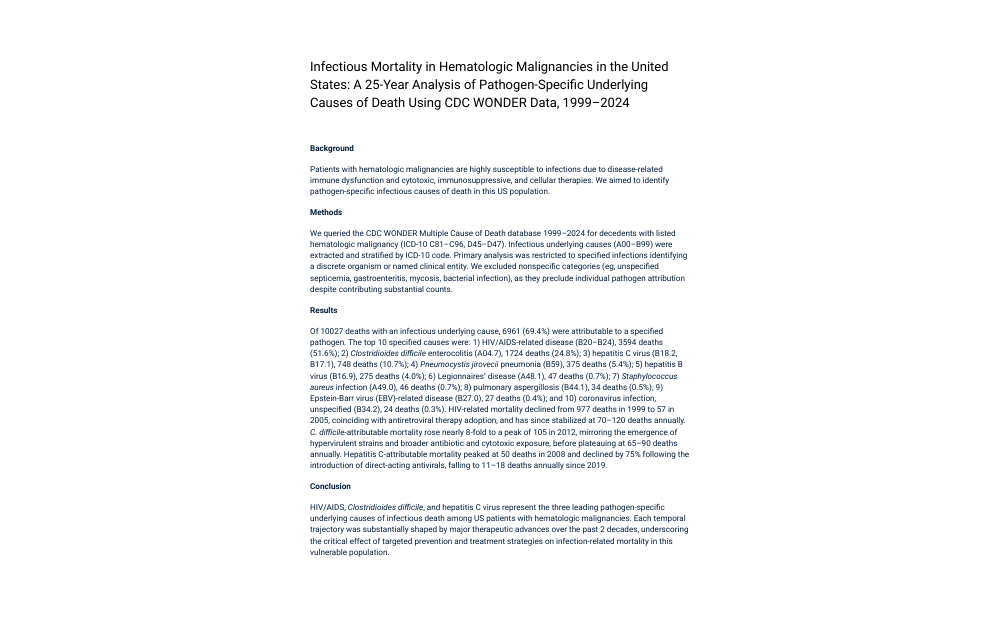
Infectious Mortality in Hematologic Malignancies in the United States: A 25-Year Analysis of Pathogen-Specific Underlying Causes of Death Using CDC WONDER Data, 1999–2024
Background
Patients with hematologic malignancies are highly susceptible to infections due to disease-related immune dysfunction and cytotoxic, immunosuppressive, and cellular therapies. We aimed to identify pathogen-specific infectious causes of death in this US population.
Methods
We queried the CDC WONDER Multiple Cause of Death database 1999–2024 for decedents with listed hematologic malignancy (ICD-10 C81–C96, D45–D47). Infectious underlying causes (A00–B99) were extracted and stratified by ICD-10 code. Primary analysis was restricted to specified infections identifying a discrete organism or named clinical entity. We excluded nonspecific categories (eg, unspecified septicemia, gastroenteritis, mycosis, bacterial infection), as they preclude individual pathogen attribution despite contributing substantial counts.
Results
Of 10027 deaths with an infectious underlying cause, 6961 (69.4%) were attributable to a specified pathogen. The top 10 specified causes were: 1) HIV/AIDS-related disease (B20–B24), 3594 deaths (51.6%); 2) Clostridioides difficile enterocolitis (A04.7), 1724 deaths (24.8%); 3) hepatitis C virus (B18.2, B17.1), 748 deaths (10.7%); 4) Pneumocystis jirovecii pneumonia (B59), 375 deaths (5.4%); 5) hepatitis B virus (B16.9), 275 deaths (4.0%); 6) Legionnaires’ disease (A48.1), 47 deaths (0.7%); 7) Staphylococcus aureus infection (A49.0), 46 deaths (0.7%); 8) pulmonary aspergillosis (B44.1), 34 deaths (0.5%); 9) Epstein-Barr virus (EBV)-related disease (B27.0), 27 deaths (0.4%); and 10) coronavirus infection, unspecified (B34.2), 24 deaths (0.3%). HIV-related mortality declined from 977 deaths in 1999 to 57 in 2005, coinciding with antiretroviral therapy adoption, and has since stabilized at 70–120 deaths annually. C. difficile-attributable mortality rose nearly 8-fold to a peak of 105 in 2012, mirroring the emergence of hypervirulent strains and broader antibiotic and cytotoxic exposure, before plateauing at 65–90 deaths annually. Hepatitis C-attributable mortality peaked at 50 deaths in 2008 and declined by 75% following the introduction of direct-acting antivirals, falling to 11–18 deaths annually since 2019.
Conclusion
HIV/AIDS, Clostridioides difficile, and hepatitis C virus represent the three leading pathogen-specific underlying causes of infectious death among US patients with hematologic malignancies. Each temporal trajectory was substantially shaped by major therapeutic advances over the past 2 decades, underscoring the critical effect of targeted prevention and treatment strategies on infection-related mortality in this vulnerable population.