1,267 posters, 47 videos, 13 topics, 4 sessions, 853 authors
ePostersLive by SciGen Technologies S.A. All rights reserved.
SOHO 2026 Annual Meeting
September 9 - 12, 2026 | George R. Brown Convention Center, Houston, Texas

ABCL - 1388
Secondary Primary Malignancies Associated With CD20ΧCD3 Bispecific T-Cell Engaging Antibodies in Patients With B-Cell Non-Hodgkin's Lymphoma
Poster Presenter
Authors
Part of Topic
Aggressive B-Cell Lymphoma (ABCL)
Background
CD20×CD3 bispecific antibodies: mosunetuzumab, epcoritamab, and glofitamab are approved for relapsed/
refractory B-cell lymphoma. Long-term safety regarding secondary primary malignancies (SPM) is incompletely
defined in a population already exposed to cytotoxic therapy, T-cell dysfunction, and cumulative immunosuppression.
No published study has systematically evaluated SPM risk across this class.
Methods
FDA Adverse Event Reporting System (FAERS) reports of mosunetuzumab, epcoritamab, and glofitamab in lymphoma
patients (Q4 2022–Q4 2025) were screened for SPM via MedDRA preferred terms, clinically adjudicated,
and deduplicated. Reporting odds ratios (RORs; 95% CIs; signal: lower limit of 95% CI >1.0) were calculated
overall and against CAR-T comparators.
Results
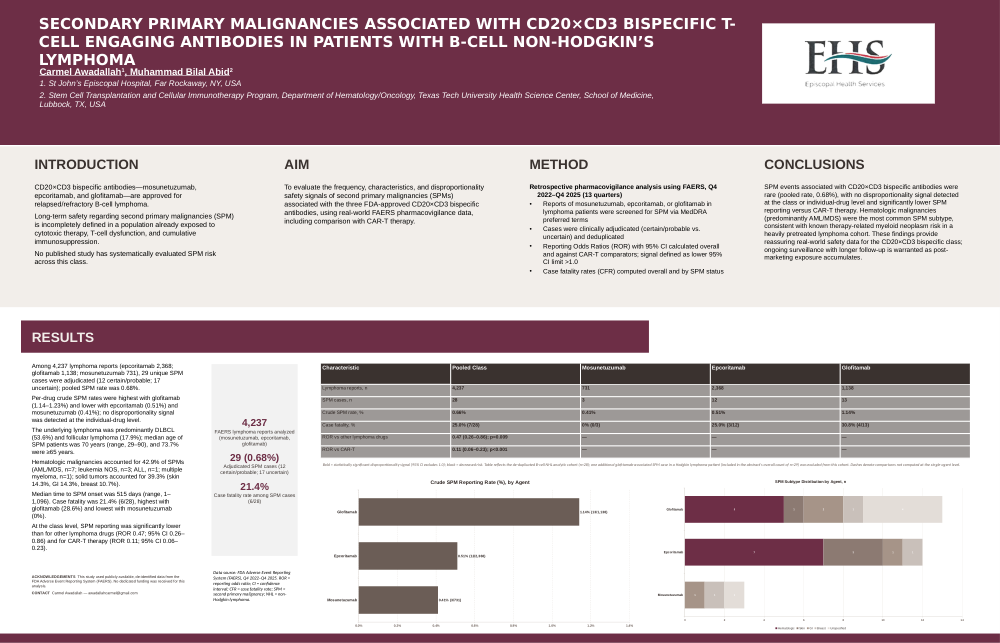
Among 4237 lymphoma reports (epcoritamab, 2368; glofitamab, 1138; mosunetuzumab, 731), 29 unique SPM
cases were adjudicated (12 certain/probable; 17 uncertain), pooled SPM rate 0.68%. Per-drug rates were: glofitamab,
1.23%; epcoritamab, 0.51%; and mosunetuzumab, 0.41% (all uncertain). Median age of SPM patients was
70 years (range, 29–90). The underlying lymphoma was DLBCL (53.6%) and follicular lymphoma (17.9%). Hematological
SPMs comprised 42.9% (12/28): AML/MDS (n=7), leukemia NOS (n=3), ALL (n=1), multiple myeloma
(n=1). Solid tumors accounted for 39.3% (skin, 14.3%; GI, 14.3%; breast, 10.7%). Nearly three-quarters (73.7%)
of SPM patients were aged ≥65 years, and one-third (31.6%) were ≥75 years; a population with elevated baseline
malignancy risk, supporting age-stratified post-marketing surveillance. Median time to onset (n=9 with available
dates) was 515 days (range, 1–1096). Case fatality was 21.4% (6/28); highest with glofitamab (28.6%) and lowest
with mosunetuzumab (0%).
Conclusion
In this comprehensive FAERS analysis spanning 13 quarters and over 4200 bispecific antibody + lymphoma
reports, SPM events associated with CD20×CD3 bispecific antibodies were rare (pooled rate, 0.68%) with no
disproportionality signal detected at the class or individual drug level. Hematologic malignancies (predominantly
AML/MDS) comprised the largest SPM subtype, consistent with known therapy-related myeloid neoplasm risk in
a heavily pretreated lymphoma cohort. The case fatality rate of 21.4% underscores the clinical significance of
SPMs when they do occur. Importantly, the bispecific class showed a significantly lower SPM reporting frequency
compared to CAR-T therapy. These findings provide reassuring real-world safety data for the CD20×CD3
bispecific class, though ongoing surveillance with longer follow-up is warranted as post-marketing exposure
accumulates.
ALL: acute lymphoblastic leukemia, AML: acute myeloid leukemia, CAR: chimeric antigen receptor, CD: cluster of
differentiation, DLBCL: diffuse large B-cell lymphoma, FDA: Food and Drug Administration, GI: gastrointestinal,
MDS: myelodysplastic syndrome, MedDRA: medical dictionary for regulatory activities, NOS: not otherwise
specified
Keywords
ABCL, aggressive B-cell lymphoma, secondary primary malignancies, bispecific antibodies, NHL, FAERS, pharmacovigilance,
reporting odds ratio