1,267 posters, 47 videos, 13 topics, 4 sessions, 853 authors
ePostersLive by SciGen Technologies S.A. All rights reserved.
SOHO 2026 Annual Meeting
September 9 - 12, 2026 | George R. Brown Convention Center, Houston, Texas

MPN - 1345
From Chronic to Blast: How Diagnostic Delay Shapes Outcomes in MLN-FGFR1
Poster Presenter
Authors
Part of Topic
Myeloproliferative Neoplasms (MPN)
From Chronic to Blast: How Diagnostic Delay Shapes Outcomes in MLN-FGFR1
Mohammad Abu-Tineh, MD
Department of Internal Medicine, Reading Hospital -Tower Health, PA, USA
INTRODUCTION
MLN-FGFR1 (formerly the 8p11 myeloproliferative syndrome) is a rare, aggressive stem cell malignancy driven by FGFR1 fusion kinases.
Presentations range from chronic MPN with eosinophilia to T-or B-lymphoblastic lymphoma and acute leukemia, depending on the fusion partner.
This heterogeneity often leads to delayed recognition, allowing progression from chronic phase to refractory blast phase before targeted therapy begins.
Pemigatinib, FDA-approved in 2022 for relapsed/refractory MLN-FGFR1, is the first targeted therapy -yet the clinical impact of diagnostic delay across phases has not been directly addressed.
AIM
To synthesize published evidence on MLN-FGFR1 outcomes and evaluate whether diagnostic delay, by allowing progression to blast phase, contributes to worse treatment outcomes.
Specific objectives:
1. Characterize phase at diagnosis across published series
2. Compare pemigatinib responses and outcomes by disease phase
3. Identify barriers to early recognition and testing
METHOD
Narrative review of published literature from 1995 through April 2026.
Databases searched:
MEDLINE, EMBASE, ASH and EHA proceedings
Inclusion: Studies reporting outcomes in patients with cytogenetically or molecularly confirmed MLN-FGFR1.
Evidence hierarchy:
1. Prospective trial data
2. Registry cohorts
3. Retrospective series
4. Case reports
CONCLUSIONS
MLN-FGFR1 is rare but molecularly targetable.
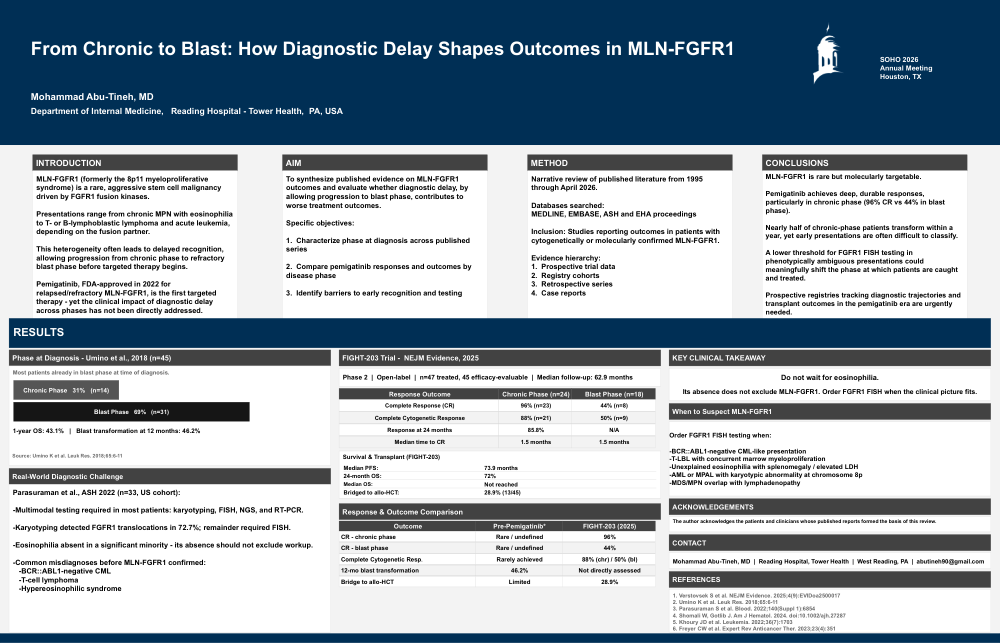
Pemigatinib achieves deep, durable responses, particularly in chronic phase (96% CR vs 44% in blast phase).
Nearly half of chronic-phase patients transform within a year, yet early presentations are often difficult to classify.
A lower threshold for FGFR1 FISH testing in phenotypically ambiguous presentations could meaningfully shift the phase at which patients are caught and treated.
Prospective registries tracking diagnostic trajectories and transplant outcomes in the pemigatinib era are urgently needed.