1,267 posters, 47 videos, 13 topics, 4 sessions, 853 authors
ePostersLive by SciGen Technologies S.A. All rights reserved.
SOHO 2026 Annual Meeting
September 9 - 12, 2026 | George R. Brown Convention Center, Houston, Texas

IBCL - 1262
Rosai-Dorfman disease, histiocytosis, radiotherapy, rare diseases, real-world data
Poster Presenter
Authors
Part of Topic
Indolent B-Cell Lymphoma (IBCL)
BACKGROUND
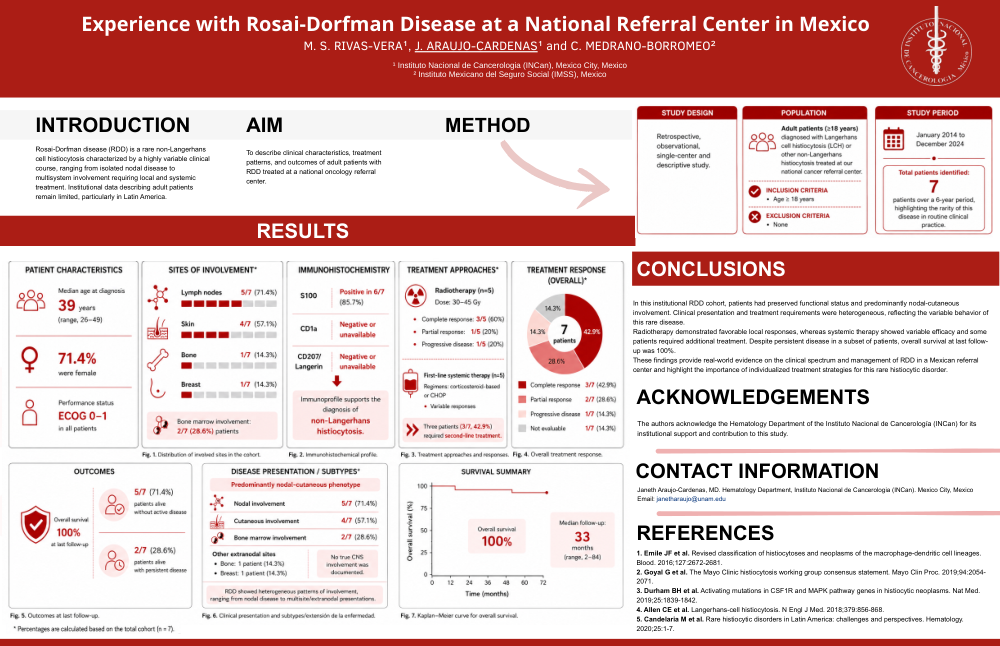
Rosai-Dorfman disease (RDD) is a rare non-Langerhans cell histiocytosis with heterogeneous clinical behavior, ranging from self-limited nodal disease to multisite involvement requiring systemic therapy. Evidence regarding clinical presentation, treatment response, and outcomes in adult institutional cohorts remains limited.
AIM
To describe the clinical characteristics, patterns of organ involvement, treatment approaches, responses, and outcomes of adult patients with Rosai-Dorfman disease treated at a national cancer referral center in Mexico.
METHODS
We conducted a retrospective, observational, descriptive study at a tertiary national cancer referral center in Mexico City. Adult patients aged 18 years or older with RDD were identified from the institutional histiocytosis database. Clinical characteristics, involved sites, immunohistochemistry, treatment modalities, response, and last recorded disease status were analyzed.
RESULTS
Seven patients with RDD were identified. Median age at diagnosis was 39 years (range, 26-49), and 5/7 patients (71.4%) were female. Baseline performance status was favorable in all patients: four had ECOG 0 and three had ECOG 1.
The predominant clinical presentation was nodal-cutaneous. Lymph node involvement was documented in 5/7 patients (71.4%) and cutaneous involvement in 4/7 (57.1%). Bone marrow involvement was present in 2/7 patients (28.6%). Other extranodal sites included bone and breast, with one patient each. No true central nervous system involvement was documented.
S100 expression was positive in 6/7 cases (85.7%), whereas CD1a and CD207/Langerin were negative or unavailable, supporting the diagnosis of non-Langerhans histiocytosis.
Treatment approaches were heterogeneous. Five patients received radiotherapy at doses ranging from 30 to 45 Gy, achieving complete response in three patients, partial response in one, and progressive disease in one. Five patients also received first-line systemic therapy, including corticosteroid-based regimens or CHOP. Responses to first-line systemic therapy were variable, with partial response in one patient, stable disease in two, and progressive disease in two. Three patients required second-line treatment.
At last follow-up, all patients were alive. Five of seven patients (71.4%) were alive without active disease, while two (28.6%) remained alive with persistent disease. Overall survival at last follow-up was 100%.
CONCLUSIONS
In this institutional RDD cohort, patients had preserved functional status and predominantly nodal-cutaneous involvement. Clinical presentation and treatment requirements were heterogeneous, reflecting the variable behavior of this rare disease.
Radiotherapy demonstrated favorable local responses, whereas systemic therapy showed variable efficacy and some patients required additional treatment. Despite persistent disease in a subset of patients, overall survival at last follow-up was 100%.
These findings provide real-world evidence on the clinical spectrum and management of RDD in a Mexican referral center and highlight the importance of individualized treatment strategies for this rare histiocytic disorder.