1,267 posters, 47 videos, 13 topics, 4 sessions, 853 authors
ePostersLive by SciGen Technologies S.A. All rights reserved.
SOHO 2026 Annual Meeting
September 9 - 12, 2026 | George R. Brown Convention Center, Houston, Texas

MPN - 1076
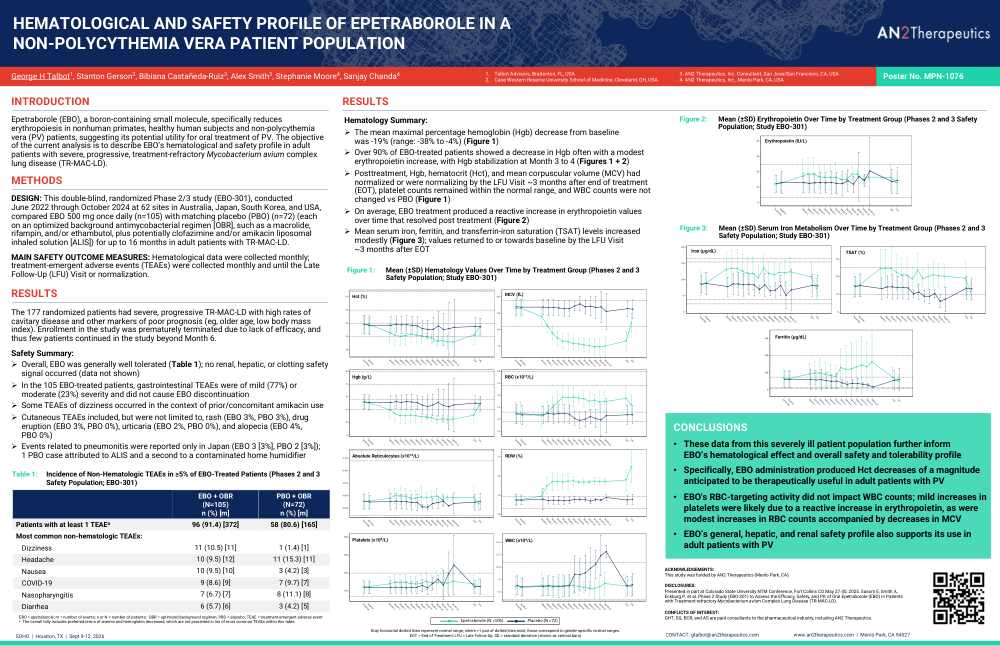
Hematologic and Safety Profile of Epetraborole in a Non-Polycythemia Vera Patient Population
Poster Presenter
Authors
Part of Topic
Myeloproliferative Neoplasms (MPN)
INTRODUCTION:
Epetraborole (EBO), a boron-containing small molecule, specifically reduces erythropoiesis in nonhuman primates, healthy human subjects and non-polycythemia vera (PV) patients, suggesting its potential utility for oral treatment of PV. The objective of the current analysis is to describe EBO’s hematological and safety profile in adult patients with severe, progressive, treatment-refractory Mycobacterium avium complex lung disease (TR-MAC-LD).
METHODS:
DESIGN: This double-blind, randomized Phase 2/3 study (EBO-301), conducted June 2022 through October 2024 at 62 sites in Australia, Japan, South Korea, and USA, compared EBO 500 mg once daily (n=105) with matching placebo (PBO) (n=72) (each on an optimized background antimycobacterial regimen [OBR], such as a macrolide, rifampin, and/or ethambutol, plus potentially clofazimine and/or amikacin liposomal inhaled solution [ALIS]) for up to 16 months in adult patients with TR-MAC-LD.
MAIN SAFETY OUTCOME MEASURES: Hematological data were collected monthly; treatment-emergent adverse events (TEAEs) were collected monthly and until the Late Follow-Up (LFU) Visit or normalization.
RESULTS:
The 177 randomized patients had severe, progressive TR-MAC-LD with high rates of cavitary disease and other markers of poor prognosis (eg, older age, low body mass index). Enrollment in the study was prematurely terminated due to lack of efficacy, and thus few patients continued in the study beyond Month 6.
Safety Summary: Overall, EBO was generally well tolerated (Table 1); no renal, hepatic, or clotting safety signal occurred (data not shown). In the 105 EBO-treated patients, gastrointestinal TEAEs were of mild (77%) or moderate (23%) severity and did not cause EBO discontinuation. Some TEAEs of dizziness occurred in the context of prior/concomitant amikacin use. Cutaneous TEAEs included, but were not limited to, rash (EBO 3%, PBO 3%), drug eruption (EBO 3%, PBO 0%), urticaria (EBO 2%, PBO 0%), and alopecia (EBO 4%, PBO 0%). Events related to pneumonitis were reported only in Japan (EBO 3 [3%], PBO 2 [3%]); 1 PBO case attributed to ALIS and a second to a contaminated home humidifier.
Hematology Summary: The mean maximal percentage hemoglobin (Hgb) decrease from baseline was ‑19% (range: ‑38% to -4%) (Figure1). Over 90% of EBO-treated patients showed a decrease in Hgb often with a modest erythropoietin increase, with Hgb stabilization at Month 3 to 4 (Figures 1 + 2). Posttreatment, Hgb, hematocrit (Hct), and mean corpuscular volume (MCV) had normalized or were normalizing by the LFU Visit ~3 months after end of treatment (EOT), platelet counts remained within the normal range, and WBC counts were not changed vs PBO (Figure 1). On average, EBO treatment produced a reactive increase in erythropoietin values over time that resolved post treatment (Figure 2). Mean serum iron, ferritin, and transferrin-iron saturation (TSAT) levels increased modestly (Figure 3); values returned to or towards baseline by the LFU Visit ~3 months after EOT.
CONCLUSIONS:
These data from this severely ill patient population further inform EBO’s hematological effect and overall safety and tolerability profile. Specifically, EBO administration produced Hct decreases of a magnitude anticipated to be therapeutically useful in adult patients with PV. EBO's RBC-targeting activity did not impact WBC counts; mild increases in platelets were likely due to a reactive increase in erythropoietin, as were modest increases in RBC counts accompanied by decreases in MCV. EBO’s general, hepatic, and renal safety profile also supports its use in adult patients with PV.