1,267 posters, 47 videos, 13 topics, 4 sessions, 853 authors
ePostersLive by SciGen Technologies S.A. All rights reserved.
SOHO 2026 Annual Meeting
September 9 - 12, 2026 | George R. Brown Convention Center, Houston, Texas

MPN - 1067
Comparative Efficacy of Drug Therapies on Spleen Size and Symptom Reduction in Myelofibrosis: A Frequentist Network Meta-Analysis
Poster Presenter
Authors
Part of Topic
Myeloproliferative Neoplasms (MPN)
Title: Comparative Efficacy of Drug Therapies on Spleen Size and Symptom Reduction in Myelofibrosis: A Frequentist Network Meta-analysis
Background:
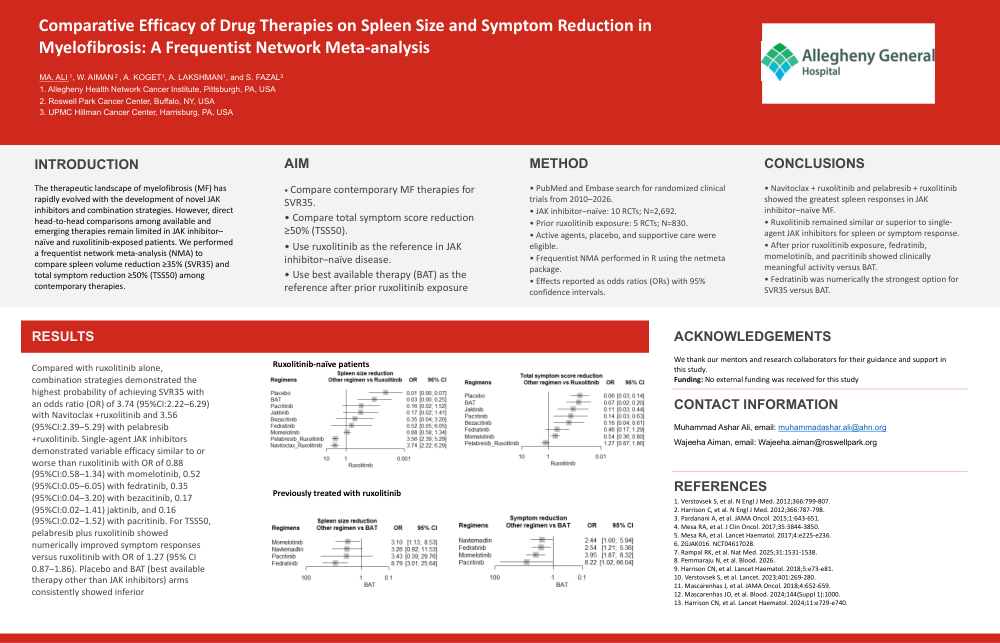
The therapeutic landscape of myelofibrosis (MF) has rapidly evolved with the development of novel JAK inhibitors and combination strategies. However, direct head-to-head comparisons among available and emerging therapies remain limited in JAK inhibitor–naïve and ruxolitinib-exposed patients. We performed a frequentist network meta-analysis (NMA) to compare spleen volume reduction ≥35% (SVR35) and total symptom reduction ≥50% (TSS50) among contemporary therapies.
Methods:
A literature search was conducted on PubMed and Embase for randomized clinical trials (RCTs) from 2010 to 2026 in MF patients treated with active agents, placebo, or supportive care. A total of 10 RCTs (N=2,692) were included on JAK naïve patients and 5 RCTs (N=830) on ruxolitinib exposure patients. R programming software with netmeta package was used to conduct this NMA.
Results:
Compared with ruxolitinib alone, combination strategies demonstrated the highest probability of achieving SVR35 with an odds ratio (OR) of 3.74 (95%CI:2.22–6.29) with Navitoclax+ruxolitinib and 3.56 (95%CI:2.39–5.29) with pelabresib+ruxolitinib. Single-agent JAK inhibitors demonstrated variable efficacy similar to or worse than ruxolitinib with OR of 0.88 (95%CI:0.58–1.34) with momelotinib, 0.52 (95%CI:0.05–6.05) with fedratinib, 0.35 (95%CI:0.04–3.20) with bezacitinib, 0.17 (95%CI:0.02–1.41) jaktinib, and 0.16 (95%CI:0.02–1.52) with pacritinib. For TSS50, pelabresib plus ruxolitinib showed numerically improved symptom responses versus ruxolitinib with OR of 1.27 (95% CI 0.87–1.86). Placebo and BAT (best available therapy other than JAK inhibitors) arms consistently showed inferior outcomes.
In MF patients with prior ruxolitinib exposure, fedratinib demonstrated the highest SVR35 versus BAT with OR 8.79 (95%CI:3.01–25.64). Pacritinib showed OR 3.43 (95%CI:0.39–29.76), navtemadlin OR 3.26 (95%CI:0.92–11.53), momelotinib showed OR 3.10 (95%CI:1.13–8.53) versus BAT. For TSS50, pacritinib showed OR 8.22 (95%CI:1.02–66.04), and momelotinib showed OR 3.95 (95%CI:1.87–8.32) versus BAT.
Conclusion:
In JAK inhibitor–naïve MF, combination strategies with navitoclax or pelabresib added to ruxolitinib demonstrated the greatest spleen responses. Ruxolitinib remains similar or superior to single-agent JAK inhibitors in spleen or symptom response. In ruxolitinib-exposed MF patients, fedratinib, momelotinib, and pacritinib showed clinically meaningful activity compared with BAT and fedratinib was numerically better than others.