1,267 posters, 47 videos, 13 topics, 4 sessions, 853 authors
ePostersLive by SciGen Technologies S.A. All rights reserved.
SOHO 2026 Annual Meeting
September 9 - 12, 2026 | George R. Brown Convention Center, Houston, Texas

ABCL - 1058
Phase 1 study to evaluate safety, tolerability, pharmacokinetics (PK), and clinical activity of the antibody-drug conjugate (ADC) ARC-02 as monotherapy and in combination with rituximab in adults with B-cell non-Hodgkins lymphoma (NHL)
Poster Presenter
Authors
Part of Topic
Aggressive B-Cell Lymphoma (ABCL)
Phase 1 Study to Evaluate Safety, Tolerability, Pharmacokinetics (PK), and Clinical Activity of the Antibody–Drug Conjugate (ADC) ARC-02 as Monotherapy and in Combination With Rituximab in Adults With B-Cell Non-Hodgkin Lymphoma (NHL)
•As many as 50% of individuals with B-cell non-Hodgkin lymphoma (NHL) may experience refractory or relapsed (R/R) disease, for which there are limited treatment options
•Antibody–drug conjugates (ADC) are indicated for the treatment of aggressive high-grade lymphomas but are not approved for the treatment of other B-cell NHL subtypes. Toxicities induced by the unintended and premature release of the monomethyl auristatin E have limited the development of the anti-CD79b ADC polatuzumab-vedotin in other B-cell NHLs
•ARC-02 is a novel anti-CD79b ADC developed using proprietary AraLinQ™ technology, which enhances ADC homogeneity and stability, offering improved on-target activity and enhanced safety
–In preclinical studies, ARC-02 demonstrated a 16-fold higher therapeutic index over polatuzumab-vedotin (data on file). This was based on an up to 8-fold improvement in safety margin and potent cytotoxicity in NHL cell lines and xenograft models, with ARC-02 achieving comparable efficacy at 2-fold lower payload delivery. Preclinical evidence also shows potential synergy between CD79b-targeted therapy and rituximab
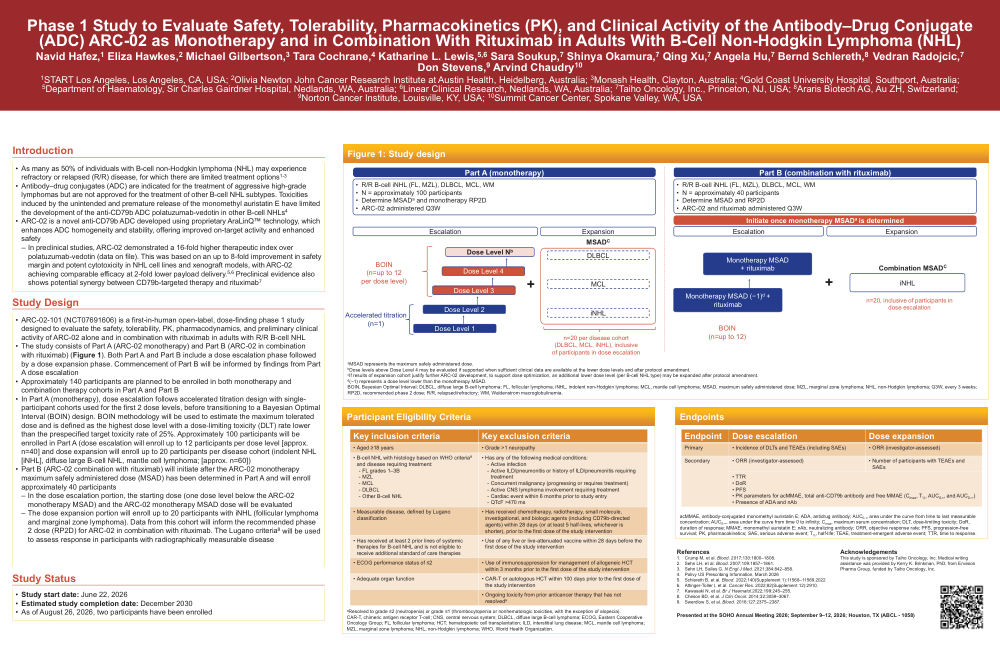
•ARC-02-101 (NCT07691606) is a first-in-human open-label, dose-finding phase 1 study designed to evaluate the safety, tolerability, PK, pharmacodynamics, and preliminary clinical activity of ARC-02 alone and in combination with rituximab in adults with R/R B-cell NHL
•The study consists of Part A (ARC-02 monotherapy) and Part B (ARC-02 in combination with rituximab) (Figure 1). Both Part A and Part B include a dose escalation phase followed by a dose expansion phase. Commencement of Part B will be informed by findings from Part A dose escalation
•Approximately 140 participants are planned to be enrolled in both monotherapy and combination therapy cohorts in Part A and Part B
•In Part A (monotherapy), dose escalation follows accelerated titration design with single-participant cohorts used for the first 2 dose levels, before transitioning to a Bayesian Optimal Interval (BOIN) design. BOIN methodology will be used to estimate the maximum tolerated dose and is defined as the highest dose level with a dose-limiting toxicity (DLT) rate lower than the prespecified target toxicity rate of 25%. Approximately 100 participants will be enrolled in Part A (dose escalation will enroll up to 12 participants per dose level [approx. n=40] and dose expansion will enroll up to 20 participants per disease cohort (indolent NHL [iNHL], diffuse large B-cell NHL, mantle cell lymphoma; [approx. n=60])
•Part B (ARC-02 combination with rituximab) will initiate after the ARC-02 monotherapy maximum safely administered dose (MSAD) has been determined in Part A and will enroll approximately 40 participants
–In the dose escalation portion, the starting dose (one dose level below the ARC-02 monotherapy MSAD) and the ARC-02 monotherapy MSAD dose will be evaluated
–The dose expansion portion will enroll up to 20 participants with iNHL (follicular lymphoma and marginal zone lymphoma). Data from this cohort will inform the recommended phase 2 dose (RP2D) for ARC-02 in combination with rituximab. The Lugano criteria will be used to assess response in participants with radiographically measurable disease
•Study start date: June 22, 2026
•Estimated study completion date: December 2030
•As of August 26, 2026, two participants have been enrolled